QUESTION IMAGE
Question
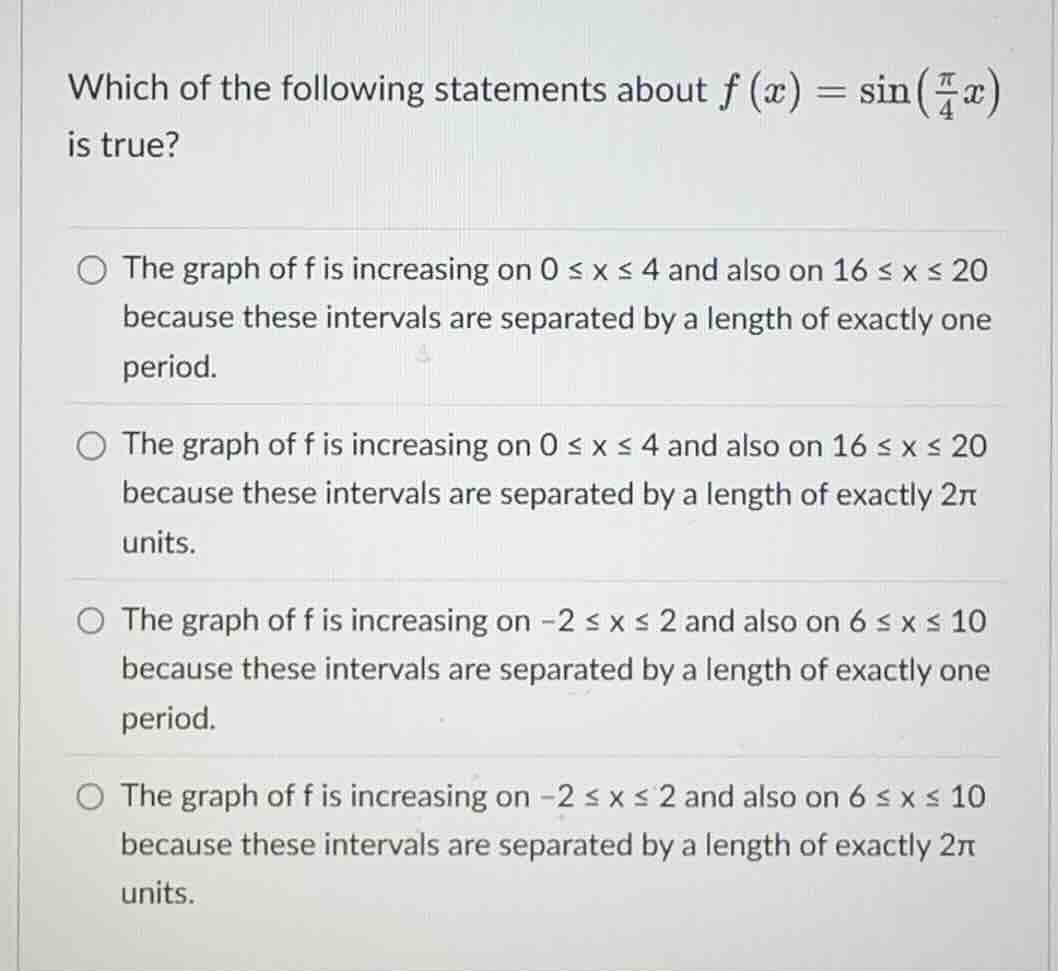
which of the following statements about \\(f(x) = \sin\left(\frac{\pi}{4}x\
ight)\\) is true?
- the graph of \\(f\\) is increasing on \\(0 \le x \le 4\\) and also on \\(16 \le x \le 20\\) because these intervals are separated by a length of exactly one period.
- the graph of \\(f\\) is increasing on \\(0 \le x \le 4\\) and also on \\(16 \le x \le 20\\) because these intervals are separated by a length of exactly \\(2\pi\\) units.
- the graph of \\(f\\) is increasing on \\(-2 \le x \le 2\\) and also on \\(6 \le x \le 10\\) because these intervals are separated by a length of exactly one period.
- the graph of \\(f\\) is increasing on \\(-2 \le x \le 2\\) and also on \\(6 \le x \le 10\\) because these intervals are separated by a length of exactly \\(2\pi\\) units.
Find the period of the function
Using the Sinusoidal Period Analysis knowledge point
$$
T = \frac{2\pi}{B} = \frac{2\pi}{\frac{\pi}{4}} = 8
$$
Determine the interval of increase
Using the Trigonometric Monotonicity knowledge point
$$
LATEXBLOCK0
$$
Apply periodicity to find other intervals
Using the Sinusoidal Period Analysis knowledge point
$$
LATEXBLOCK1
$$

Snap & solve any problem in the app
Get step-by-step solutions on Sovi AI
Photo-based solutions with guided steps
Explore more problems and detailed explanations
- (A) The graph of f is increasing on \(0 \le x \le 4\) and also on \(16 \le x \le 20\) because these intervals are separated by a length of exactly one period.
- (B) The graph of f is increasing on \(0 \le x \le 4\) and also on \(16 \le x \le 20\) because these intervals are separated by a length of exactly \(2\pi\) units.
- (C) The graph of f is increasing on \(-2 \le x \le 2\) and also on \(6 \le x \le 10\) because these intervals are separated by a length of exactly one period. (Correct answer)
- (D) The graph of f is increasing on \(-2 \le x \le 2\) and also on \(6 \le x \le 10\) because these intervals are separated by a length of exactly \(2\pi\) units.