QUESTION IMAGE
Question
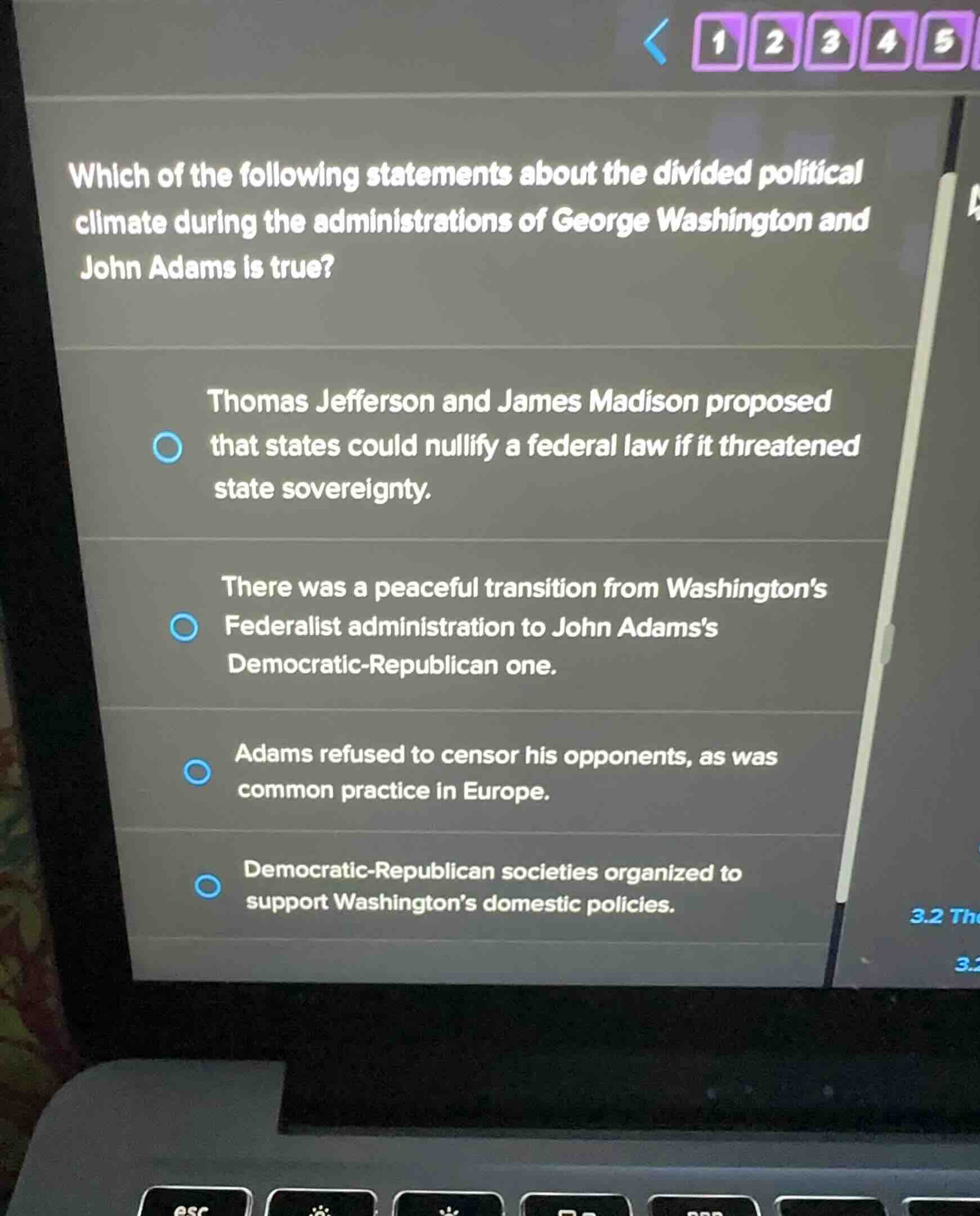
which of the following statements about the divided political climate during the administrations of george washington and john adams is true?
thomas jefferson and james madison proposed that states could nullify a federal law if it threatened state sovereignty.
there was a peaceful transition from washingtons federalist administration to john adamss democratic-republican one.
adams refused to censor his opponents, as was common practice in europe.
democratic-republican societies organized to support washingtons domestic policies.
Analyze the historical context of the early republic
During the Federalist Era, the political climate under George Washington and the John Adams Administration was highly polarized between the Federalists and the Democratic-Republicans. A major point of contention arose with the passage of the Alien and Sedition Acts in 1798, which restricted speech critical of the government.
Evaluate the first statement
Thomas Jefferson and James Madison secretly drafted the Kentucky and Virginia Resolutions in response to the Alien and Sedition Acts. In these resolutions, they argued that the Constitution was a compact among states, and therefore, states had the right to nullify unconstitutional federal laws that threatened state sovereignty. This matches the first option.
Evaluate the second statement
George Washington was not officially affiliated with a political party, though his policies aligned with the Federalists. John Adams was also a Federalist, not a Democratic-Republican. The transition from Adams (Federalist) to Jefferson (Democratic-Republican) in 1801 is known as the "Revolution of 1800," which was the first peaceful partisan transition. Thus, this statement is historically incorrect.
Evaluate the third statement
Under the John Adams Administration, the Sedition Act of 1798 was actively used to prosecute and censor Democratic-Republican editors, writers, and politicians who criticized the Federalist government. Therefore, Adams did not refuse to censor his opponents.
Evaluate the fourth statement
Democratic-Republican societies were formed in the 1790s to oppose, rather than support, Washington's domestic and foreign policies (such as Hamilton's financial plan and the Jay Treaty). Thus, this statement is incorrect.

Snap & solve any problem in the app
Get step-by-step solutions on Sovi AI
Photo-based solutions with guided steps
Explore more problems and detailed explanations
- (A) Thomas Jefferson and James Madison proposed that states could nullify a federal law if it threatened state sovereignty. (Correct answer)
- (B) There was a peaceful transition from Washington's Federalist administration to John Adams's Democratic-Republican one.
- (C) Adams refused to censor his opponents, as was common practice in Europe.
- (D) Democratic-Republican societies organized to support Washington's domestic policies.