QUESTION IMAGE
Question
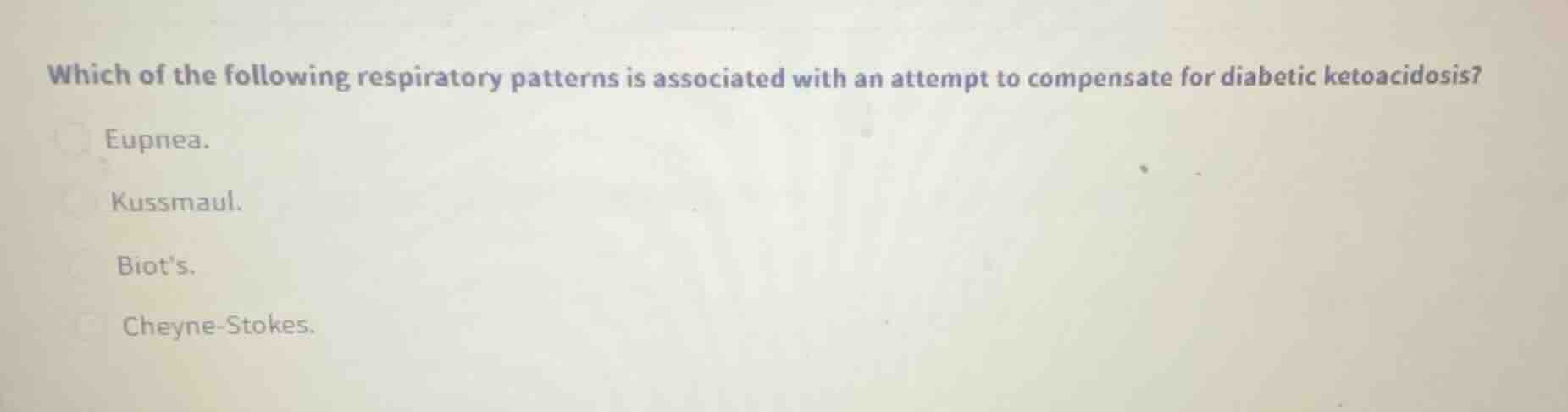
which of the following respiratory patterns is associated with an attempt to compensate for diabetic ketoacidosis?
eupnea.
kussmaul.
biots.
cheyne-stokes.
<pre_analysis>
{
"quality": "clear",
"question_count": 1,
"skills_matched": [
"direct_cot",
"multiple_choice_formatter",
"explain_then_answer",
"tutor",
"mastery_adaptive_brevity"
],
"needs_drawing": false,
"concepts_used": [
"Diabetic Ketoacidosis Pathophysiology",
"Kussmaul Respiration"
],
"new_concepts": [],
"current_concepts": [
"Diabetic Ketoacidosis Pathophysiology",
"Kussmaul Respiration"
]
}
</pre_analysis>
<reasoning>
Identify the physiological state
Using the Diabetic Ketoacidosis Pathophysiology knowledge point
Diabetic ketoacidosis (DKA) results in metabolic acidosis due to the accumulation of ketone bodies. The body attempts to compensate for this metabolic acidosis by eliminating excess carbon dioxide (\(\text{CO}_2\)), which acts as an acid in the blood.
Determine the compensatory respiratory pattern
Using the Kussmaul Respiration knowledge point
To blow off excess \(\text{CO}_2\), the respiratory center triggers deep, rapid, and sighing respirations. This specific compensatory breathing pattern is known as Kussmaul respiration.
</reasoning>
<answer>
<mcq-option>Eupnea.</mcq-option>
<mcq-correct>Kussmaul.</mcq-correct>
<mcq-option>Biot's.</mcq-option>
<mcq-option>Cheyne-Stokes.</mcq-option>
</answer>
<post_analysis>
{
"subject": "Natural Science",
"question_type": "Multiple Choice",
"knowledge_point": [
"Natural Science",
"Medicine",
"Diabetic Ketoacidosis Pathophysiology"
]
}
</post_analysis>
Snap & solve any problem in the app
Get step-by-step solutions on Sovi AI
Photo-based solutions with guided steps
Explore more problems and detailed explanations
<pre_analysis>
{
"quality": "clear",
"question_count": 1,
"skills_matched": [
"direct_cot",
"multiple_choice_formatter",
"explain_then_answer",
"tutor",
"mastery_adaptive_brevity"
],
"needs_drawing": false,
"concepts_used": [
"Diabetic Ketoacidosis Pathophysiology",
"Kussmaul Respiration"
],
"new_concepts": [],
"current_concepts": [
"Diabetic Ketoacidosis Pathophysiology",
"Kussmaul Respiration"
]
}
</pre_analysis>
<reasoning>
Identify the physiological state
Using the Diabetic Ketoacidosis Pathophysiology knowledge point
Diabetic ketoacidosis (DKA) results in metabolic acidosis due to the accumulation of ketone bodies. The body attempts to compensate for this metabolic acidosis by eliminating excess carbon dioxide (\(\text{CO}_2\)), which acts as an acid in the blood.
Determine the compensatory respiratory pattern
Using the Kussmaul Respiration knowledge point
To blow off excess \(\text{CO}_2\), the respiratory center triggers deep, rapid, and sighing respirations. This specific compensatory breathing pattern is known as Kussmaul respiration.
</reasoning>
<answer>
<mcq-option>Eupnea.</mcq-option>
<mcq-correct>Kussmaul.</mcq-correct>
<mcq-option>Biot's.</mcq-option>
<mcq-option>Cheyne-Stokes.</mcq-option>
</answer>
<post_analysis>
{
"subject": "Natural Science",
"question_type": "Multiple Choice",
"knowledge_point": [
"Natural Science",
"Medicine",
"Diabetic Ketoacidosis Pathophysiology"
]
}
</post_analysis>