QUESTION IMAGE
Question
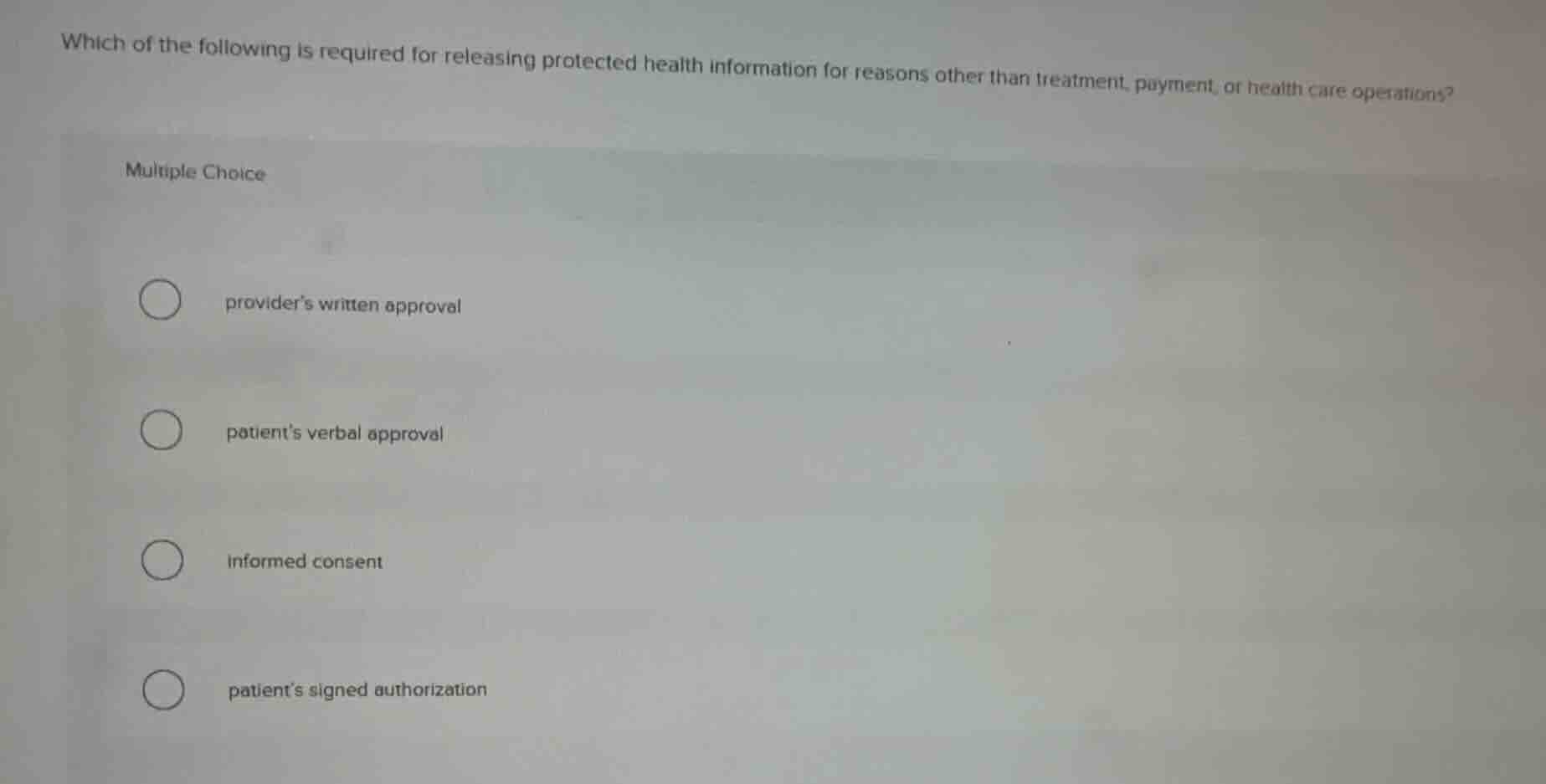
which of the following is required for releasing protected health information for reasons other than treatment, payment, or health care operations?
multiple choice
providers written approval
patients verbal approval
informed consent
patients signed authorization
<pre_analysis>
{
"quality": "clear",
"question_count": 1,
"skills_matched": [
"direct_cot",
"multiple_choice_formatter",
"explain_then_answer",
"tutor",
"mastery_adaptive_brevity"
],
"needs_drawing": false,
"concepts_used": [
"Medical Information Release Authority",
"HIPAA Privacy Rule"
],
"new_concepts": [],
"current_concepts": [
"Medical Information Release Authority",
"HIPAA Privacy Rule"
]
}
</pre_analysis>
<reasoning>
Analyze the regulatory requirements
Using the HIPAA Privacy Rule knowledge point
Under federal regulations, covered entities are permitted to use or disclose Protected Health Information (PHI) without patient authorization specifically for Treatment, Payment, and Healthcare Operations (TPO). For purposes outside of TPO, a formal mechanism is required to legally release this information.
Determine the required release mechanism
Using the Medical Information Release Authority knowledge point
For disclosures not covered by TPO, the HIPAA Privacy Rule explicitly mandates obtaining a valid, written authorization from the patient. This document must be signed and dated, detailing exactly what information is being shared, to whom, and for what purpose. Verbal consent, provider approval, or general clinical informed consent do not satisfy this legal standard.
</reasoning>
<answer>
<mcq-option>provider's written approval</mcq-option>
<mcq-option>patient's verbal approval</mcq-option>
<mcq-option>informed consent</mcq-option>
<mcq-correct>patient's signed authorization</mcq-correct>
</answer>
<post_analysis>
{
"subject": "Business",
"question_type": "Multiple Choice",
"knowledge_point": [
"Business",
"Healthcare Administration",
"Medical Information Release Authority"
]
}
</post_analysis>
Snap & solve any problem in the app
Get step-by-step solutions on Sovi AI
Photo-based solutions with guided steps
Explore more problems and detailed explanations
<pre_analysis>
{
"quality": "clear",
"question_count": 1,
"skills_matched": [
"direct_cot",
"multiple_choice_formatter",
"explain_then_answer",
"tutor",
"mastery_adaptive_brevity"
],
"needs_drawing": false,
"concepts_used": [
"Medical Information Release Authority",
"HIPAA Privacy Rule"
],
"new_concepts": [],
"current_concepts": [
"Medical Information Release Authority",
"HIPAA Privacy Rule"
]
}
</pre_analysis>
<reasoning>
Analyze the regulatory requirements
Using the HIPAA Privacy Rule knowledge point
Under federal regulations, covered entities are permitted to use or disclose Protected Health Information (PHI) without patient authorization specifically for Treatment, Payment, and Healthcare Operations (TPO). For purposes outside of TPO, a formal mechanism is required to legally release this information.
Determine the required release mechanism
Using the Medical Information Release Authority knowledge point
For disclosures not covered by TPO, the HIPAA Privacy Rule explicitly mandates obtaining a valid, written authorization from the patient. This document must be signed and dated, detailing exactly what information is being shared, to whom, and for what purpose. Verbal consent, provider approval, or general clinical informed consent do not satisfy this legal standard.
</reasoning>
<answer>
<mcq-option>provider's written approval</mcq-option>
<mcq-option>patient's verbal approval</mcq-option>
<mcq-option>informed consent</mcq-option>
<mcq-correct>patient's signed authorization</mcq-correct>
</answer>
<post_analysis>
{
"subject": "Business",
"question_type": "Multiple Choice",
"knowledge_point": [
"Business",
"Healthcare Administration",
"Medical Information Release Authority"
]
}
</post_analysis>