Sovi.AI - AI Math Tutor

Scan to solve math questions

QUESTION IMAGE

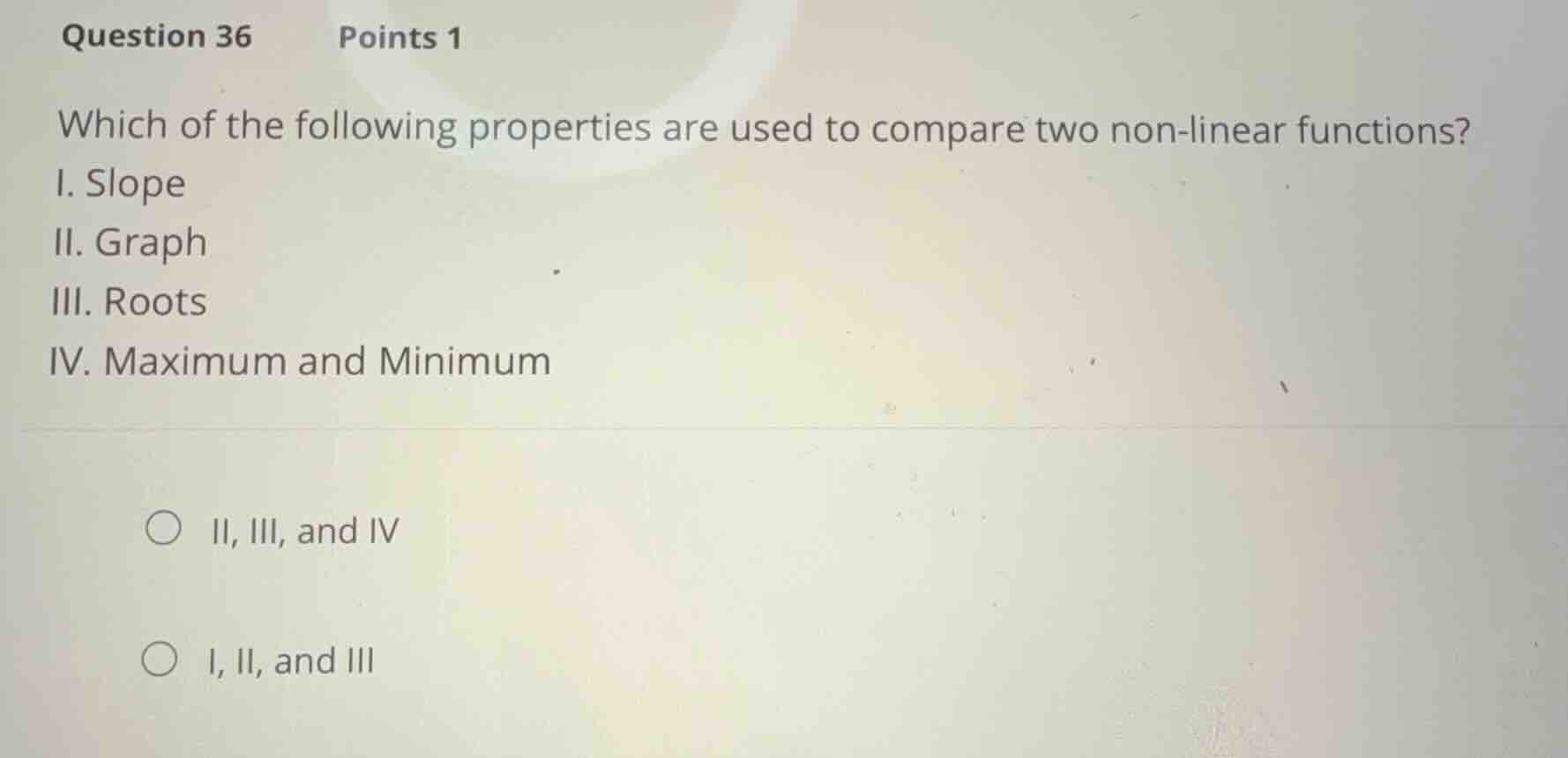
which of the following properties are used to compare two non-linear fu…

Question

which of the following properties are used to compare two non-linear functions?
i. slope
ii. graph
iii. roots
iv. maximum and minimum

  • ii, iii, and iv
  • i, ii, and iii

Explanation:

Response

<pre_analysis>
{
"quality": "clear",
"question_count": 1,
"skills_matched": [
"direct_cot",
"multiple_choice_formatter",
"explain_then_answer",
"quick"
],
"needs_drawing": false,
"concepts_used": [],
"new_concepts": [
"Comparing Non-Linear Functions",
"Properties of Functions"
],
"current_concepts": [
"Comparing Non-Linear Functions",
"Properties of Functions"
]
}
</pre_analysis>

<reasoning>

Analyze the concept of slope for non-linear functions

Slope is a constant property unique to linear functions. For non-linear functions, the rate of change is not constant, meaning they do not have a single "slope" to compare them directly. Thus, property I is not a standard property used to compare two non-linear functions.

Evaluate the remaining properties

  • II. Graph: Visualizing and comparing the graphs of non-linear functions helps identify their shapes, behaviors, and key features.
  • III. Roots: Comparing the roots (x-intercepts) shows where each non-linear function intersects the horizontal axis.
  • IV. Maximum and Minimum: Comparing the extrema (vertices, local/global maximums or minimums) is a fundamental way to analyze and compare non-linear behaviors.

Determine the correct combination

Since properties II, III, and IV are valid and standard properties used to compare non-linear functions, the correct combination is II, III, and IV.
</reasoning>

<answer>
<mcq-correct>II, III, and IV</mcq-correct>
<mcq-option>I, II, and III</mcq-option>
</answer>

<post_analysis>
{
"subject": "Mathematics",
"question_type": "Multiple Choice",
"knowledge_point": [
"Mathematics",
"Algebra",
"Comparing Non-Linear Functions"
]
}
</post_analysis>

Answer:

<pre_analysis>
{
"quality": "clear",
"question_count": 1,
"skills_matched": [
"direct_cot",
"multiple_choice_formatter",
"explain_then_answer",
"quick"
],
"needs_drawing": false,
"concepts_used": [],
"new_concepts": [
"Comparing Non-Linear Functions",
"Properties of Functions"
],
"current_concepts": [
"Comparing Non-Linear Functions",
"Properties of Functions"
]
}
</pre_analysis>

<reasoning>

Analyze the concept of slope for non-linear functions

Slope is a constant property unique to linear functions. For non-linear functions, the rate of change is not constant, meaning they do not have a single "slope" to compare them directly. Thus, property I is not a standard property used to compare two non-linear functions.

Evaluate the remaining properties

  • II. Graph: Visualizing and comparing the graphs of non-linear functions helps identify their shapes, behaviors, and key features.
  • III. Roots: Comparing the roots (x-intercepts) shows where each non-linear function intersects the horizontal axis.
  • IV. Maximum and Minimum: Comparing the extrema (vertices, local/global maximums or minimums) is a fundamental way to analyze and compare non-linear behaviors.

Determine the correct combination

Since properties II, III, and IV are valid and standard properties used to compare non-linear functions, the correct combination is II, III, and IV.
</reasoning>

<answer>
<mcq-correct>II, III, and IV</mcq-correct>
<mcq-option>I, II, and III</mcq-option>
</answer>

<post_analysis>
{
"subject": "Mathematics",
"question_type": "Multiple Choice",
"knowledge_point": [
"Mathematics",
"Algebra",
"Comparing Non-Linear Functions"
]
}
</post_analysis>