QUESTION IMAGE
Question
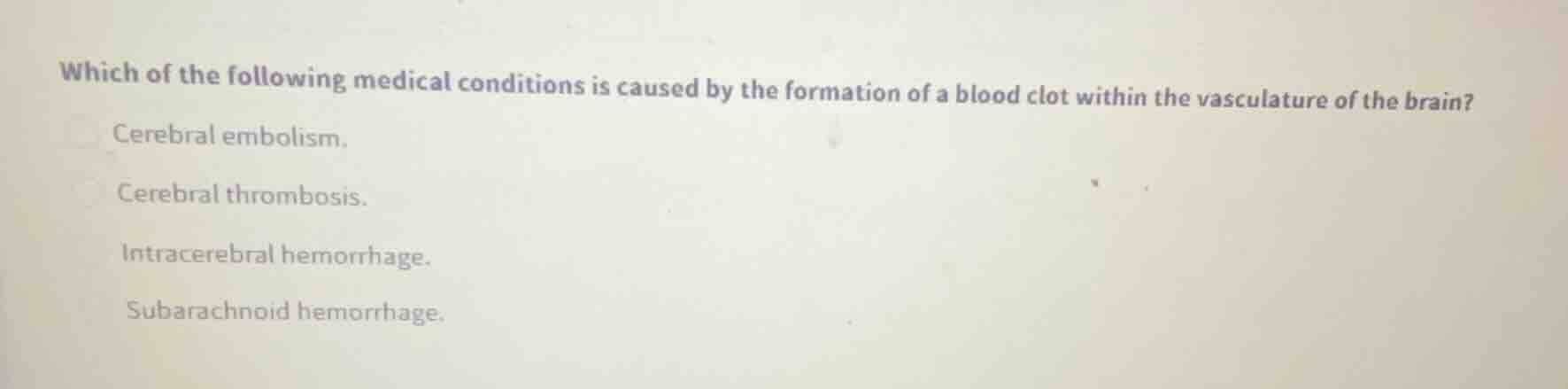
which of the following medical conditions is caused by the formation of a blood clot within the vasculature of the brain?
cerebral embolism.
cerebral thrombosis.
intracerebral hemorrhage.
subarachnod hemorrhage.
<pre_analysis>
{
"quality": "clear",
"question_count": 1,
"skills_matched": [
"direct_cot",
"multiple_choice_formatter",
"explain_then_answer",
"tutor"
],
"needs_drawing": false,
"concepts_used": [
"Stroke Pathophysiology"
],
"new_concepts": [
"Cerebral Thrombosis",
"Cerebral Embolism"
],
"current_concepts": [
"Stroke Pathophysiology",
"Cerebral Thrombosis",
"Cerebral Embolism"
]
}
</pre_analysis>
<reasoning>
Analyze the question prompt
The question asks for the medical condition caused by the formation of a blood clot within the vasculature of the brain. The key distinction here is the site of clot formation versus where it ultimately causes an occlusion.
Define the options
- Cerebral embolism: Occurs when a blood clot or debris forms elsewhere in the body (often the heart or carotid arteries) and travels through the bloodstream to lodge in a cerebral artery.
- Cerebral thrombosis: Occurs when a blood clot (thrombus) develops locally within one of the cerebral arteries of the brain, usually at the site of atherosclerotic plaque.
- Intracerebral hemorrhage: Bleeding directly into the brain tissue, typically caused by rupture of a blood vessel (e.g., due to hypertension or aneurysm).
- Subarachnoid hemorrhage: Bleeding into the subarachnoid space surrounding the brain, often due to a ruptured aneurysm.
Apply Stroke Pathophysiology
Using the Stroke Pathophysiology knowledge point, we differentiate between ischemic stroke subtypes. Since the prompt specifies that the clot is formed within the vasculature of the brain itself, this describes a local thrombotic event rather than an embolic event (where the clot forms elsewhere and travels). Therefore, the correct condition is cerebral thrombosis.
</reasoning>
<answer>
<mcq-option>Cerebral embolism.</mcq-option>
<mcq-correct>Cerebral thrombosis.</mcq-correct>
<mcq-option>Intracerebral hemorrhage.</mcq-option>
<mcq-option>Subarachnoid hemorrhage.</mcq-option>
</answer>
<post_analysis>
{
"subject": "Natural Science",
"question_type": "Multiple Choice",
"knowledge_point": [
"Natural Science",
"Medicine",
"Stroke Pathophysiology"
]
}
</post_analysis>
Snap & solve any problem in the app
Get step-by-step solutions on Sovi AI
Photo-based solutions with guided steps
Explore more problems and detailed explanations
<pre_analysis>
{
"quality": "clear",
"question_count": 1,
"skills_matched": [
"direct_cot",
"multiple_choice_formatter",
"explain_then_answer",
"tutor"
],
"needs_drawing": false,
"concepts_used": [
"Stroke Pathophysiology"
],
"new_concepts": [
"Cerebral Thrombosis",
"Cerebral Embolism"
],
"current_concepts": [
"Stroke Pathophysiology",
"Cerebral Thrombosis",
"Cerebral Embolism"
]
}
</pre_analysis>
<reasoning>
Analyze the question prompt
The question asks for the medical condition caused by the formation of a blood clot within the vasculature of the brain. The key distinction here is the site of clot formation versus where it ultimately causes an occlusion.
Define the options
- Cerebral embolism: Occurs when a blood clot or debris forms elsewhere in the body (often the heart or carotid arteries) and travels through the bloodstream to lodge in a cerebral artery.
- Cerebral thrombosis: Occurs when a blood clot (thrombus) develops locally within one of the cerebral arteries of the brain, usually at the site of atherosclerotic plaque.
- Intracerebral hemorrhage: Bleeding directly into the brain tissue, typically caused by rupture of a blood vessel (e.g., due to hypertension or aneurysm).
- Subarachnoid hemorrhage: Bleeding into the subarachnoid space surrounding the brain, often due to a ruptured aneurysm.
Apply Stroke Pathophysiology
Using the Stroke Pathophysiology knowledge point, we differentiate between ischemic stroke subtypes. Since the prompt specifies that the clot is formed within the vasculature of the brain itself, this describes a local thrombotic event rather than an embolic event (where the clot forms elsewhere and travels). Therefore, the correct condition is cerebral thrombosis.
</reasoning>
<answer>
<mcq-option>Cerebral embolism.</mcq-option>
<mcq-correct>Cerebral thrombosis.</mcq-correct>
<mcq-option>Intracerebral hemorrhage.</mcq-option>
<mcq-option>Subarachnoid hemorrhage.</mcq-option>
</answer>
<post_analysis>
{
"subject": "Natural Science",
"question_type": "Multiple Choice",
"knowledge_point": [
"Natural Science",
"Medicine",
"Stroke Pathophysiology"
]
}
</post_analysis>