QUESTION IMAGE
Question
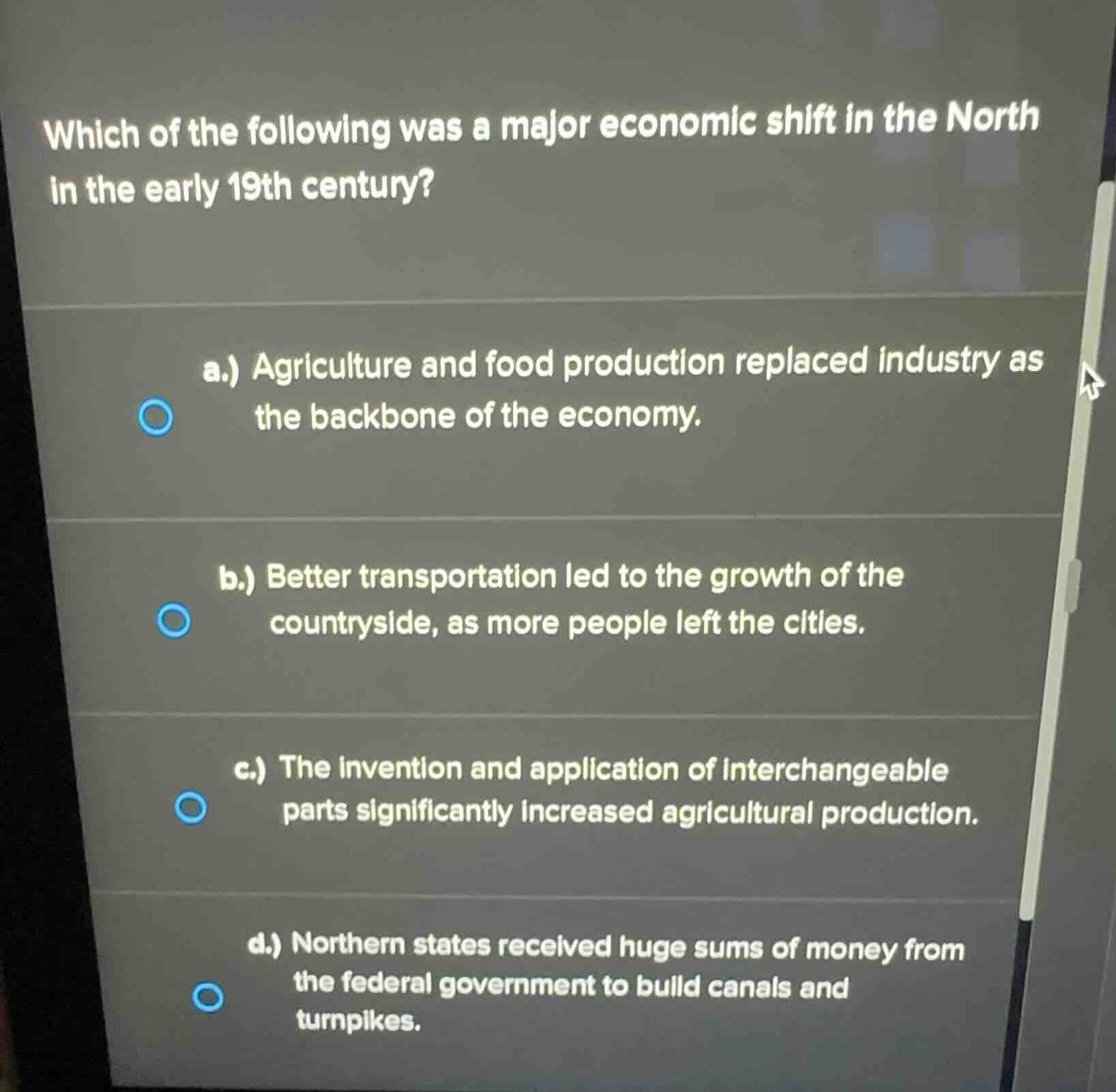
which of the following was a major economic shift in the north in the early 19th century?
a.) agriculture and food production replaced industry as the backbone of the economy.
b.) better transportation led to the growth of the countryside, as more people left the cities.
c.) the invention and application of interchangeable parts significantly increased agricultural production.
d.) northern states received huge sums of money from the federal government to build canals and turnpikes.
Analyze the historical context of the early 19th-century Northern economy
The early 19th century in the United States, particularly in the North, was characterized by the Market Revolution and the onset of the Industrial Revolution. This period saw a shift from home-based, manual production to factory-based, mechanized manufacturing. Key innovations during this era transformed how goods were produced and distributed.
Evaluate option (a)
Option (a) states that agriculture and food production replaced industry as the backbone of the economy. This is historically incorrect. The actual shift was the reverse: industrialization and manufacturing grew rapidly, reducing the relative dominance of subsistence agriculture in the Northeast.
Evaluate option (b)
Option (b) suggests that better transportation led to the growth of the countryside as people left the cities. This is incorrect. Improved transportation (such as canals and early railroads) actually facilitated urbanization, drawing people from rural areas into rapidly growing industrial cities to work in factories.
Evaluate option (c)
Option (c) discusses the invention and application of interchangeable parts. Eli Whitney and other innovators popularized the concept of interchangeable parts in manufacturing (initially for firearms). This development allowed for the rapid assembly and easy repair of standardized goods, which was a cornerstone of the Industrial Revolution Labor systems and early factory production. While interchangeable parts primarily revolutionized manufacturing rather than directly increasing agricultural yields, we must look at the options carefully to see if there is a misstatement in the option text or if another option is more accurate. Let's re-examine option (d).
Evaluate option (d)
Option (d) states that Northern states received huge sums of money from the federal government to build canals and turnpikes. Historically, the funding of internal improvements (like canals and turnpikes) was a major political debate. While the federal government funded some projects (like the National Road), the vast majority of canals (such as the Erie Canal) and turnpikes were funded by state governments and private investors, not by huge federal sums.
Looking back at option (c), although interchangeable parts are primarily associated with industrial manufacturing, standardized manufacturing techniques also began to be applied to agricultural tools (like mechanical reapers and steel plows) later on, but more fundamentally, the introduction of interchangeable parts is universally recognized as a major economic and industrial shift in the North during this era. Therefore, option (c) is the best fit among the choices provided.

Snap & solve any problem in the app
Get step-by-step solutions on Sovi AI
Photo-based solutions with guided steps
Explore more problems and detailed explanations
- a.) Agriculture and food production replaced industry as the backbone of the economy.
- b.) Better transportation led to the growth of the countryside, as more people left the cities.
- c.) The invention and application of interchangeable parts significantly increased agricultural production. (Correct answer)
- d.) Northern states received huge sums of money from the federal government to build canals and turnpikes.