QUESTION IMAGE
Question
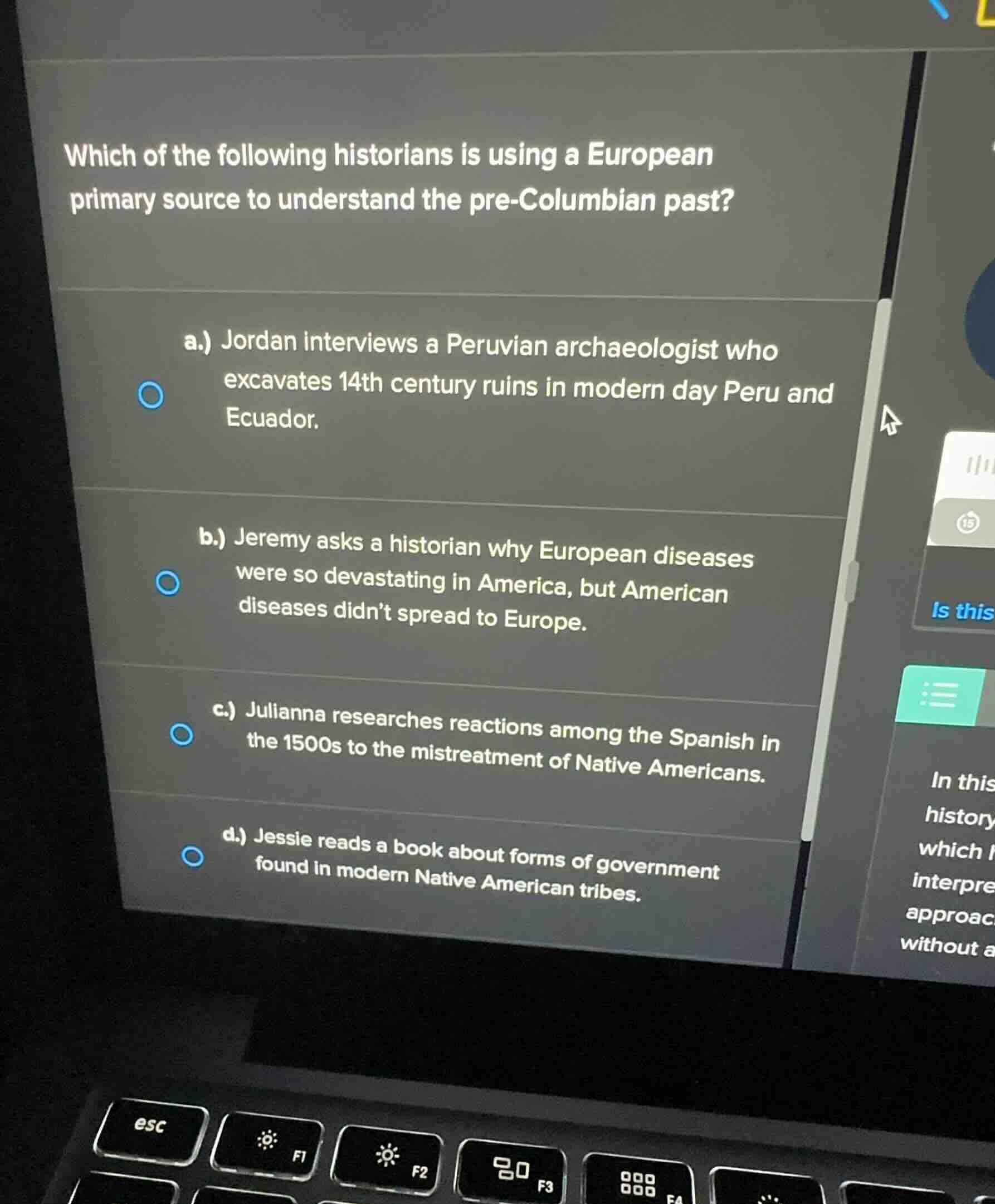
which of the following historians is using a european primary source to understand the pre-columbian past?
a.) jordan interviews a peruvian archaeologist who excavates 14th century ruins in modern day peru and ecuador.
b.) jeremy asks a historian why european diseases were so devastating in america, but american diseases didnt spread to europe.
c.) julianna researches reactions among the spanish in the 1500s to the mistreatment of native americans.
d.) jessie reads a book about forms of government found in modern native american tribes.
Define the core requirements of the question
The question asks to identify which historian is using a European primary source to study the pre-Columbian past (the period in the Americas before the arrival of Christopher Columbus and European colonization).
Analyze the source types and timeframes
Using the Primary Sources and Historical Evidence knowledge points:
- A primary source is an immediate, first-hand account of a topic, from people who had a direct connection with it during the time period being studied.
- "European primary source" means a document or artifact created by Europeans during the period of contact or shortly thereafter.
- "Pre-Columbian past" refers to indigenous history before European contact. Because pre-Columbian societies in many regions (like the Andes) did not leave written records, historians often rely on early European written accounts (from the 1500s) describing indigenous life, traditions, and structures as they found them.
Evaluate each option
- Option a: Jordan conducts an interview with a modern archaeologist. An interview with a living archaeologist is a secondary source (or primary source only for the history of archaeology itself), not a historical primary source from the era.
- Option b: Jeremy asks a modern historian a question. A modern historian's explanation is a secondary source.
- Option c: Julianna researches Spanish reactions in the 1500s. The writings, letters, or chronicles written by the Spanish in the 1500s are first-hand, contemporary documents (European primary sources) that describe indigenous societies and early contact, helping reconstruct the pre-Columbian lifestyle and transition.
- Option d: Jessie reads a modern book about modern Native American tribes. This is a secondary source focusing on the modern era, not the pre-Columbian past.

Snap & solve any problem in the app
Get step-by-step solutions on Sovi AI
Photo-based solutions with guided steps
Explore more problems and detailed explanations
- a.) Jordan interviews a Peruvian archaeologist who excavates 14th century ruins in modern day Peru and Ecuador.
- b.) Jeremy asks a historian why European diseases were so devastating in America, but American diseases didn’t spread to Europe.
- c.) Julianna researches reactions among the Spanish in the 1500s to the mistreatment of Native Americans. (Correct answer)
- d.) Jessie reads a book about forms of government found in modern Native American tribes.