QUESTION IMAGE
Question
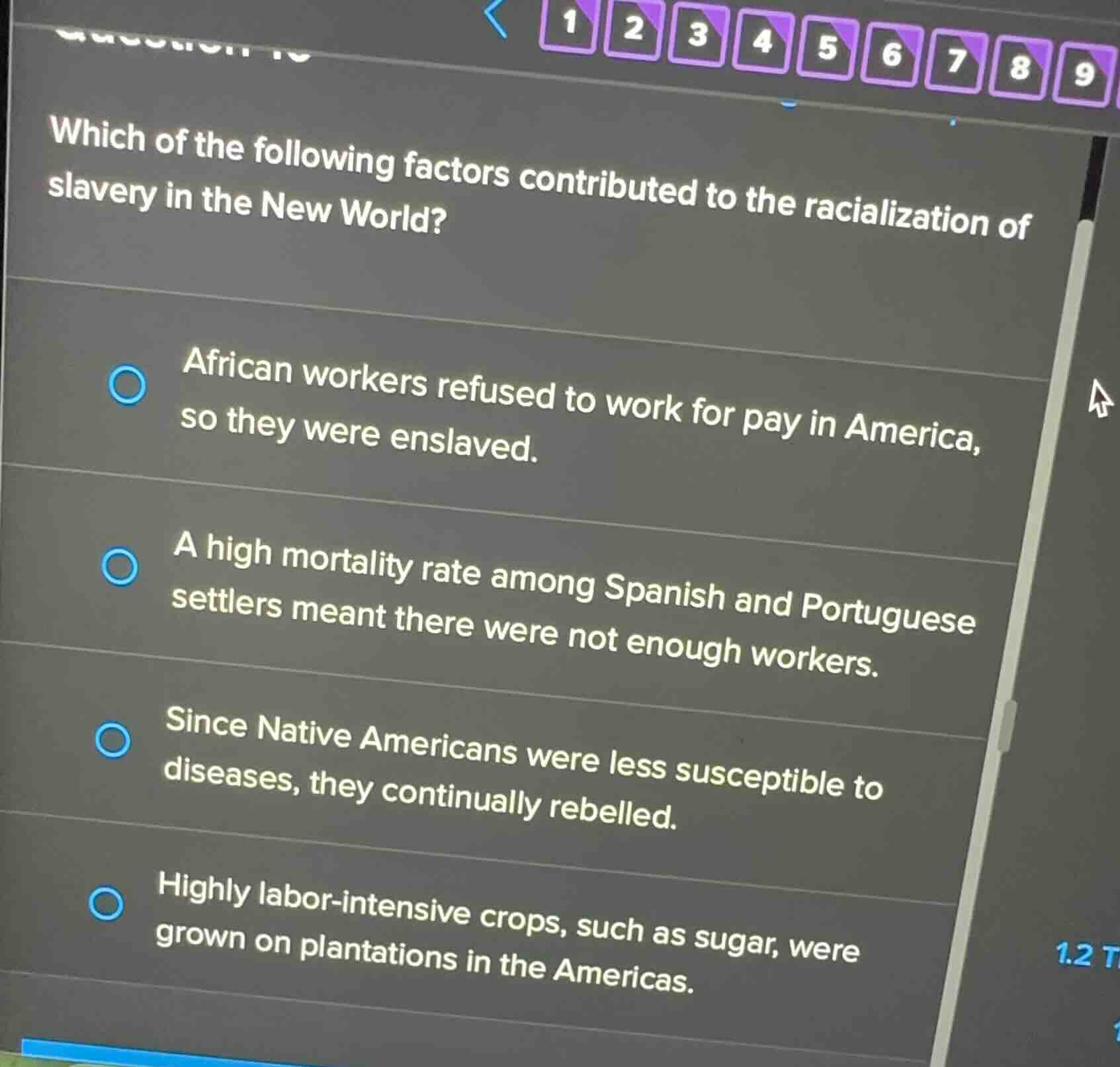
which of the following factors contributed to the racialization of slavery in the new world?
- african workers refused to work for pay in america, so they were enslaved.
- a high mortality rate among spanish and portuguese settlers meant there were not enough workers.
- since native americans were less susceptible to diseases, they continually rebelled.
- highly labor-intensive crops, such as sugar, were grown on plantations in the americas.
Analyze the historical context of New World labor
The expansion of European colonization in the Americas led to the establishment of large-scale plantation economies. These plantations focused on growing highly lucrative, labor-intensive cash crops such as sugar, tobacco, and later cotton. To maximize profits, European colonizers required a massive, permanent, and cheap labor force.
Evaluate the role of cash crops
The cultivation of sugar in particular was incredibly demanding and dangerous, leading to high mortality rates among laborers. As the demand for these crops grew, traditional labor systems—such as European indentured servitude and the enslavement of Indigenous populations (who suffered catastrophic population declines due to Old World diseases introduced during the Columbian Exchange)—proved insufficient or unsustainable for the colonizers.
Connect labor demands to the racialization of slavery
To meet the extreme labor demands of plantation crops like sugar, European powers turned to the transatlantic slave trade, importing millions of enslaved Africans. Over time, to justify the lifelong, hereditary enslavement of African people and to prevent alliances between poor European servants and enslaved laborers, colonial legal and social systems increasingly tied the status of enslavement directly to African descent. This process of linking legal servitude to race is known as the racialization of slavery, driven fundamentally by the economic demands of plantation agriculture.
Assess the given options
- Option 1: "African workers refused to work for pay..." is historically inaccurate. Enslavement was forced through violence and capture, not a response to wage disputes.
- Option 2: "A high mortality rate among Spanish and Portuguese settlers..." is incorrect. While settlers faced diseases, their mortality did not drive the racialization of the labor force; rather, the high mortality and susceptibility of Indigenous populations to European diseases did.
- Option 3: "Since Native Americans were less susceptible to diseases..." is historically false. Native Americans were highly susceptible to Afro-Eurasian pathogens, which devastated their populations.
- Option 4: "Highly labor-intensive crops, such as sugar, were grown on plantations in the Americas." This is correct, as the immense labor requirements of these cash crops drove the transition to and justification of a racialized, permanent system of chattel slavery.

Snap & solve any problem in the app
Get step-by-step solutions on Sovi AI
Photo-based solutions with guided steps
Explore more problems and detailed explanations
- African workers refused to work for pay in America, so they were enslaved.
- A high mortality rate among Spanish and Portuguese settlers meant there were not enough workers.
- Since Native Americans were less susceptible to diseases, they continually rebelled.
- Highly labor-intensive crops, such as sugar, were grown on plantations in the Americas. (Correct answer)