QUESTION IMAGE
Question
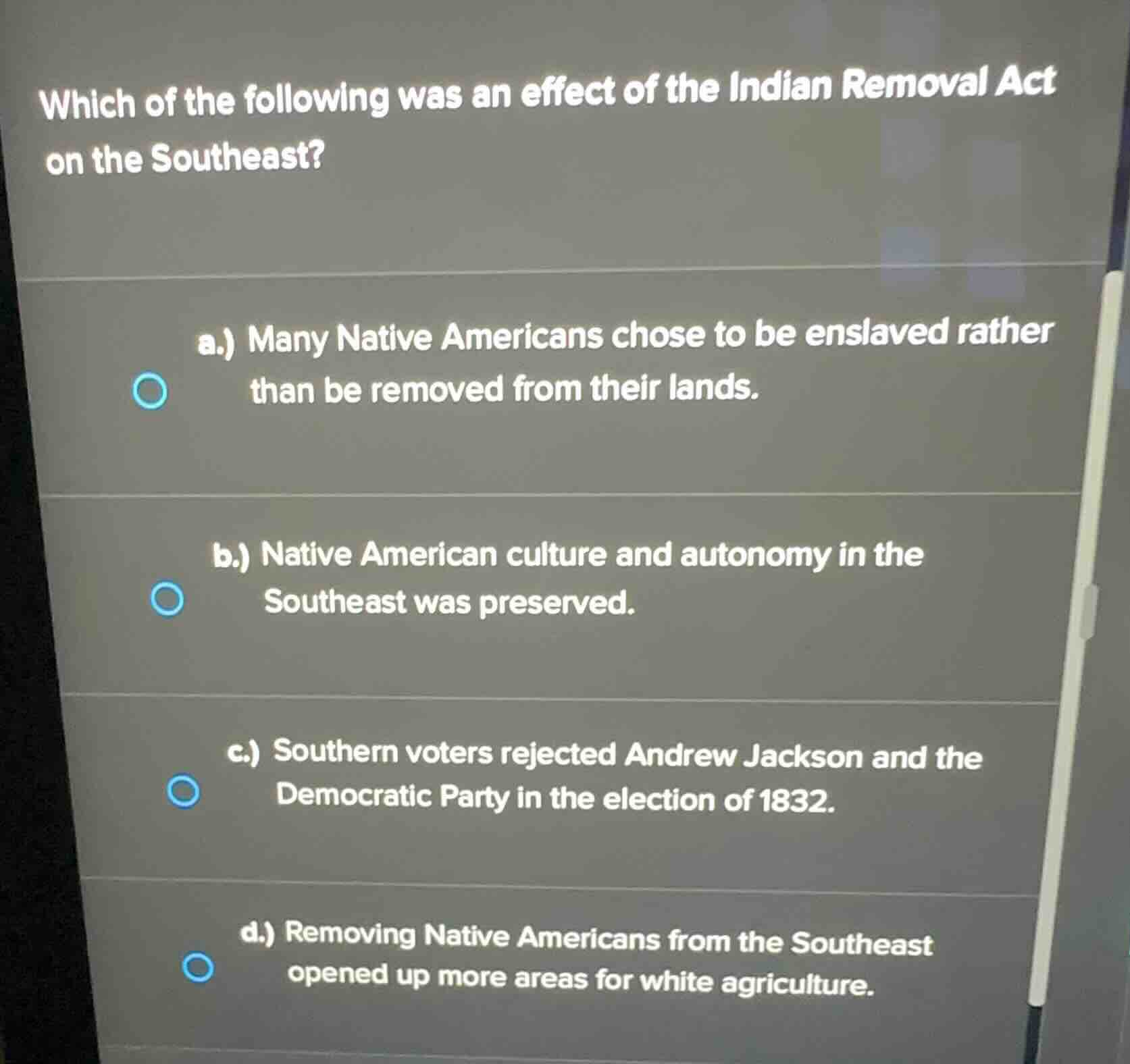
which of the following was an effect of the indian removal act on the southeast?
a.) many native americans chose to be enslaved rather than be removed from their lands.
b.) native american culture and autonomy in the southeast was preserved.
c.) southern voters rejected andrew jackson and the democratic party in the election of 1832.
d.) removing native americans from the southeast opened up more areas for white agriculture.
Analyze the historical context of the Indian Removal Act
The Indian Removal Act was signed into law by President Andrew Jackson in 1830. It authorized the federal government to negotiate removal treaties with Native American tribes living in the Southeast, exchanging their ancestral homelands for lands west of the Mississippi River (in modern-day Oklahoma).
Evaluate the economic and social motivations
The primary driving force behind the policy of removal in the Southeast was the desire of white settlers and agriculturalists to acquire fertile lands. This was especially true in states like Georgia, Alabama, and Mississippi, where the expansion of the cotton economy ("King Cotton") created immense pressure to open up Native American territories for white-owned plantations and agricultural development.
Assess the given options
- Option a: This statement is historically inaccurate. Native Americans did not choose enslavement as an alternative to removal.
- Option b: The forced relocation (such as the Trail of Tears) devastated Native American societies, severely disrupting their traditional cultures, autonomy, and sovereignty in their southeastern homelands rather than preserving them.
- Option c: Southern voters overwhelmingly supported Andrew Jackson and his Democratic Party in the election of 1832, largely because they favored his aggressive policies on Indian removal and states' rights.
- Option d: This is historically accurate. The forced displacement of tens of thousands of Native Americans cleared millions of acres of land, directly facilitating the expansion of white-owned agricultural operations, particularly cotton cultivation.

Snap & solve any problem in the app
Get step-by-step solutions on Sovi AI
Photo-based solutions with guided steps
Explore more problems and detailed explanations
- a.) Many Native Americans chose to be enslaved rather than be removed from their lands.
- b.) Native American culture and autonomy in the Southeast was preserved.
- c.) Southern voters rejected Andrew Jackson and the Democratic Party in the election of 1832.
- d.) Removing Native Americans from the Southeast opened up more areas for white agriculture. (Correct answer)