QUESTION IMAGE
Question
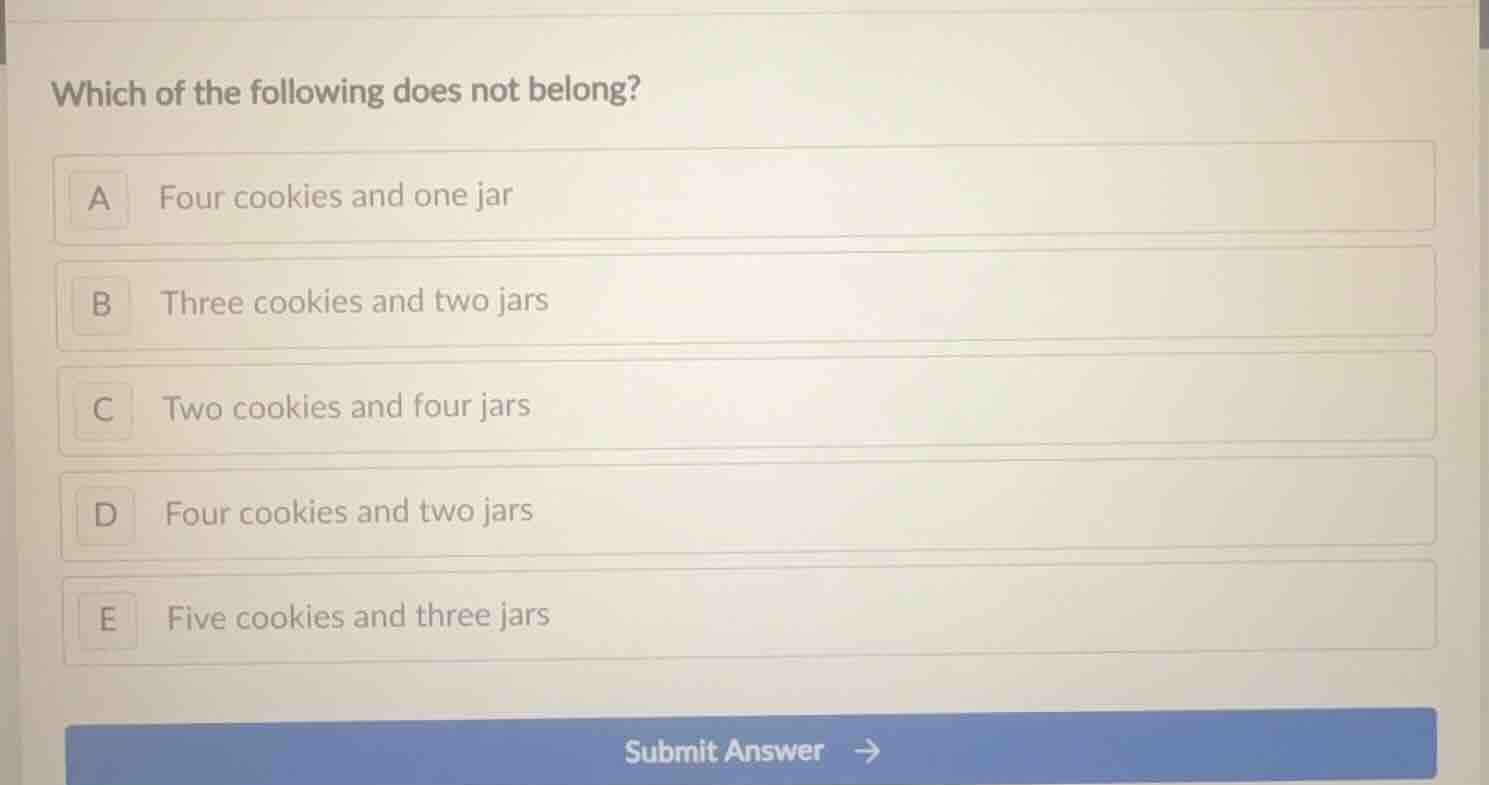
which of the following does not belong?
a four cookies and one jar
b three cookies and two jars
c two cookies and four jars
d four cookies and two jars
e five cookies and three jars
Analyze the numerical values in each option
We extract the number of cookies and jars for each option:
- Option A: 4 cookies, 1 jar
- Option B: 3 cookies, 2 jars
- Option C: 2 cookies, 4 jars
- Option D: 4 cookies, 2 jars
- Option E: 5 cookies, 3 jars
Identify the mathematical relationship
We look for a consistent relationship or pattern between the number of cookies \(C\) and the number of jars \(J\) in each option:
- Option A: \(4 + 1 = 5\)
- Option B: \(3 + 2 = 5\)
- Option C: \(2 + 4 = 6\)
- Option D: \(4 + 2 = 6\)
- Option E: \(5 + 3 = 8\)
Alternatively, we check the difference or other properties:
- Option A: \(4 - 1 = 3\) (odd)
- Option B: \(3 - 2 = 1\) (odd)
- Option C: \(2 - 4 = -2\) (even)
- Option D: \(4 - 2 = 2\) (even)
- Option E: \(5 - 3 = 2\) (even)
Let's look at the parity (even/odd) of the sum of cookies and jars:
- Option A: \(4 + 1 = 5\) (odd)
- Option B: \(3 + 2 = 5\) (odd)
- Option C: \(2 + 4 = 6\) (even)
- Option D: \(4 + 2 = 6\) (even)
- Option E: \(5 + 3 = 8\) (even)
Let's look at prime/composite relationships or divisibility.
Another common pattern in these types of verbal-numerical puzzles is the relationship where the sum of the two numbers is a constant, or one is a multiple.
Let's look at the sum of the digits of the spelled-out numbers, or simply the parity of the numbers themselves:
- Option A: 4 (even), 1 (odd) -> different parities
- Option B: 3 (odd), 2 (even) -> different parities
- Option C: 2 (even), 4 (even) -> same parity
- Option D: 4 (even), 2 (even) -> same parity
- Option E: 5 (odd), 3 (odd) -> same parity
Let's look at the relationship \(C - J\):
- Option A: \(4 - 1 = 3\)
- Option B: \(3 - 2 = 1\)
- Option C: \(2 - 4 = -2\)
- Option D: \(4 - 2 = 2\)
- Option E: \(5 - 3 = 2\)
Let's look at the relationship \(C + J\):
- Option A: \(4 + 1 = 5\)
- Option B: \(3 + 2 = 5\)
- Option C: \(2 + 4 = 6\)
- Option D: \(4 + 2 = 6\)
- Option E: \(5 + 3 = 8\)
Let's look at the relationship where the number of cookies is strictly greater than the number of jars:
- Option A: \(4 > 1\) (True)
- Option B: \(3 > 2\) (True)
- Option C: \(2 > 4\) (False)
- Option D: \(4 > 2\) (True)
- Option E: \(5 > 3\) (True)
In Option C, the number of cookies (2) is less than the number of jars (4). In all other options (A, B, D, E), the number of cookies is strictly greater than the number of jars. Thus, Option C does not belong.

Snap & solve any problem in the app
Get step-by-step solutions on Sovi AI
Photo-based solutions with guided steps
Explore more problems and detailed explanations
- (A) Four cookies and one jar
- (B) Three cookies and two jars
- (C) Two cookies and four jars (Correct answer)
- (D) Four cookies and two jars
- (E) Five cookies and three jars