QUESTION IMAGE
Question
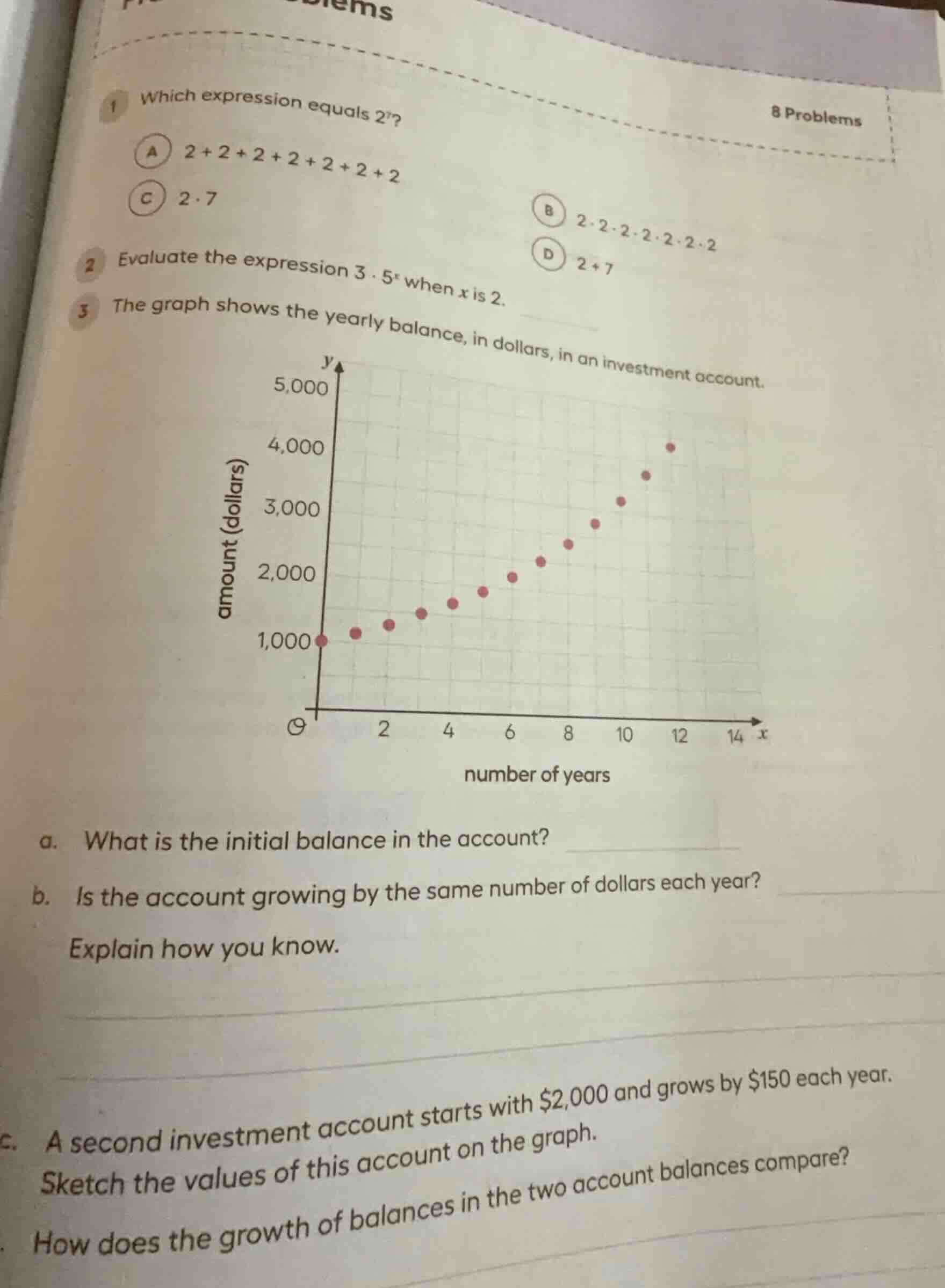
1 which expression equals $2^7$?
a $2 + 2 + 2 + 2 + 2 + 2 + 2$
c $2 \cdot 7$
b $2 \cdot 2 \cdot 2 \cdot 2 \cdot 2 \cdot 2 \cdot 2$
d $2 + 7$
2 evaluate the expression $3 \cdot 5^x$ when $x$ is 2.
3 the graph shows the yearly balance, in dollars, in an investment account.
(graph: x-axis: number of years, y-axis: amount (dollars). points plotted, starting at (0,1000) and increasing.)
a. what is the initial balance in the account?
b. is the account growing by the same number of dollars each year? explain how you know.
c. a second investment account starts with $2,000 and grows by $150 each year. sketch the values of this account on the graph.
how does the growth of balances in the two account balances compare?
Problem 1
Step1: Recall exponent definition
An exponent \(a^n\) means \(a\) multiplied by itself \(n\) times. So \(2^7\) means 2 multiplied by itself 7 times.
Step2: Analyze each option
- Option A: \(2 + 2+2 + 2+2 + 2+2\) is addition of 2 seven times, which is \(2\times7\), not \(2^7\).
- Option B: \(2\cdot2\cdot2\cdot2\cdot2\cdot2\cdot2\) is 2 multiplied by itself 7 times, which is \(2^7\).
- Option C: \(2\cdot7\) is multiplication, equal to \(14\), while \(2^7 = 128\), not equal.
- Option D: \(2 + 7=9\), not equal to \(2^7\).
Step1: Substitute \(x = 2\) into the expression
We have the expression \(3\cdot5^x\), substitute \(x = 2\), so it becomes \(3\cdot5^2\).
Step2: Evaluate the exponent first
Calculate \(5^2=5\times5 = 25\).
Step3: Multiply by 3
Now multiply 3 by 25: \(3\times25 = 75\).
The initial balance is when the number of years \(x = 0\). From the graph, when \(x = 0\), the \(y\)-value (amount in dollars) is 1000.

Snap & solve any problem in the app
Get step-by-step solutions on Sovi AI
Photo-based solutions with guided steps
Explore more problems and detailed explanations
B. \(2\cdot2\cdot2\cdot2\cdot2\cdot2\cdot2\)