QUESTION IMAGE
Question
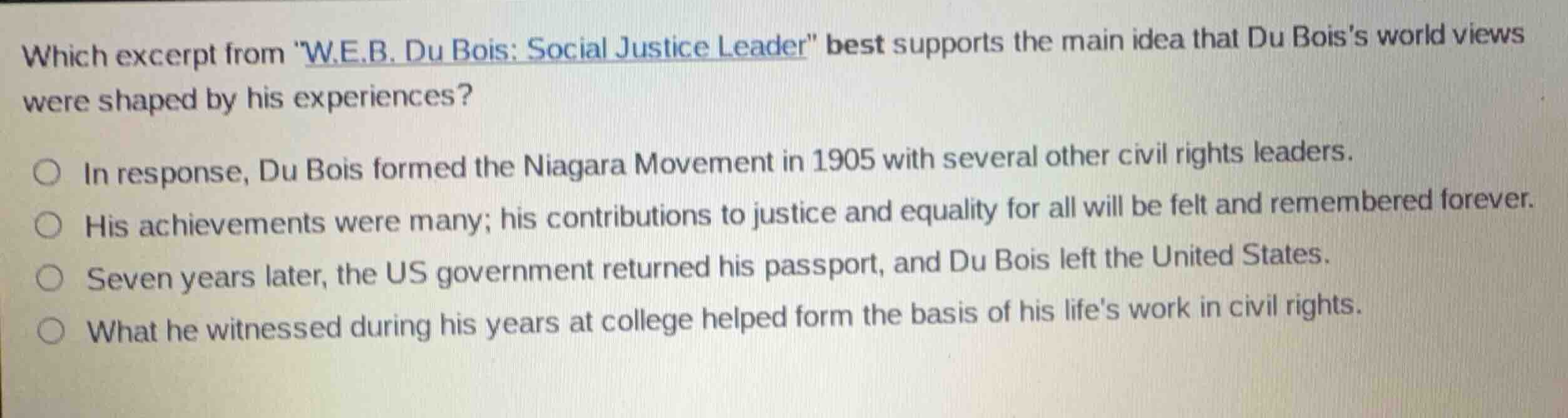
which excerpt from \w.e.b. du bois: social justice leader\ best supports the main idea that du boiss world views were shaped by his experiences?
in response, du bois formed the niagara movement in 1905 with several other civil rights leaders.
his achievements were many; his contributions to justice and equality for all will be felt and remembered forever.
seven years later, the us government returned his passport, and du bois left the united states.
what he witnessed during his years at college helped form the basis of his lifes work in civil rights.
Analyze the target main idea
The target main idea is that Du Bois's world views were shaped by his experiences. We need to find an excerpt that directly connects his personal experiences to the formation of his views or life's work.
Evaluate the options
- Option 1 describes an action taken in response to something, but does not explicitly discuss his world views being shaped by experiences.
- Option 2 summarizes his achievements and legacy.
- Option 3 states a historical fact about his passport and departure from the US.
- Option 4 explicitly states that "What he witnessed during his years at college" (his experiences) "helped form the basis of his life's work" (his world views and actions).
Select the best supporting evidence
Option 4 is the only choice that directly links his personal experiences ("what he witnessed") to the shaping of his perspective and career ("form the basis of his life's work").

Snap & solve any problem in the app
Get step-by-step solutions on Sovi AI
Photo-based solutions with guided steps
Explore more problems and detailed explanations
- (A) In response, Du Bois formed the Niagara Movement in 1905 with several other civil rights leaders.
- (B) His achievements were many; his contributions to justice and equality for all will be felt and remembered forever.
- (C) Seven years later, the US government returned his passport, and Du Bois left the United States.
- (D) What he witnessed during his years at college helped form the basis of his life's work in civil rights. (Correct answer)