QUESTION IMAGE
Question
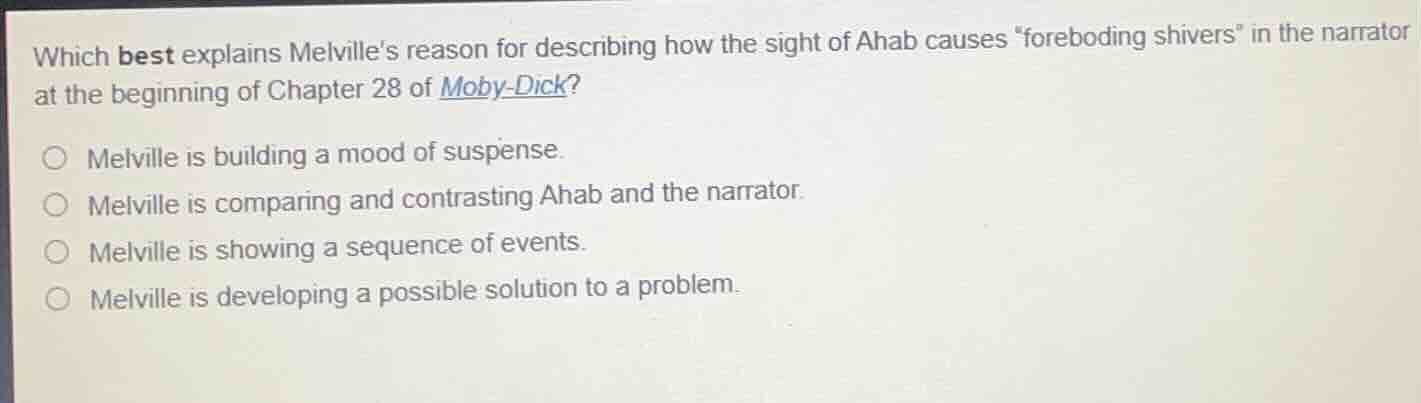
which best explains melvilles reason for describing how the sight of ahab causes \foreboding shivers\ in the narrator at the beginning of chapter 28 of moby-dick?
melville is building a mood of suspense.
melville is comparing and contrasting ahab and the narrator.
melville is showing a sequence of events.
melville is developing a possible solution to a problem.
Analyze the prompt and quote
The question asks for the reason Herman Melville describes how the sight of Captain Ahab causes "foreboding shivers" in the narrator (Ishmael) at the start of Chapter 28 of Moby-Dick. We must evaluate this through the lens of Authorial Intent.
Evaluate the literary effect of the phrase
The phrase "foreboding shivers" directly relates to an emotional state of anticipation, dread, and unease. In Moby-Dick Analysis, this description serves to establish a dark, tense atmosphere surrounding Ahab's first physical appearance on the ship, which builds a strong mood of suspense for the reader.
Assess the given options
- Option 1: "Melville is building a mood of suspense." This aligns perfectly with the psychological dread of "foreboding shivers."
- Option 2: "Melville is comparing and contrasting Ahab and the narrator." The phrase focuses on the narrator's reaction to Ahab, not a comparative analysis of their characters.
- Option 3: "Melville is showing a sequence of events." The description is focused on sensory and emotional impact rather than plot progression.
- Option 4: "Melville is developing a possible solution to a problem." There is no problem-solving context established by this emotional reaction.

Snap & solve any problem in the app
Get step-by-step solutions on Sovi AI
Photo-based solutions with guided steps
Explore more problems and detailed explanations
- (A) Melville is building a mood of suspense. (Correct answer)
- (B) Melville is comparing and contrasting Ahab and the narrator.
- (C) Melville is showing a sequence of events.
- (D) Melville is developing a possible solution to a problem.