QUESTION IMAGE
Question
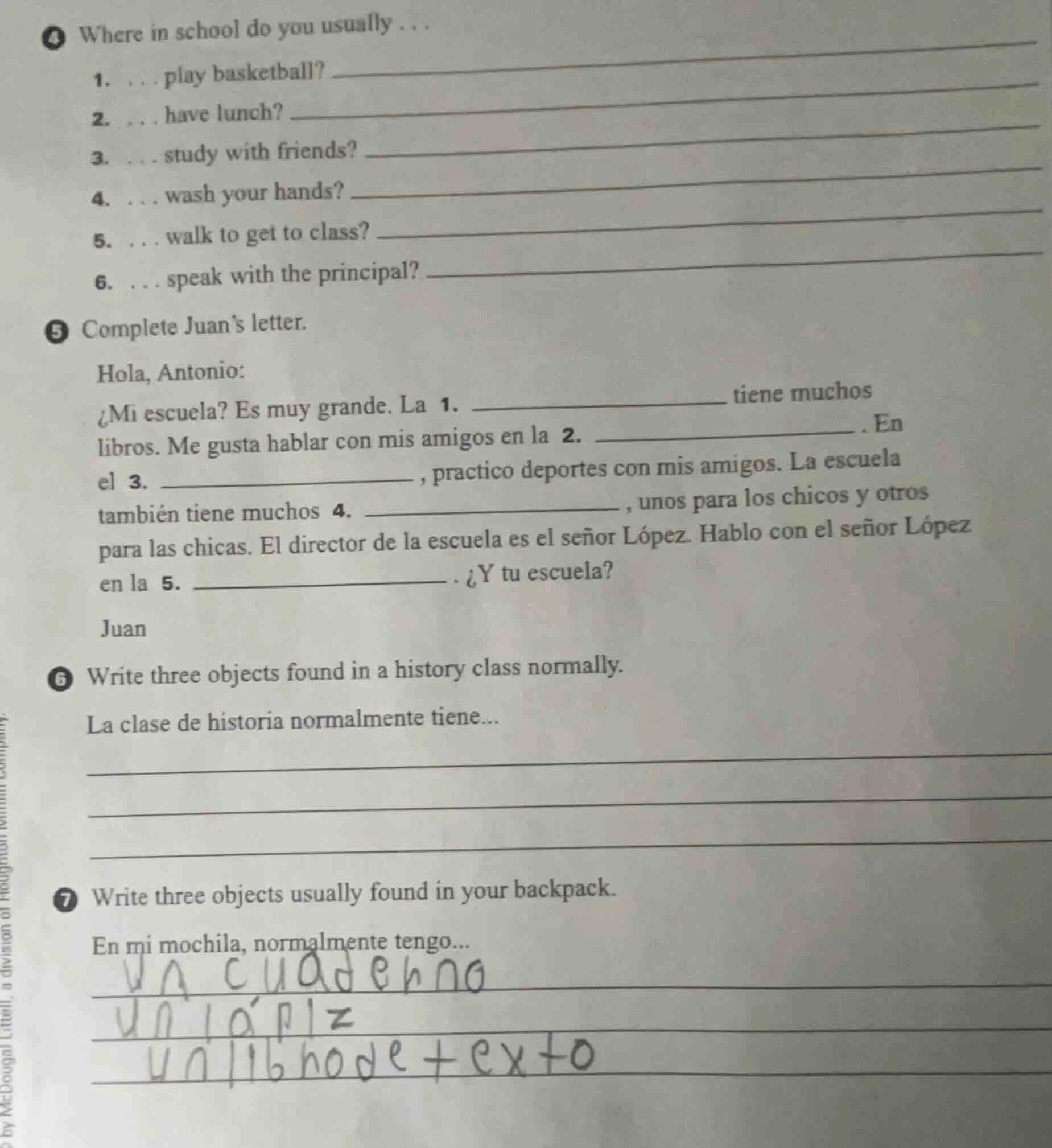
4 where in school do you usually...
- ...play basketball?
- ...have lunch?
- ...study with friends?
- ...wash your hands?
- ...walk to get to class?
- ...speak with the principal?
5 complete juan’s letter.
hola, antonio:
¿mi escuela? es muy grande. la 1. tiene muchos libros. me gusta hablar con mis amigos en la 2. . en el 3. , practico deportes con mis amigos. la escuela también tiene muchos 4. , unos para los chicos y otros para las chicas. el director de la escuela es el señor lópez. hablo con el señor lópez en la 5. . ¿y tu escuela?
juan
6 write three objects found in a history class normally.
la clase de historia normalmente tiene...
7 write three objects usually found in your backpack.
en mi mochila, normalmente tengo...
un cuaderno
un lápiz
un libro de texto
Question 4
- For "…play basketball?", a common place in school to play basketball is the gymnasium (el gimnasio) or basketball court (la cancha de baloncesto).
- For "…have lunch?", the usual place is the cafeteria (la cafetería).
- For "…study with friends?", a common spot is the library (la biblioteca), classroom (el aula), or study hall (el salón de estudio).
- For "…wash your hands?", the bathroom (el baño) or restroom (los servicios higiénicos) is where you wash hands.
- For "…walk to get to class?", you walk in the hallway (el pasillo) or corridor (el corredor).
- For "…speak with the principal?", you usually speak with the principal in the principal’s office (la oficina del director).
Question 5
To complete Juan’s letter, we use common school-related vocabulary in Spanish:
- "La biblioteca tiene muchos libros." (The library has many books.)
- "Me gusta hablar con mis amigos en la playa de recreo (playground) or salón de clase (classroom) or more likely pasillo (hallway) – but a better fit is cafetería (cafeteria) or salón de estudio (study hall). Wait, more contextually, "en la playa de recreo" is for playing, but "hablar con amigos" could be in the pasillo or biblioteca? Wait, let's think again. Common places to talk with friends: pasillo (hallway), cafetería, or playa de recreo. But let's use standard answers:
- biblioteca (library) – since it has many books.
- pasillo (hallway) or cafetería (cafeteria) – let's go with cafetería (but maybe playa de recreo is for sports. Wait, the next line is "practico deportes", so the second blank is a place to talk, so pasillo or salón de clase. Maybe salón de clase (classroom) is not right. Let's use:
- La biblioteca tiene muchos libros.
- Me gusta hablar con mis amigos en la playa de recreo – no, "hablar" is better in pasillo (hallway). Alternatively, "en la cafetería".
- En el gimnasio (gym), practico deportes con mis amigos.
- La escuela también tiene muchos baños (bathrooms) or lockers (los casilleros) – "unos para los chicos y otros para las chicas" – so casilleros (lockers) or baños (bathrooms). Let's use casilleros (lockers).
- Hablo con el señor López en la oficina del director (principal’s office).
So filling in:
- biblioteca
- cafetería (or pasillo)
- gimnasio
- casilleros (or baños)
- oficina del director
Question 6
Three objects found in a history class (in Spanish):
- un libro de historia (a history book)
- una pizarra (a chalkboard/whiteboard)
- un mapa (a map)
- un cronómetro (a timer) – no, better: un libro de texto (a textbook), una regla (a ruler) – no, history class: maps, history books, chalkboard, textbooks, etc. So:
La clase de historia normalmente tiene un libro de historia, un mapa y una pizarra.
Question 7
Three objects usually found in a backpack (in Spanish):
- un cuaderno (a notebook)
- un lápiz (a pencil)
- un libro de texto (a textbook)
- una regla (a ruler)
- un borrador (an eraser)
So:
En mi mochila, normalmente tengo un cuaderno, un lápiz y un libro de texto.

Snap & solve any problem in the app
Get step-by-step solutions on Sovi AI
Photo-based solutions with guided steps
Explore more problems and detailed explanations
Question 4
- For "…play basketball?", a common place in school to play basketball is the gymnasium (el gimnasio) or basketball court (la cancha de baloncesto).
- For "…have lunch?", the usual place is the cafeteria (la cafetería).
- For "…study with friends?", a common spot is the library (la biblioteca), classroom (el aula), or study hall (el salón de estudio).
- For "…wash your hands?", the bathroom (el baño) or restroom (los servicios higiénicos) is where you wash hands.
- For "…walk to get to class?", you walk in the hallway (el pasillo) or corridor (el corredor).
- For "…speak with the principal?", you usually speak with the principal in the principal’s office (la oficina del director).
Question 5
To complete Juan’s letter, we use common school-related vocabulary in Spanish:
- "La biblioteca tiene muchos libros." (The library has many books.)
- "Me gusta hablar con mis amigos en la playa de recreo (playground) or salón de clase (classroom) or more likely pasillo (hallway) – but a better fit is cafetería (cafeteria) or salón de estudio (study hall). Wait, more contextually, "en la playa de recreo" is for playing, but "hablar con amigos" could be in the pasillo or biblioteca? Wait, let's think again. Common places to talk with friends: pasillo (hallway), cafetería, or playa de recreo. But let's use standard answers:
- biblioteca (library) – since it has many books.
- pasillo (hallway) or cafetería (cafeteria) – let's go with cafetería (but maybe playa de recreo is for sports. Wait, the next line is "practico deportes", so the second blank is a place to talk, so pasillo or salón de clase. Maybe salón de clase (classroom) is not right. Let's use:
- La biblioteca tiene muchos libros.
- Me gusta hablar con mis amigos en la playa de recreo – no, "hablar" is better in pasillo (hallway). Alternatively, "en la cafetería".
- En el gimnasio (gym), practico deportes con mis amigos.
- La escuela también tiene muchos baños (bathrooms) or lockers (los casilleros) – "unos para los chicos y otros para las chicas" – so casilleros (lockers) or baños (bathrooms). Let's use casilleros (lockers).
- Hablo con el señor López en la oficina del director (principal’s office).
So filling in:
- biblioteca
- cafetería (or pasillo)
- gimnasio
- casilleros (or baños)
- oficina del director
Question 6
Three objects found in a history class (in Spanish):
- un libro de historia (a history book)
- una pizarra (a chalkboard/whiteboard)
- un mapa (a map)
- un cronómetro (a timer) – no, better: un libro de texto (a textbook), una regla (a ruler) – no, history class: maps, history books, chalkboard, textbooks, etc. So:
La clase de historia normalmente tiene un libro de historia, un mapa y una pizarra.
Question 7
Three objects usually found in a backpack (in Spanish):
- un cuaderno (a notebook)
- un lápiz (a pencil)
- un libro de texto (a textbook)
- una regla (a ruler)
- un borrador (an eraser)
So:
En mi mochila, normalmente tengo un cuaderno, un lápiz y un libro de texto.