QUESTION IMAGE
Question
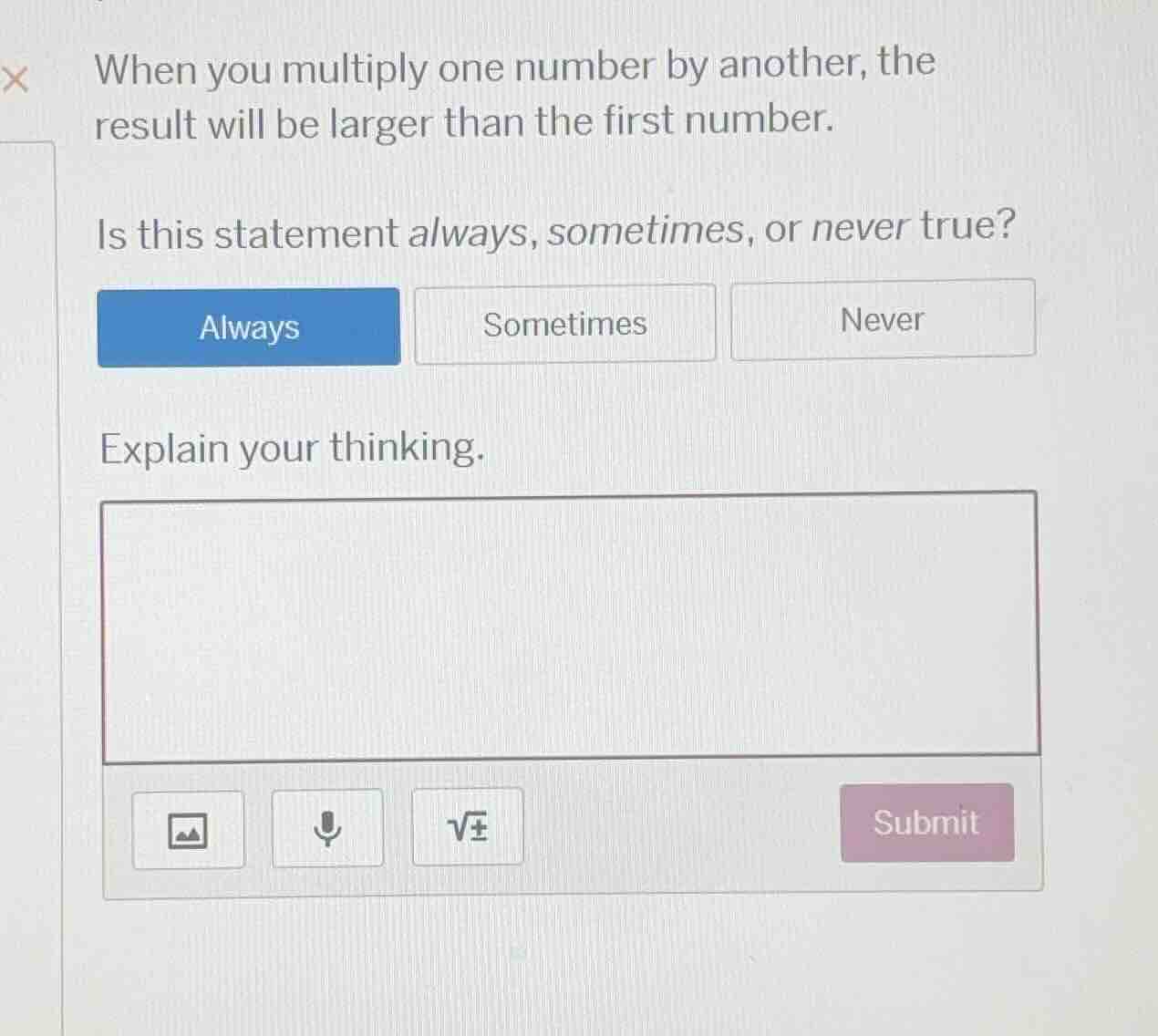
when you multiply one number by another, the result will be larger than the first number. is this statement always, sometimes, or never true? always sometimes never explain your thinking.
To determine if the statement "When you multiply one number by another, the result will be larger than the first number" is always, sometimes, or never true, we analyze different cases:
- Case 1: Multiplying by a number greater than 1
For example, \( 2 \times 3 = 6 \). Here, \( 6 > 2 \), so the result is larger than the first number.
- Case 2: Multiplying by 1
For example, \( 2 \times 1 = 2 \). Here, \( 2 = 2 \), so the result is not larger than the first number.
- Case 3: Multiplying by a number between 0 and 1 (a fraction or decimal less than 1)
For example, \( 2 \times 0.5 = 1 \). Here, \( 1 < 2 \), so the result is smaller than the first number.
- Case 4: Multiplying by a negative number
For example, \( 2 \times (-1) = -2 \). Here, \( -2 < 2 \), so the result is smaller than the first number.
Since the result is larger than the first number in some cases (e.g., multiplying by a number greater than 1) but not in others (e.g., multiplying by 1, a fraction between 0 and 1, or a negative number), the statement is sometimes true.
The result of multiplying one number by another is larger than the first number in some cases (e.g., \( 2 \times 3 = 6 \), where \( 6 > 2 \)) but not in others (e.g., \( 2 \times 1 = 2 \) or \( 2 \times 0.5 = 1 \), where the result is not larger). Thus, the statement is sometimes true.

Snap & solve any problem in the app
Get step-by-step solutions on Sovi AI
Photo-based solutions with guided steps
Explore more problems and detailed explanations
Sometimes