QUESTION IMAGE
Question
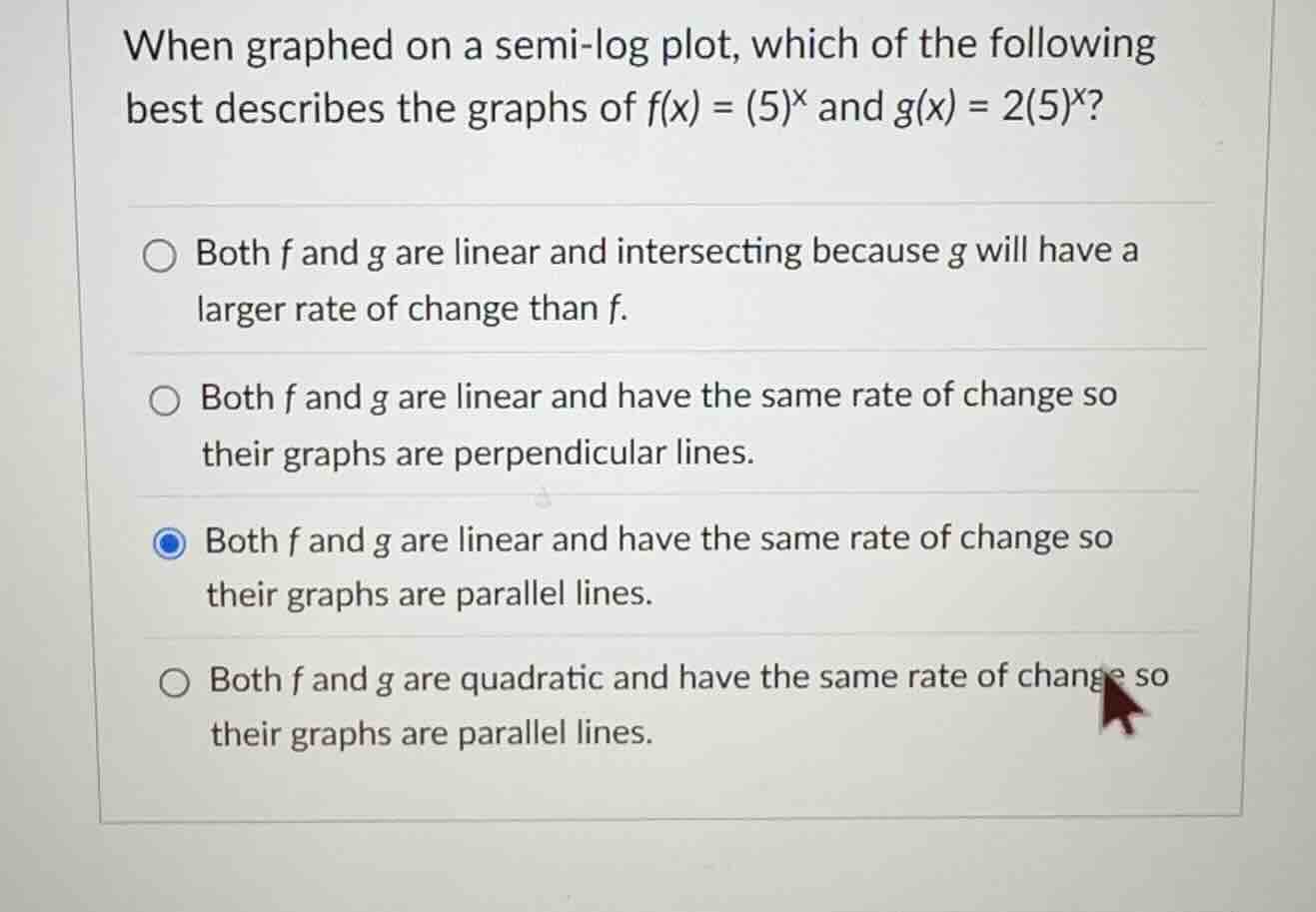
when graphed on a semi-log plot, which of the following best describes the graphs of \\(f(x) = (5)^x\\) and \\(g(x) = 2(5)^x\\)?
both \\(f\\) and \\(g\\) are linear and intersecting because \\(g\\) will have a larger rate of change than \\(f\\).
both \\(f\\) and \\(g\\) are linear and have the same rate of change so their graphs are perpendicular lines.
both \\(f\\) and \\(g\\) are linear and have the same rate of change so their graphs are parallel lines.
both \\(f\\) and \\(g\\) are quadratic and have the same rate of change so their graphs are parallel lines.
Apply logarithmic transformation
Using the Exponential Equations and Logarithmic Models knowledge points
Compare linear properties
Using the Logarithmic Models knowledge point
Determine geometric relationship
Since both transformed functions are linear equations with identical slopes but different vertical intercepts, their graphs on a semi-log plot are parallel lines.

Snap & solve any problem in the app
Get step-by-step solutions on Sovi AI
Photo-based solutions with guided steps
Explore more problems and detailed explanations
- (A) Both \(f\) and \(g\) are linear and intersecting because \(g\) will have a larger rate of change than \(f\).
- (B) Both \(f\) and \(g\) are linear and have the same rate of change so their graphs are perpendicular lines.
- (C) Both \(f\) and \(g\) are linear and have the same rate of change so their graphs are parallel lines. (Correct answer)
- (D) Both \(f\) and \(g\) are quadratic and have the same rate of change so their graphs are parallel lines.