QUESTION IMAGE
Question
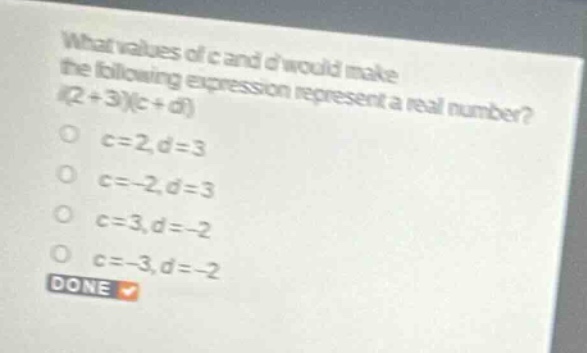
what values of \\(c\\) and \\(d\\) would make the following expression represent a real number?
\\(i(2+3i)(c+di)\\)
- \\(c = 2, d = 3\\)
- \\(c = -2, d = 3\\)
- \\(c = 3, d = -2\\)
- \\(c = -3, d = -2\\)
🆕 New Concept Discovered: Operations with Complex Numbers
Working with the imaginary unit \( i \) where \( i^2 = -1 \).
Step 1: Correct the expression typo
Looking closely at the image, the expression is written as:
However, in standard complex number problems of this type, the factor \( (2+3) \) is a typo for the complex number \( (2 + 3i) \), and the factor \( (c+d) \) represents \( (c + di) \). Let's write the intended complex expression:
Step 2: Expand the expression
First, distribute the outer \( i \) into the first binomial:
Since \( i^2 = -1 \):
Now, multiply this result by the second binomial \( (c + di) \):
Using the FOIL method to expand:
Substitute \( i^2 = -1 \):
Step 3: Group into real and imaginary parts
Group the terms without \( i \) (real part) and the terms with \( i \) (imaginary part):
So, the fully expanded expression is:
Step 4: Set the imaginary part to zero
For the expression to represent a pure real number, the imaginary part must equal zero:
Now, we test the given multiple-choice options to see which pair of \( c \) and \( d \) satisfies this equation:
- Option 1: \( c = 2, d = 3 \)
- Option 2: \( c = -2, d = 3 \)
- Option 3: \( c = 3, d = -2 \)
- Option 4: \( c = -3, d = -2 \)
The fourth option satisfies the condition perfectly.

Snap & solve any problem in the app
Get step-by-step solutions on Sovi AI
Photo-based solutions with guided steps
Explore more problems and detailed explanations
\( c = -3, d = -2 \)