QUESTION IMAGE
Question
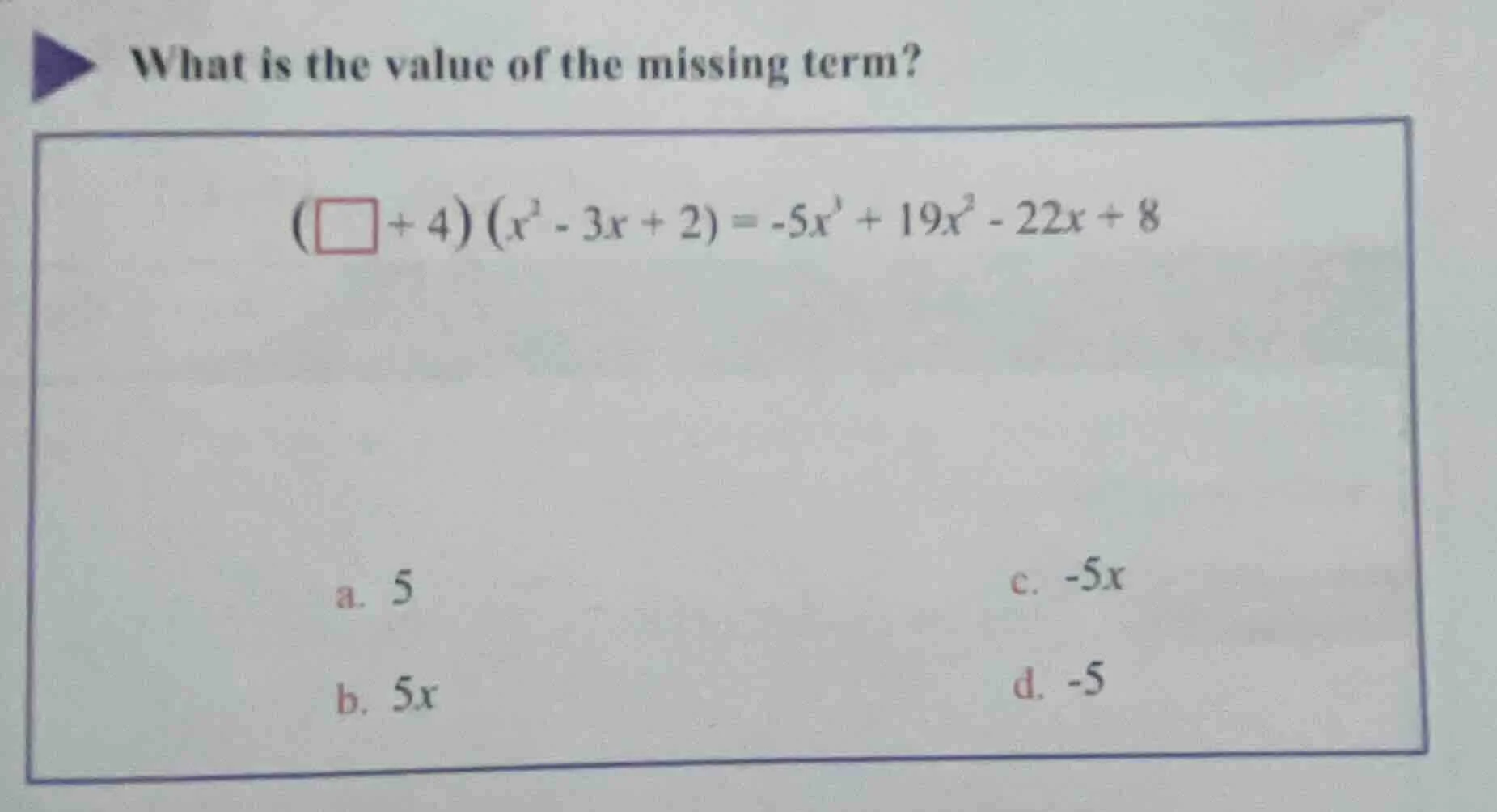
what is the value of the missing term?
$(square + 4)(x^2 - 3x + 2) = -5x^3 + 19x^2 - 22x + 8$
a. $5$
b. $5x$
c. $-5x$
d. $-5$
Step1: Let the missing term be \( ax \) (wait, actually, let's assume the missing term is \( mx \)? No, wait, the left side is \( (\square + 4)(x^2 - 3x + 2) \), and the right side has \( -5x^3 \), so the missing term must be a linear term in \( x \) (or maybe a constant? Wait, no, when we multiply \( \square \) (let's call it \( A \)) with \( x^2 \), we get \( A x^2 \times x \)? Wait, no, wait: \( (A + 4)(x^2 - 3x + 2) \). Let's expand the left side:
\( A(x^2 - 3x + 2) + 4(x^2 - 3x + 2) \)
\( = A x^2 - 3A x + 2A + 4x^2 - 12x + 8 \)
Now, combine like terms:
For \( x^3 \)? Wait, wait, no! Wait, the right side has \( -5x^3 \), but the left side, if \( A \) is a linear term (like \( bx \)), then \( bx \times x^2 = bx^3 \). Oh! I made a mistake. The missing term is a linear term? No, wait, the left side is \( (\square + 4)(x^2 - 3x + 2) \). So \( \square \) must be a linear term (degree 1) because when multiplied by \( x^2 \) (degree 2), we get degree 3, which matches the right side's \( -5x^3 \). So let \( \square = mx \). Then:
\( (mx + 4)(x^2 - 3x + 2) = mx(x^2 - 3x + 2) + 4(x^2 - 3x + 2) \)
\( = mx^3 - 3mx^2 + 2mx + 4x^2 - 12x + 8 \)
Now, combine like terms:
- \( x^3 \) term: \( m x^3 \)
- \( x^2 \) term: \( (-3m + 4) x^2 \)
- \( x \) term: \( (2m - 12) x \)
- constant term: \( 8 \)
Now, set equal to the right side: \( -5x^3 + 19x^2 - 22x + 8 \)
So equate coefficients:
- \( x^3 \) term: \( m = -5 \)? Wait, no, wait: \( m x^3 = -5x^3 \) ⇒ \( m = -5 \)? Wait, but let's check the \( x^2 \) term:
\( -3m + 4 = 19 \)
If \( m = -5 \), then \( -3(-5) + 4 = 15 + 4 = 19 \), which matches the \( x^2 \) coefficient (19). Let's check the \( x \) term:
\( 2m - 12 = 2(-5) - 12 = -10 - 12 = -22 \), which matches the \( x \) coefficient (-22). And the constant term is 8, which matches. So the missing term is \( -5x \)? Wait, no, wait: \( \square = mx \), and \( m = -5 \), so \( \square = -5x \)? Wait, but let's check the options. Option c is \( -5x \). Wait, but let's re-express:
Wait, when we set \( \square = A \), and when we expand, the \( x^3 \) term comes from \( A \times x^2 \), so \( A \) must be a linear term (degree 1) to get \( x^3 \) (degree 3). So \( A = -5x \), because \( -5x \times x^2 = -5x^3 \), which matches the right side's \( -5x^3 \). Then, let's verify:
\( (-5x + 4)(x^2 - 3x + 2) \)
Multiply \( -5x \) by \( x^2 - 3x + 2 \): \( -5x^3 + 15x^2 - 10x \)
Multiply 4 by \( x^2 - 3x + 2 \): \( 4x^2 - 12x + 8 \)
Now, add them together:
\( -5x^3 + 15x^2 - 10x + 4x^2 - 12x + 8 \)
Combine like terms:
\( -5x^3 + (15x^2 + 4x^2) + (-10x - 12x) + 8 \)
\( = -5x^3 + 19x^2 - 22x + 8 \), which matches the right side. So the missing term is \( -5x \), which is option c.
Wait, but let's check the steps again. Let's denote the missing term as \( A \). Then:
\( (A + 4)(x^2 - 3x + 2) = -5x^3 + 19x^2 - 22x + 8 \)
Expand left side:
\( A(x^2 - 3x + 2) + 4(x^2 - 3x + 2) \)
\( = A x^2 - 3A x + 2A + 4x^2 - 12x + 8 \)
Wait, but this would give \( x^2 \) terms, not \( x^3 \). Oh! Wait, I made a mistake earlier. The left side is \( (A + 4)(x^2 - 3x + 2) \), but the right side has \( x^3 \), so \( A \) must be a linear term (degree 1) to get \( x^3 \) when multiplied by \( x^2 \) (degree 2). So \( A \) is a linear term, say \( A = mx \). Then:
\( (mx + 4)(x^2 - 3x + 2) = mx(x^2 - 3x + 2) + 4(x^2 - 3x + 2) \)
\( = mx^3 - 3mx^2 + 2mx + 4x^2 - 12x + 8 \)
Now, combine like terms:
- \( x^3 \): \( m x^3 \)
- \( x^2 \): \( (-3m + 4) x^2 \)
- \( x \): \( (2m - 12) x \)
- constant: 8
Now, set equal to right side: \( -5x^3 + 19x^2 - 22x…

Snap & solve any problem in the app
Get step-by-step solutions on Sovi AI
Photo-based solutions with guided steps
Explore more problems and detailed explanations
c. -5x