QUESTION IMAGE
Question
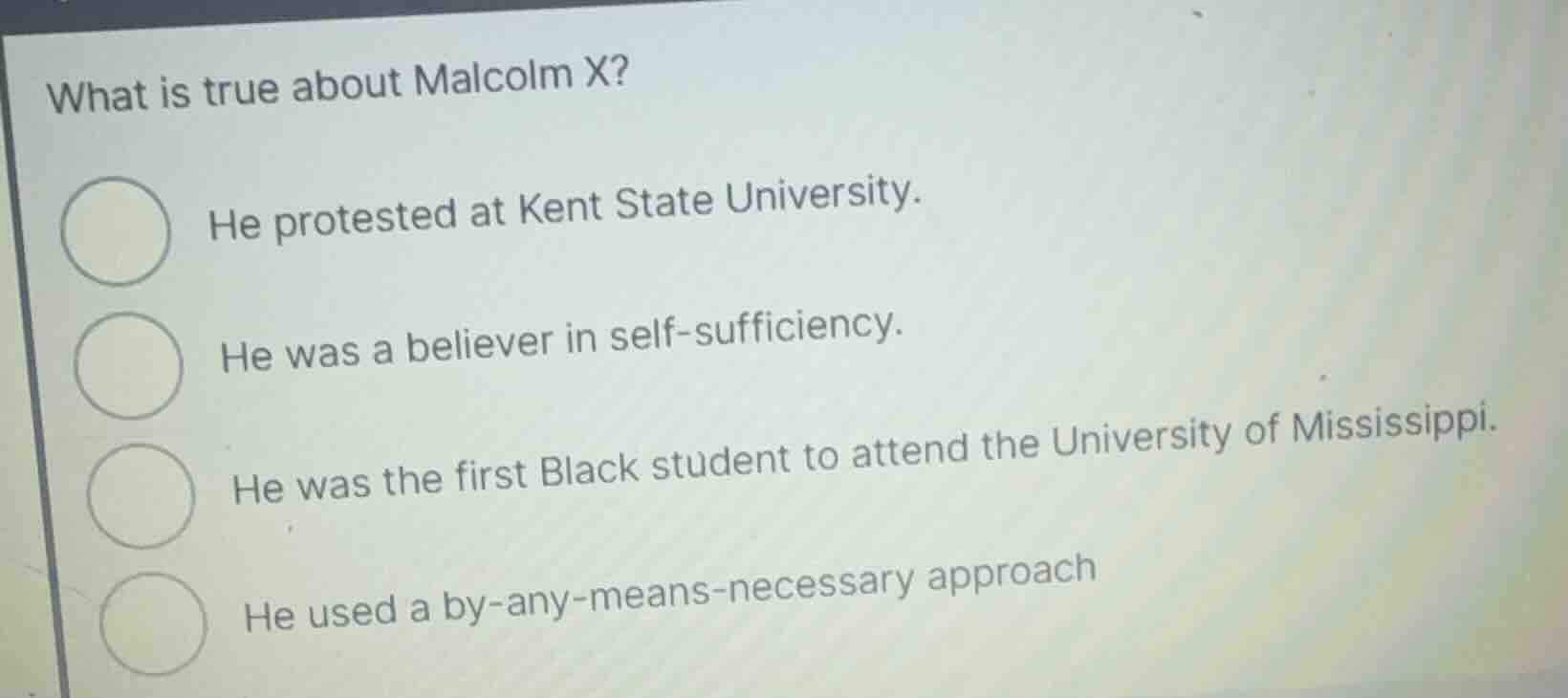
what is true about malcolm x?
he protested at kent state university.
he was a believer in self-sufficiency.
he was the first black student to attend the university of mississippi.
he used a by-any-means-necessary approach
Analyze the historical figure
Malcolm X was a prominent leader in the Civil Rights Movement and a key architect of Black Nationalism. He advocated for self-defense, racial pride, and economic and social self-reliance.
Evaluate the options
- "He protested at Kent State University." This is incorrect. The Kent State protests occurred in 1970, primarily involving students protesting the Vietnam War, years after Malcolm X's death in 1965.
- "He was a believer in self-sufficiency." This is historically true. Malcolm X strongly advocated for Black self-reliance, economic independence, and community self-sufficiency, which heavily influenced the subsequent Black Power movement.
- "He was the first Black student to attend the University of Mississippi." This is incorrect. James Meredith was the first Black student to integrate the University of Mississippi in 1962.
- "He used a by-any-means-necessary approach" This is also a highly famous and true statement associated with Malcolm X's philosophy on achieving justice and equality.
Resolve the best fit
In standard US History curricula, both self-sufficiency and the "by any means necessary" philosophy are central to Malcolm X's teachings. Looking closely at typical assessment questions of this format, his advocacy for Black self-sufficiency and self-reliance is a primary conceptual definition of his ideology alongside his famous declaration to secure freedom "by any means necessary." Let's provide the full context for these options.

Snap & solve any problem in the app
Get step-by-step solutions on Sovi AI
Photo-based solutions with guided steps
Explore more problems and detailed explanations
- He protested at Kent State University.
- He was a believer in self-sufficiency. (Correct answer)
- He was the first Black student to attend the University of Mississippi.
- He used a by-any-means-necessary approach