QUESTION IMAGE
Question
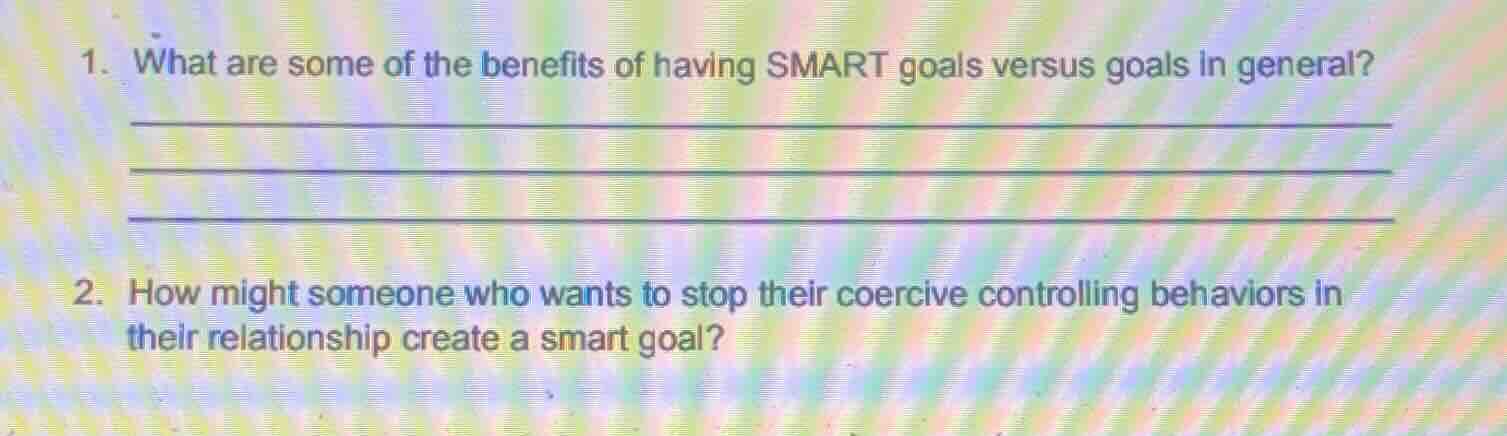
- what are some of the benefits of having smart goals versus goals in general?
- how might someone who wants to stop their coercive controlling behaviors in their relationship create a smart goal?
Define SMART goals and general goals
SMART goals are Specific, Measurable, Achievable, Relevant, and Time-bound, whereas general goals are often vague, open-ended, and lack a clear roadmap. By structuring objectives with these five criteria, individuals can track progress and maintain focus.
Analyze benefits of SMART goals
Using SMART goals provides clarity, increases motivation, and establishes accountability. In Behavioral Therapy and Cognitive Behavioral Therapy, breaking down broad desires into actionable steps helps individuals monitor behavioral changes systematically and recognize incremental success.
Apply SMART criteria to coercive control
To address coercive controlling behaviors, a person must replace vague intentions (e.g., "being a better partner") with concrete actions. This involves identifying specific triggers, tracking communication patterns, and practicing healthy Relationship Communication techniques.
Construct a sample SMART goal
A structured goal might focus on eliminating a specific controlling behavior, such as checking a partner's phone or demanding constant updates. The goal must specify what will be done, how it will be measured, and the timeframe for evaluation.

Snap & solve any problem in the app
Get step-by-step solutions on Sovi AI
Photo-based solutions with guided steps
Explore more problems and detailed explanations
Question 1
SMART goals (Specific, Measurable, Achievable, Relevant, Time-bound) provide a clear, structured roadmap that vague, general goals lack. Key benefits include:
- Clarity and Focus: They define exactly what needs to be accomplished, reducing ambiguity.
- Measurability: They establish concrete criteria for tracking progress and recognizing success.
- Accountability and Motivation: Setting a specific timeframe creates a sense of urgency and keeps individuals committed to their objectives.
Question 2
An individual wanting to stop coercive controlling behaviors can create a SMART goal by focusing on a specific, measurable action to improve relationship dynamics:
- Specific: "I will stop checking my partner's phone and asking for constant location updates."
- Measurable: "I will track my daily behavior in a journal and discuss my progress in weekly therapy sessions."
- Achievable: "I will practice self-soothing techniques when feeling anxious instead of acting on controlling urges."
- Relevant: "This will help rebuild trust and foster healthier, respectful communication in my relationship."
- Time-bound: "I will maintain this practice consistently for the next 30 days and review my progress with my therapist."