QUESTION IMAGE
Question
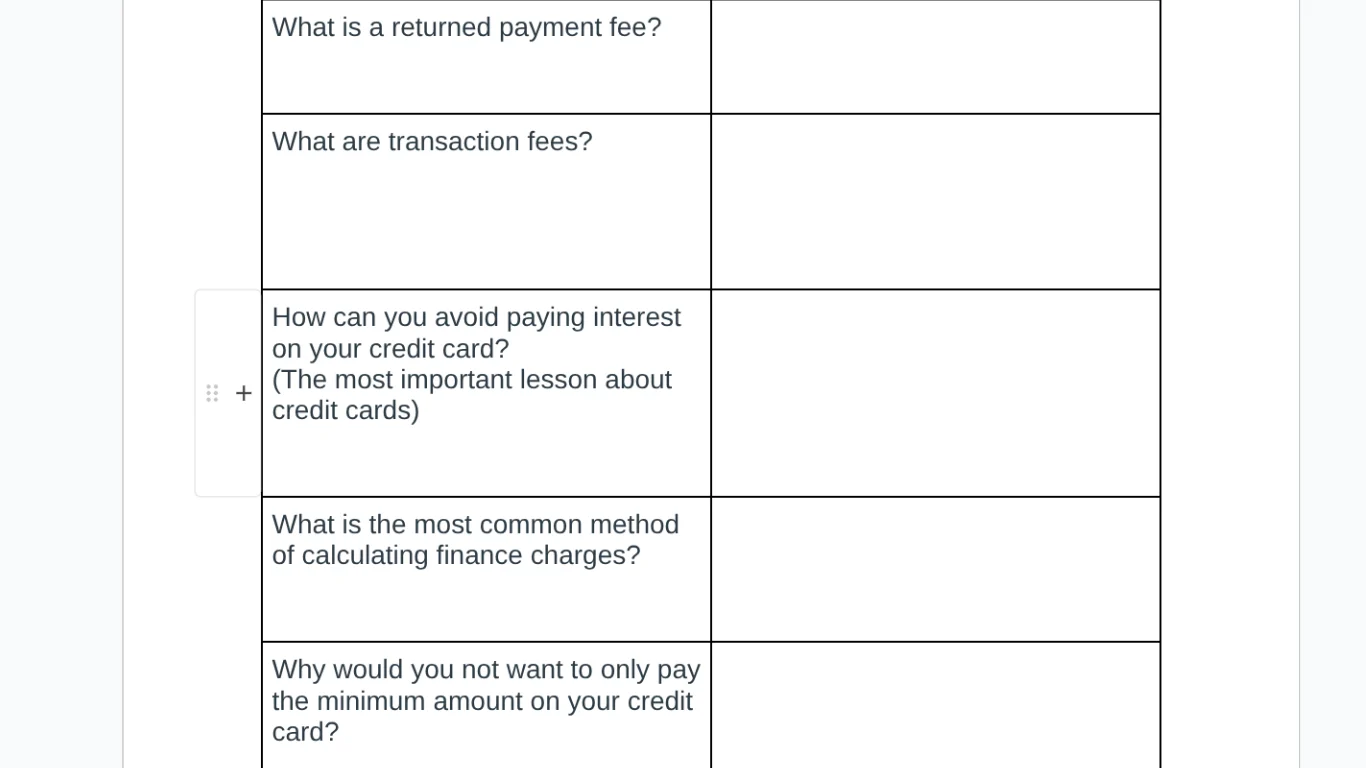
what is a returned payment fee?
what are transaction fees?
how can you avoid paying interest on your credit card? (the most important lesson about credit cards)
what is the most common method of calculating finance charges?
why would you not want to only pay the minimum amount on your credit card?
Since the problem here is to explain these financial - related questions (which fall under the Business discipline, specifically the sub - field of Finance), we will use the Answer - Explanation Format.
1. What is a returned payment fee?
A returned payment fee is a charge imposed by a financial institution (like a bank or credit card issuer) when a payment made from an account (such as a check or an electronic payment) is not honored. This can happen if there are insufficient funds in the account, or if the account is closed, or for other reasons that make the payment unable to be processed. For example, if you write a check to pay your credit card bill but there isn't enough money in your checking account, the credit card company may charge you a returned payment fee.
Transaction fees are charges associated with a financial transaction. In the context of credit cards, they can be fees for using the card for certain types of transactions like cash advances (when you withdraw cash using your credit card), balance transfers (when you transfer a balance from one credit card to another), or for transactions made internationally (foreign transaction fees). Different financial institutions and different types of financial products (like debit cards, credit cards, or bank accounts) may have different transaction fees. For example, a credit card may charge a 3% fee for a balance transfer.
To avoid paying interest on a credit card, you should pay the full statement balance by the due date each month. Credit card companies typically offer a grace period (usually around 21 - 25 days) during which if you pay the entire amount you owe (the statement balance) from the previous billing cycle, no interest will be charged on the purchases made in that cycle. If you only pay the minimum amount or a portion of the balance, interest will be charged on the remaining balance. Also, avoid cash advances and balance transfers if you want to minimize interest - related costs, as these often start accruing interest immediately with no grace period.

Snap & solve any problem in the app
Get step-by-step solutions on Sovi AI
Photo-based solutions with guided steps
Explore more problems and detailed explanations
A returned payment fee is a charge by a financial institution when a payment (e.g., check, electronic) is not honored (e.g., due to insufficient funds, closed account).