QUESTION IMAGE
Question
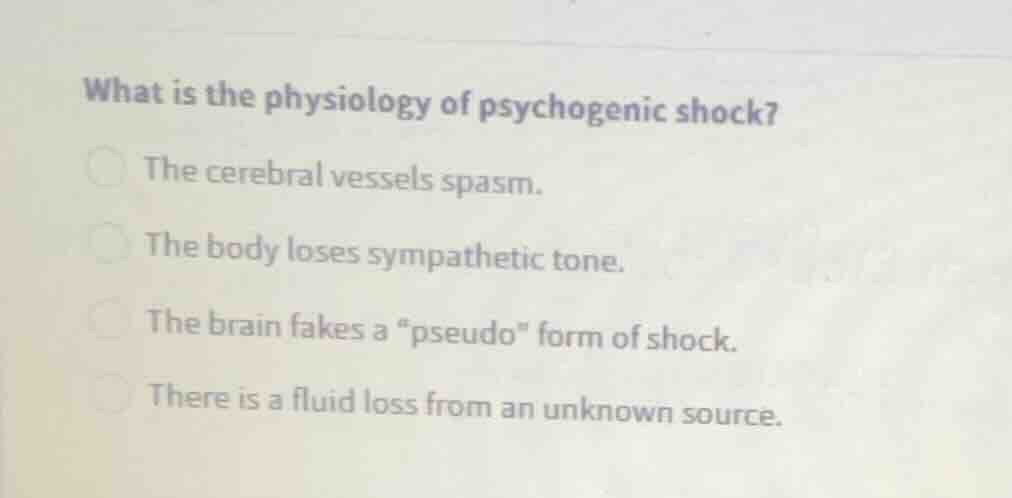
what is the physiology of psychogenic shock?
the cerebral vessels spasm.
the body loses sympathetic tone.
the brain fakes a \pseudo\ form of shock.
there is a fluid loss from an unknown source.
<pre_analysis>
{
"quality": "clear",
"question_count": 1,
"skills_matched": [
"direct_cot",
"multiple_choice_formatter",
"explain_then_answer",
"tutor"
],
"needs_drawing": false,
"concepts_used": [
"Shock Stages"
],
"new_concepts": [
"Psychogenic Shock Physiology",
"Autonomic Nervous System Regulation"
],
"current_concepts": [
"Shock Stages",
"Psychogenic Shock Physiology",
"Autonomic Nervous System Regulation"
]
}
</pre_analysis>
<reasoning>
Define psychogenic shock
Psychogenic shock is a sudden, temporary reduction in blood flow to the brain that leads to fainting (syncope). It is typically triggered by psychological factors such as extreme fear, bad news, or the sight of blood.
Analyze the physiological mechanism
When a psychological trigger occurs, the autonomic nervous system is suddenly disrupted. Specifically, there is a temporary, rapid reduction in sympathetic nervous system activity (loss of sympathetic tone) alongside an increase in parasympathetic (vagal) activity.
Evaluate the options
- The cerebral vessels spasm: This is incorrect; cerebral vasospasm is not the primary mechanism of psychogenic shock.
- The body loses sympathetic tone: This is correct. The sudden loss of sympathetic tone leads to widespread vasodilation, causing blood to pool in the vascular beds, reducing venous return, and decreasing perfusion to the brain, which results in syncope.
- The brain fakes a "pseudo" form of shock: This is incorrect; while "psychogenic" refers to the mind, the physiological response (vasodilation and syncope) is real, not faked.
- There is a fluid loss from an unknown source: This is incorrect; fluid loss is characteristic of hypovolemic shock, not psychogenic shock.
Connect to shock physiology
Using the Shock Stages knowledge point, we understand that shock is inadequate tissue perfusion. In psychogenic shock, this hypoperfusion is transient and caused by neurogenic/vasomotor dysfunction (loss of sympathetic tone) rather than fluid loss or mechanical obstruction.
</reasoning>
<answer>
<mcq-option>(A) The cerebral vessels spasm.</mcq-option>
<mcq-correct>(B) The body loses sympathetic tone.</mcq-correct>
<mcq-option>(C) The brain fakes a "pseudo" form of shock.</mcq-option>
<mcq-option>(D) There is a fluid loss from an unknown source.</mcq-option>
</answer>
<post_analysis>
{
"subject": "Natural Science",
"question_type": "Multiple Choice",
"knowledge_point": [
"Natural Science",
"Medicine",
"Psychogenic Shock Physiology"
]
}
</post_analysis>
Snap & solve any problem in the app
Get step-by-step solutions on Sovi AI
Photo-based solutions with guided steps
Explore more problems and detailed explanations
<pre_analysis>
{
"quality": "clear",
"question_count": 1,
"skills_matched": [
"direct_cot",
"multiple_choice_formatter",
"explain_then_answer",
"tutor"
],
"needs_drawing": false,
"concepts_used": [
"Shock Stages"
],
"new_concepts": [
"Psychogenic Shock Physiology",
"Autonomic Nervous System Regulation"
],
"current_concepts": [
"Shock Stages",
"Psychogenic Shock Physiology",
"Autonomic Nervous System Regulation"
]
}
</pre_analysis>
<reasoning>
Define psychogenic shock
Psychogenic shock is a sudden, temporary reduction in blood flow to the brain that leads to fainting (syncope). It is typically triggered by psychological factors such as extreme fear, bad news, or the sight of blood.
Analyze the physiological mechanism
When a psychological trigger occurs, the autonomic nervous system is suddenly disrupted. Specifically, there is a temporary, rapid reduction in sympathetic nervous system activity (loss of sympathetic tone) alongside an increase in parasympathetic (vagal) activity.
Evaluate the options
- The cerebral vessels spasm: This is incorrect; cerebral vasospasm is not the primary mechanism of psychogenic shock.
- The body loses sympathetic tone: This is correct. The sudden loss of sympathetic tone leads to widespread vasodilation, causing blood to pool in the vascular beds, reducing venous return, and decreasing perfusion to the brain, which results in syncope.
- The brain fakes a "pseudo" form of shock: This is incorrect; while "psychogenic" refers to the mind, the physiological response (vasodilation and syncope) is real, not faked.
- There is a fluid loss from an unknown source: This is incorrect; fluid loss is characteristic of hypovolemic shock, not psychogenic shock.
Connect to shock physiology
Using the Shock Stages knowledge point, we understand that shock is inadequate tissue perfusion. In psychogenic shock, this hypoperfusion is transient and caused by neurogenic/vasomotor dysfunction (loss of sympathetic tone) rather than fluid loss or mechanical obstruction.
</reasoning>
<answer>
<mcq-option>(A) The cerebral vessels spasm.</mcq-option>
<mcq-correct>(B) The body loses sympathetic tone.</mcq-correct>
<mcq-option>(C) The brain fakes a "pseudo" form of shock.</mcq-option>
<mcq-option>(D) There is a fluid loss from an unknown source.</mcq-option>
</answer>
<post_analysis>
{
"subject": "Natural Science",
"question_type": "Multiple Choice",
"knowledge_point": [
"Natural Science",
"Medicine",
"Psychogenic Shock Physiology"
]
}
</post_analysis>