QUESTION IMAGE
Question
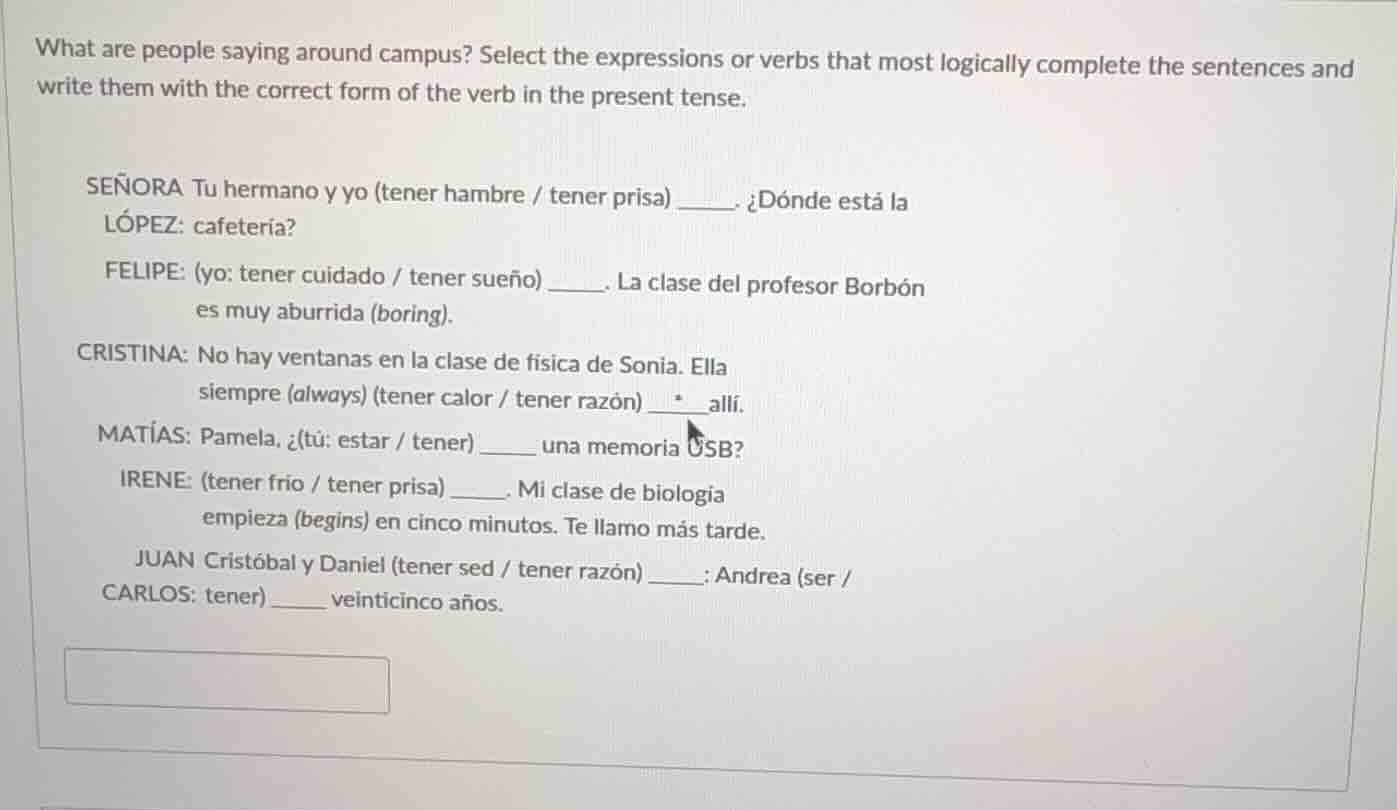
what are people saying around campus? select the expressions or verbs that most logically complete the sentences and write them with the correct form of the verb in the present tense.
señora lópez: tu hermano y yo (tener hambre / tener prisa) _____. ¿dónde está la cafetería?
felipe: (yo: tener cuidado / tener sueño) _____. la clase del profesor borbón es muy aburrida (boring).
cristina: no hay ventanas en la clase de física de sonia. ella siempre (always) (tener calor / tener razón) _____ allí.
matías: pamela, ¿(tú: estar / tener) _____ una memoria usb?
irene: (tener frío / tener prisa) _____. mi clase de biología empieza (begins) en cinco minutos. te llamo más tarde.
juan carlos: cristóbal y daniel (tener sed / tener razón) ___; andrea (ser / tener) ___ veinticinco años.
Analyze Señora López's statement
The prompt asks where the cafeteria is, which relates to food. Therefore, "tener hambre" (to be hungry) is more logical than "tener prisa" (to be in a hurry). The subject is "Tu hermano y yo" (Your brother and I), which corresponds to the first-person plural "nosotros". We apply Spanish Verb Conjugation and Spanish Idiomatic Expressions with Tener to conjugate "tener" as "tenemos".
The complete phrase is: "tenemos hambre".
Analyze Felipe's statement
Felipe mentions that Professor Borbón's class is very boring ("muy aburrida"). This logically causes sleepiness ("tener sueño") rather than caution ("tener cuidado"). The subject is "yo" (I). We apply Spanish Idiomatic Expressions with Tener and conjugate "tener" for "yo" in the present tense, which is "tengo".
The complete phrase is: "tengo sueño".
Analyze Cristina's statement
Cristina mentions there are no windows ("No hay ventanas") in Sonia's physics class. A room with no windows is likely to feel hot, so "tener calor" (to feel hot) is more logical than "tener razón" (to be right). The subject is "Ella" (She). We apply Spanish Idiomatic Expressions with Tener and conjugate "tener" for "ella", which is "tiene".
The complete phrase is: "tiene calor".
Analyze Matías's statement
Matías asks Pamela if she has a USB flash drive ("una memoria USB"). In Spanish, possession of an object uses the verb "tener" rather than "estar". This requires Tener vs Estar and Spanish Verb Conjugation. The subject is "tú" (you, informal). Conjugating "tener" for "tú" gives "tienes".
The complete phrase is: "tienes".
Analyze Irene's statement
Irene mentions her biology class starts in five minutes ("empieza en cinco minutos") and she will call later. This indicates she is in a rush, making "tener prisa" (to be in a hurry) more logical than "tener frío" (to be cold). The subject is implied to be "yo" (I) based on "Te llamo más tarde" (I'll call you later). We apply Spanish Idiomatic Expressions with Tener and conjugate "tener" for "yo", which is "tengo".
The complete phrase is: "tengo prisa".
Analyze Juan Carlos's statement
The statement has two blanks.
- For "Cristóbal y Daniel (tener sed / tener razón)": The context of the second part mentions age, but the first part is a standalone statement about Cristóbal and Daniel. Without a context of correctness, "tener sed" (to be thirsty) is the standard logical choice for a physical state. The subject is "Cristóbal y Daniel" (they / ellos). Conjugating "tener" gives "tienen". The complete phrase is "tienen sed".
- For "Andrea (ser / tener) ______ veinticinco años": In Spanish, expressing age always uses the verb "tener" (Tener Expressions). The subject is "Andrea" (she / ella). Conjugating "tener" for "ella" gives "tiene".

Snap & solve any problem in the app
Get step-by-step solutions on Sovi AI
Photo-based solutions with guided steps
Explore more problems and detailed explanations
Question 1
SEÑORA LÓPEZ: Tu hermano y yo (tener hambre / tener prisa) tenemos hambre. ¿Dónde está la cafetería?
Question 2
FELIPE: (yo: tener cuidado / tener sueño) tengo sueño. La clase del profesor Borbón es muy aburrida (boring).
Question 3
CRISTINA: No hay ventanas en la clase de física de Sonia. Ella siempre (always) (tener calor / tener razón) tiene calor allí.
Question 4
MATÍAS: Pamela, ¿(tú: estar / tener) tienes una memoria USB?
Question 5
IRENE: (tener frío / tener prisa) tengo prisa. Mi clase de biología empieza (begins) en cinco minutos. Te llamo más tarde.
Question 6
JUAN CARLOS: Cristóbal y Daniel (tener sed / tener razón) tienen sed; Andrea (ser / tener) tiene veinticinco años.