QUESTION IMAGE
Question
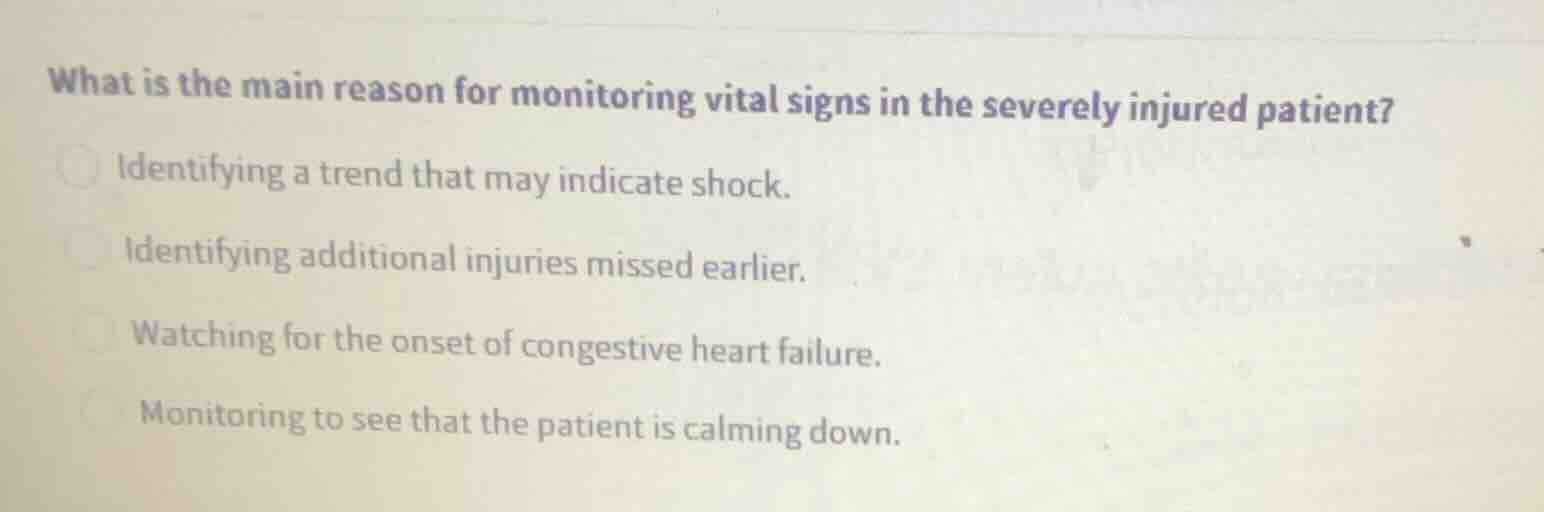
what is the main reason for monitoring vital signs in the severely injured patient?
identifying a trend that may indicate shock.
identifying additional injuries missed earlier.
watching for the onset of congestive heart failure.
monitoring to see that the patient is calming down.
<pre_analysis>
{
"quality": "clear",
"question_count": 1,
"skills_matched": [
"direct_cot",
"multiple_choice_formatter",
"explain_then_answer",
"tutor",
"mastery_adaptive_brevity"
],
"needs_drawing": false,
"concepts_used": [
"Shock Stages",
"Patient Assessment Protocols"
],
"new_concepts": [
"Vital Signs Monitoring",
"Trauma Patient Assessment"
],
"current_concepts": [
"Shock Stages",
"Patient Assessment Protocols",
"Vital Signs Monitoring",
"Trauma Patient Assessment"
]
}
</pre_analysis>
<reasoning>
Analyze the clinical objective
The question asks for the primary reason to monitor vital signs in a severely injured trauma patient. In emergency medicine, serial vital signs are critical for detecting physiological deterioration.
Evaluate the physiological significance of trends
Using the Shock Stages and Patient Assessment Protocols knowledge points
- A single set of vital signs is merely a baseline snapshot.
- Repeating vital signs allows the clinician to identify trends (e.g., rising heart rate, falling blood pressure, increasing respiratory rate).
- These trends are the earliest indicators of systemic decompensation and the onset of shock (such as hemorrhagic shock from internal bleeding).
Assess the incorrect options
- Identifying missed injuries is done via a thorough secondary assessment, not vital signs.
- Congestive heart failure is not the primary acute concern in a severely injured trauma patient.
- Monitoring to see if a patient is calming down is not the clinical priority for a severely injured patient.
</reasoning>
<answer>
<mcq-correct>Identifying a trend that may indicate shock.</mcq-correct>
<mcq-option>Identifying additional injuries missed earlier.</mcq-option>
<mcq-option>Watching for the onset of congestive heart failure.</mcq-option>
<mcq-option>Monitoring to see that the patient is calming down.</mcq-option>
</answer>
<post_analysis>
{
"subject": "Natural Science",
"question_type": "Multiple Choice",
"knowledge_point": [
"Natural Science",
"Medicine",
"Emergency Medical Services"
]
}
</post_analysis>
Snap & solve any problem in the app
Get step-by-step solutions on Sovi AI
Photo-based solutions with guided steps
Explore more problems and detailed explanations
<pre_analysis>
{
"quality": "clear",
"question_count": 1,
"skills_matched": [
"direct_cot",
"multiple_choice_formatter",
"explain_then_answer",
"tutor",
"mastery_adaptive_brevity"
],
"needs_drawing": false,
"concepts_used": [
"Shock Stages",
"Patient Assessment Protocols"
],
"new_concepts": [
"Vital Signs Monitoring",
"Trauma Patient Assessment"
],
"current_concepts": [
"Shock Stages",
"Patient Assessment Protocols",
"Vital Signs Monitoring",
"Trauma Patient Assessment"
]
}
</pre_analysis>
<reasoning>
Analyze the clinical objective
The question asks for the primary reason to monitor vital signs in a severely injured trauma patient. In emergency medicine, serial vital signs are critical for detecting physiological deterioration.
Evaluate the physiological significance of trends
Using the Shock Stages and Patient Assessment Protocols knowledge points
- A single set of vital signs is merely a baseline snapshot.
- Repeating vital signs allows the clinician to identify trends (e.g., rising heart rate, falling blood pressure, increasing respiratory rate).
- These trends are the earliest indicators of systemic decompensation and the onset of shock (such as hemorrhagic shock from internal bleeding).
Assess the incorrect options
- Identifying missed injuries is done via a thorough secondary assessment, not vital signs.
- Congestive heart failure is not the primary acute concern in a severely injured trauma patient.
- Monitoring to see if a patient is calming down is not the clinical priority for a severely injured patient.
</reasoning>
<answer>
<mcq-correct>Identifying a trend that may indicate shock.</mcq-correct>
<mcq-option>Identifying additional injuries missed earlier.</mcq-option>
<mcq-option>Watching for the onset of congestive heart failure.</mcq-option>
<mcq-option>Monitoring to see that the patient is calming down.</mcq-option>
</answer>
<post_analysis>
{
"subject": "Natural Science",
"question_type": "Multiple Choice",
"knowledge_point": [
"Natural Science",
"Medicine",
"Emergency Medical Services"
]
}
</post_analysis>