QUESTION IMAGE
Question
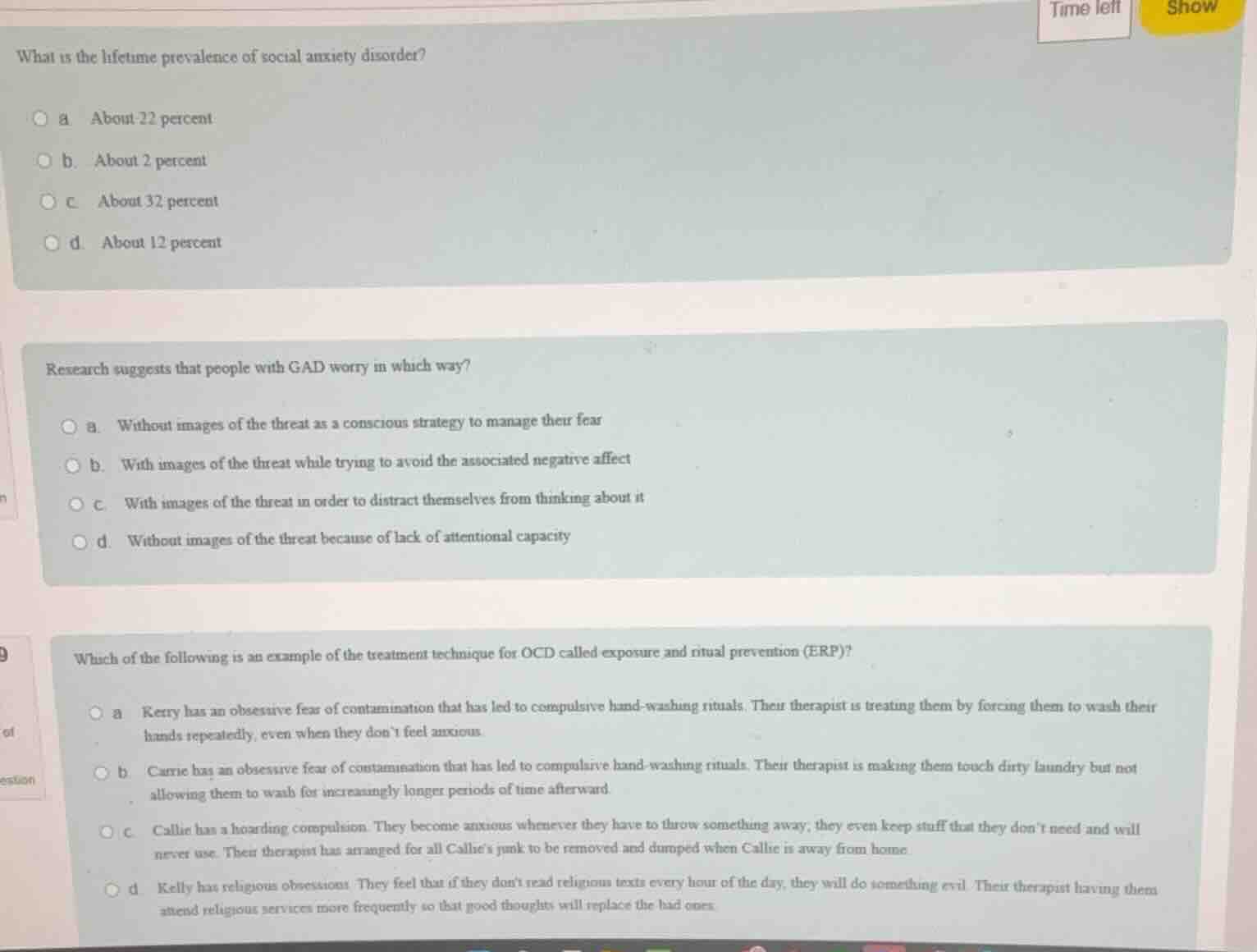
what is the lifetime prevalence of social anxiety disorder?
a. about 22 percent
b. about 2 percent
c. about 32 percent
d. about 12 percent
research suggests that people with gad worry in which way?
a. without images of the threat as a conscious strategy to manage their fear
b. with images of the threat while trying to avoid the associated negative affect
c. with images of the threat in order to distract themselves from thinking about it
d. without images of the threat because of lack of attentional capacity
which of the following is an example of the treatment technique for ocd called exposure and ritual prevention (erp)?
a. kerry has an obsessive fear of contamination that has led to compulsive hand-washing rituals. their therapist is treating them by forcing them to wash their hands repeatedly, even when they dont feel anxious.
b. carrie has an obsessive fear of contamination that has led to compulsive hand-washing rituals. their therapist is making them touch dirty laundry but not allowing them to wash for increasingly longer periods of time afterward.
c. callie has a hoarding compulsion. they become anxious whenever they have to throw something away; they even keep stuff that they dont need and will never use. their therapist has arranged for all callies junk to be removed and dumped when callie is away from home.
d. kelly has religious obsessions. they feel that if they dont read religious texts every hour of the day, they will do something evil. their therapist having them attend religious services more frequently so that good thoughts will replace the bad ones.
Analyze social anxiety disorder lifetime prevalence
This question asks for the lifetime prevalence of social anxiety disorder in the general population. According to epidemiological studies (such as the National Comorbidity Survey Replication), the lifetime prevalence of social anxiety disorder in the United States is approximately 12 percent. Therefore, option (d) is the correct choice.
Analyze cognitive mechanisms of worry in GAD
This question examines how individuals with Generalized Anxiety Disorder (GAD) worry. Borkovec's cognitive avoidance model of worry suggests that worry is a verbal-linguistic activity rather than an imagery-based one. Individuals with GAD worry primarily in words, without mental images of the threat, as a conscious or unconscious strategy to avoid the more distressing physiological activation associated with somatic imagery. Thus, option (a) is the correct choice.
Analyze Exposure and Ritual Prevention (ERP) for OCD
This question asks for an example of Exposure and Ritual Prevention (ERP), the gold-standard behavioral therapy for Obsessive-Compulsive Disorder (OCD). ERP involves exposing the individual to the feared stimulus (exposure) and preventing them from performing their typical compulsive behavior (ritual prevention).
- Option (b) describes Carrie being exposed to a contaminant (touching dirty laundry) and being prevented from performing her compulsive ritual (not washing her hands for increasingly longer periods). This perfectly illustrates ERP.

Snap & solve any problem in the app
Get step-by-step solutions on Sovi AI
Photo-based solutions with guided steps
Explore more problems and detailed explanations
Question 1
- a. About 22 percent
- b. About 2 percent
- c. About 32 percent
- d. About 12 percent (Correct answer)
Question 2
- a. Without images of the threat as a conscious strategy to manage their fear (Correct answer)
- b. With images of the threat while trying to avoid the associated negative affect
- c. With images of the threat in order to distract themselves from thinking about it
- d. Without images of the threat because of lack of attentional capacity
Question 3
- a. Kerry has an obsessive fear of contamination that has led to compulsive hand-washing rituals. Their therapist is treating them by forcing them to wash their hands repeatedly, even when they don't feel anxious.
- b. Carrie has an obsessive fear of contamination that has led to compulsive hand-washing rituals. Their therapist is making them touch dirty laundry but not allowing them to wash for increasingly longer periods of time afterward. (Correct answer)
- c. Callie has a hoarding compulsion. They become anxious whenever they have to throw something away, they even keep stuff that they don't need and will never use. Their therapist has arranged for all Callie's junk to be removed and dumped when Callie is away from home.
- d. Kelly has religious obsessions. They feel that if they don't read religious texts every hour of the day, they will do something evil. Their therapist having them attend religious services more frequently so that good thoughts will replace the bad ones.