QUESTION IMAGE
Question
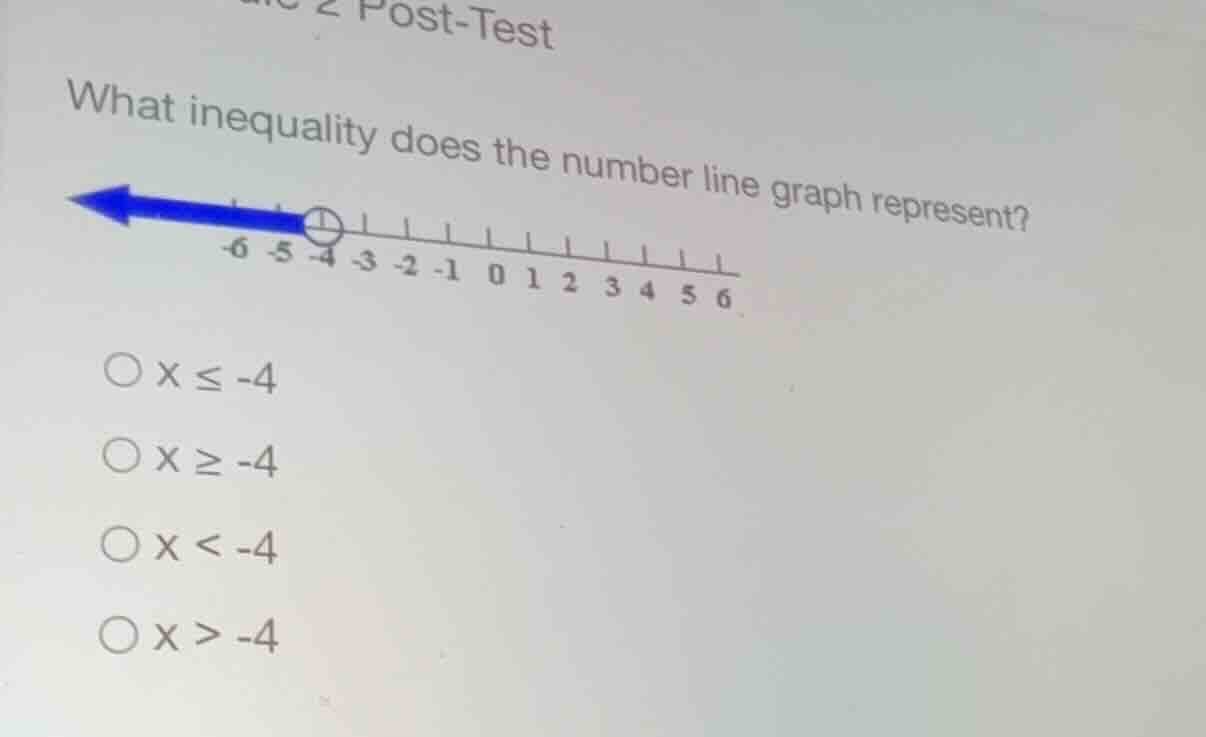
what inequality does the number line graph represent?
\\(x \le -4\\)
\\(x \ge -4\\)
\\(x < -4\\)
\\(x > -4\\)
Identify the boundary point
Using the Graphing Inequalities knowledge point
The boundary point on the number line is located at \(-4\). The circle at \(-4\) is open (unfilled), which indicates that the value \(-4\) itself is not included in the solution set. Therefore, we use a strict inequality: either \(<\) or \(>\).
Determine the direction of the inequality
Using the Linear Inequalities knowledge point
The blue arrow points to the left of \(-4\), covering values like \(-5\), \(-6\), and so on. This represents all numbers less than \(-4\). Thus, the inequality is:

Snap & solve any problem in the app
Get step-by-step solutions on Sovi AI
Photo-based solutions with guided steps
Explore more problems and detailed explanations
- \(x \le -4\)
- \(x \ge -4\)
- \(x < -4\) (Correct answer)
- \(x > -4\)