QUESTION IMAGE
Question
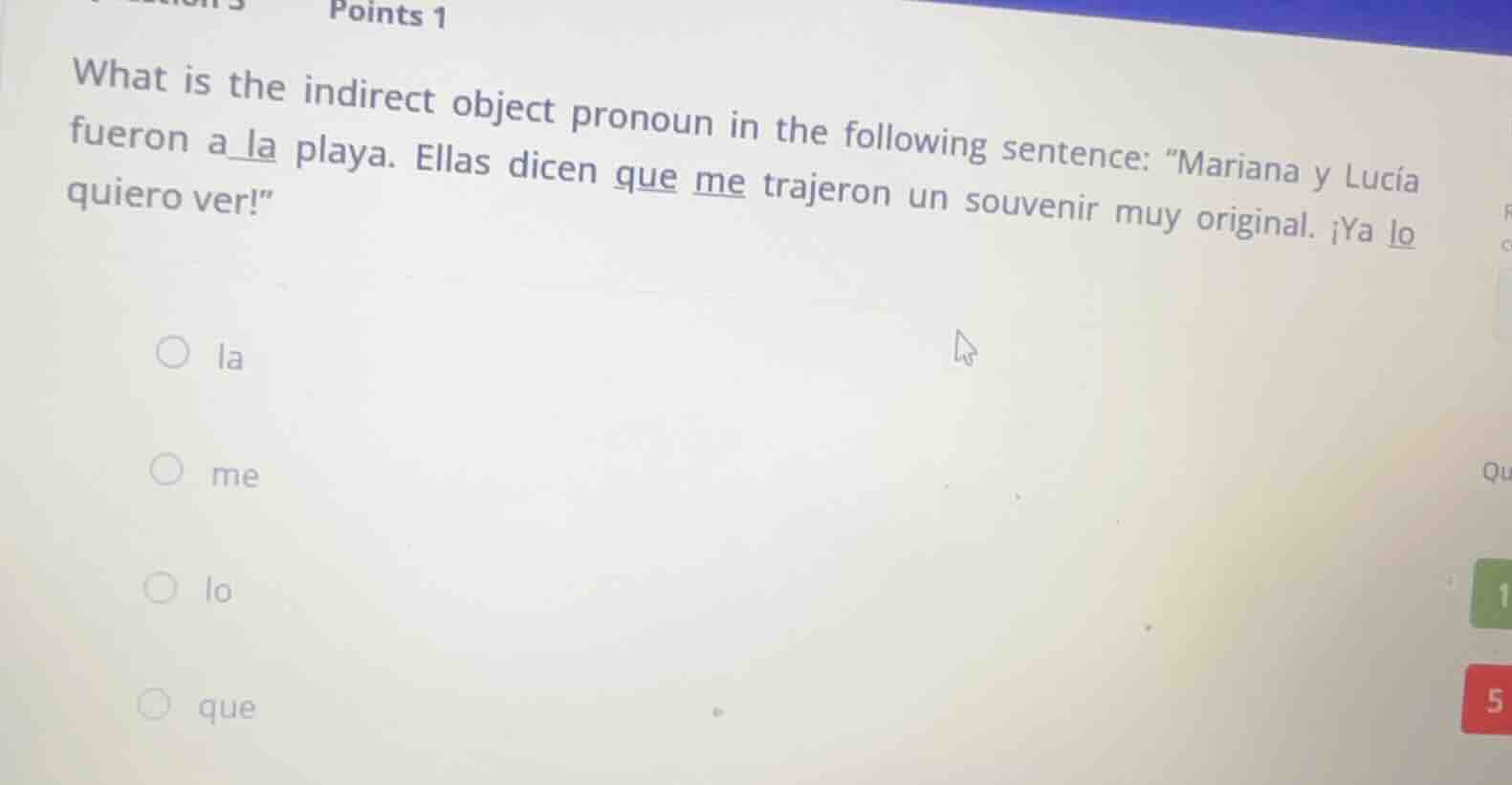
what is the indirect object pronoun in the following sentence: \mariana y lucía fueron a la playa. ellas dicen que me trajeron un souvenir muy original. ¡ya lo quiero ver!\
la
me
lo
que
<pre_analysis>
{
"quality": "clear",
"question_count": 1,
"skills_matched": [
"direct_cot",
"multiple_choice_formatter",
"explain_then_answer",
"tutor"
],
"needs_drawing": false,
"concepts_used": [
"Reading Comprehension"
],
"new_concepts": [
"Indirect Object Pronouns",
"Spanish Pronouns"
],
"current_concepts": [
"Reading Comprehension",
"Indirect Object Pronouns",
"Spanish Pronouns"
]
}
</pre_analysis>
<reasoning>
Analyze the sentence structure
Using our Reading Comprehension skills, we examine the provided Spanish sentence: "Mariana y Lucía fueron a la playa. Ellas dicen que me trajeron un souvenir muy original. ¡Ya lo quiero ver!"
Identify the underlined words
The sentence contains several underlined words: "la", "que", "me", and "lo". We need to determine which of these functions as an indirect object pronoun.
Evaluate each underlined option
- la: In "a la playa", "la" is a definite article ("the") modifying the noun "playa".
- que: In "dicen que...", "que" is a conjunction meaning "that".
- lo: In "lo quiero ver", "lo" is a direct object pronoun replacing "el souvenir" (it answers what I want to see).
- me: In "me trajeron un souvenir", "me" represents the recipient of the action (they brought a souvenir to me). This answers to whom or for whom the action was done.
Determine the indirect object pronoun
The pronoun "me" functions as the indirect object pronoun because it indicates the recipient of the direct object ("un souvenir").
</reasoning>
<answer>
<mcq-option>(A) la</mcq-option>
<mcq-correct>(B) me</mcq-correct>
<mcq-option>(C) lo</mcq-option>
<mcq-option>(D) que</mcq-option>
</answer>
<post_analysis>
{
"subject": "Arts",
"question_type": "Multiple Choice",
"knowledge_point": [
"Arts",
"Languages",
"Spanish Grammar"
]
}
</post_analysis>
Snap & solve any problem in the app
Get step-by-step solutions on Sovi AI
Photo-based solutions with guided steps
Explore more problems and detailed explanations
<pre_analysis>
{
"quality": "clear",
"question_count": 1,
"skills_matched": [
"direct_cot",
"multiple_choice_formatter",
"explain_then_answer",
"tutor"
],
"needs_drawing": false,
"concepts_used": [
"Reading Comprehension"
],
"new_concepts": [
"Indirect Object Pronouns",
"Spanish Pronouns"
],
"current_concepts": [
"Reading Comprehension",
"Indirect Object Pronouns",
"Spanish Pronouns"
]
}
</pre_analysis>
<reasoning>
Analyze the sentence structure
Using our Reading Comprehension skills, we examine the provided Spanish sentence: "Mariana y Lucía fueron a la playa. Ellas dicen que me trajeron un souvenir muy original. ¡Ya lo quiero ver!"
Identify the underlined words
The sentence contains several underlined words: "la", "que", "me", and "lo". We need to determine which of these functions as an indirect object pronoun.
Evaluate each underlined option
- la: In "a la playa", "la" is a definite article ("the") modifying the noun "playa".
- que: In "dicen que...", "que" is a conjunction meaning "that".
- lo: In "lo quiero ver", "lo" is a direct object pronoun replacing "el souvenir" (it answers what I want to see).
- me: In "me trajeron un souvenir", "me" represents the recipient of the action (they brought a souvenir to me). This answers to whom or for whom the action was done.
Determine the indirect object pronoun
The pronoun "me" functions as the indirect object pronoun because it indicates the recipient of the direct object ("un souvenir").
</reasoning>
<answer>
<mcq-option>(A) la</mcq-option>
<mcq-correct>(B) me</mcq-correct>
<mcq-option>(C) lo</mcq-option>
<mcq-option>(D) que</mcq-option>
</answer>
<post_analysis>
{
"subject": "Arts",
"question_type": "Multiple Choice",
"knowledge_point": [
"Arts",
"Languages",
"Spanish Grammar"
]
}
</post_analysis>