QUESTION IMAGE
Question
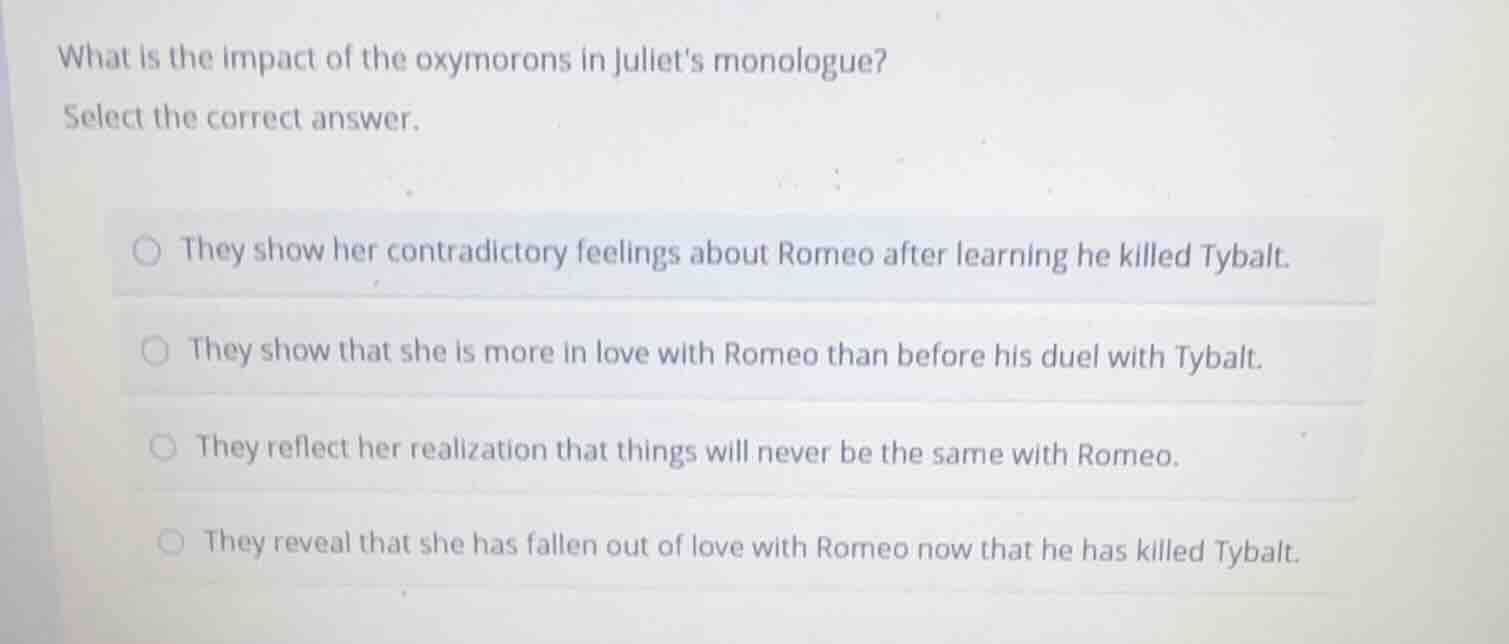
what is the impact of the oxymorons in juliets monologue?
select the correct answer.
they show her contradictory feelings about romeo after learning he killed tybalt.
they show that she is more in love with romeo than before his duel with tybalt.
they reflect her realization that things will never be the same with romeo.
they reveal that she has fallen out of love with romeo now that he has killed tybalt.
Analyze the function of oxymorons in Juliet's monologue
Juliet uses oxymorons (such as "beautiful tyrant," "fiend angelical," and "honorable villain") in Act 3, Scene 2 of Romeo and Juliet immediately after learning that Romeo has killed her cousin Tybalt.
Connect literary device to character emotion
The pairing of contradictory terms directly mirrors her internal conflict: she loves Romeo as her husband, yet she detests his violent action of killing her cousin.
Evaluate the given options
- Option 1 correctly identifies that these oxymorons express her contradictory, torn feelings about Romeo.
- Option 2 is incorrect because she is not simply "more in love."
- Option 3 is too vague and does not address the specific contradictory nature of oxymorons.
- Option 4 is incorrect because she has not completely fallen out of love; she is deeply conflicted.

Snap & solve any problem in the app
Get step-by-step solutions on Sovi AI
Photo-based solutions with guided steps
Explore more problems and detailed explanations
- (A) They show her contradictory feelings about Romeo after learning he killed Tybalt. (Correct answer)
- (B) They show that she is more in love with Romeo than before his duel with Tybalt.
- (C) They reflect her realization that things will never be the same with Romeo.
- (D) They reveal that she has fallen out of love with Romeo now that he has killed Tybalt.