QUESTION IMAGE
Question
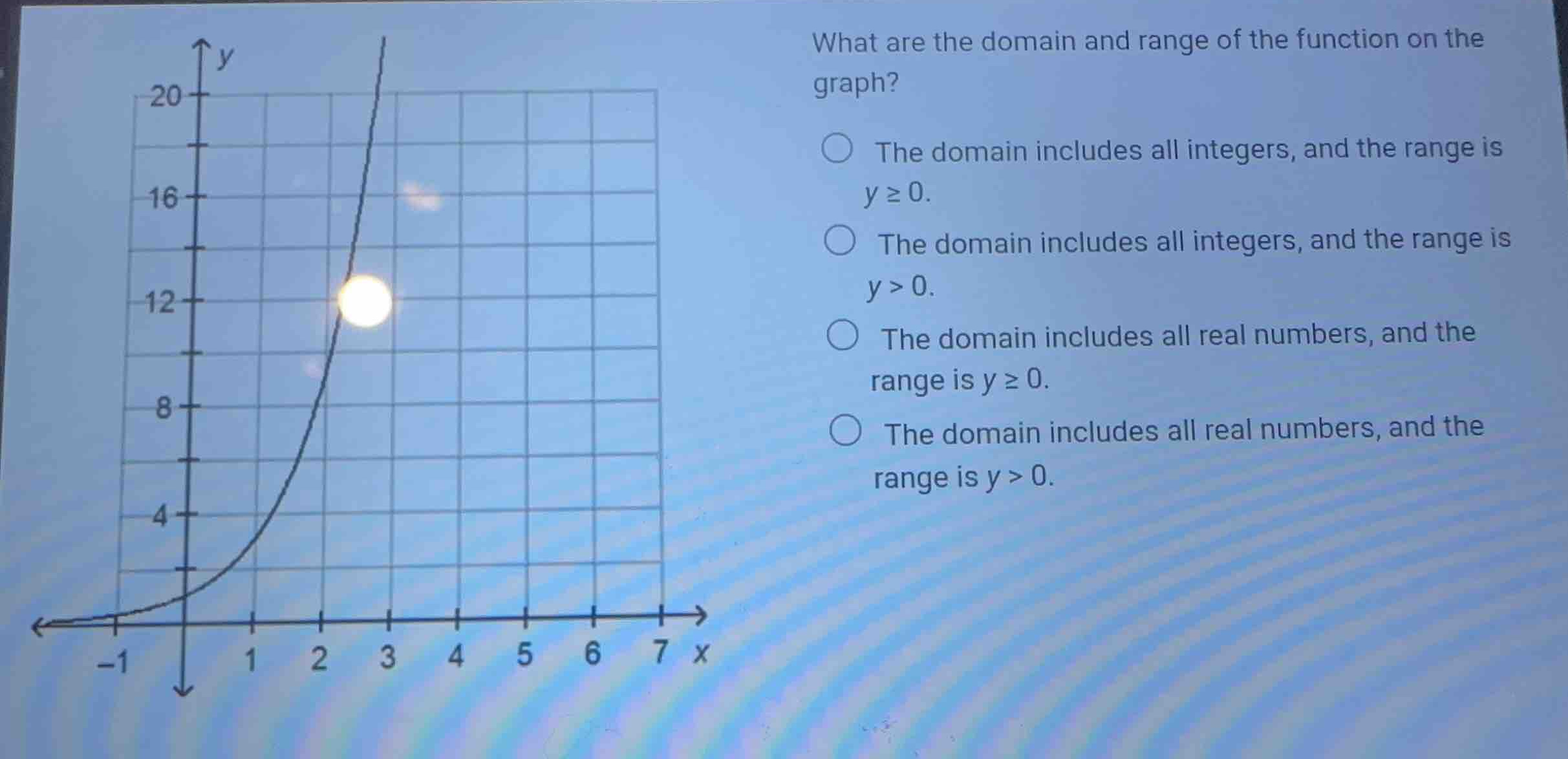
what are the domain and range of the function on the graph?
- the domain includes all integers, and the range is \\(y \ge 0\\).
- the domain includes all integers, and the range is \\(y > 0\\).
- the domain includes all real numbers, and the range is \\(y \ge 0\\).
- the domain includes all real numbers, and the range is \\(y > 0\\).
Identify the function type
The graph shows a continuous, smooth curve that increases rapidly as \(x\) increases. This represents a continuous exponential growth function.
Determine the domain
The curve extends infinitely to the left (towards negative infinity) and continues upward and to the right (towards positive infinity) without any breaks, holes, or jumps. Since the curve is continuous and defined for all real values of \(x\), the domain includes all real numbers.
Determine the range
The curve approaches the \(x\)-axis (\(y = 0\)) as an asymptote on the left but never actually touches or crosses it. As \(x\) increases, \(y\) increases toward positive infinity. Therefore, the function values are strictly greater than zero, meaning the range is \(y > 0\).
Match with options
We combine our findings:
- Domain: all real numbers
- Range: \(y > 0\)
This matches the fourth option.

Snap & solve any problem in the app
Get step-by-step solutions on Sovi AI
Photo-based solutions with guided steps
Explore more problems and detailed explanations
- The domain includes all integers, and the range is \(y \ge 0\).
- The domain includes all integers, and the range is \(y > 0\).
- The domain includes all real numbers, and the range is \(y \ge 0\).
- The domain includes all real numbers, and the range is \(y > 0\). (Correct answer)