QUESTION IMAGE
Question
what baroque style technique does the artist use in the composition above?
a. diagonally to create interest
b. horizontally to give a strong sense of space
c. diagonally to give a strong sense of space
d. vertically to give a strong sense of space
Identify the artwork and style
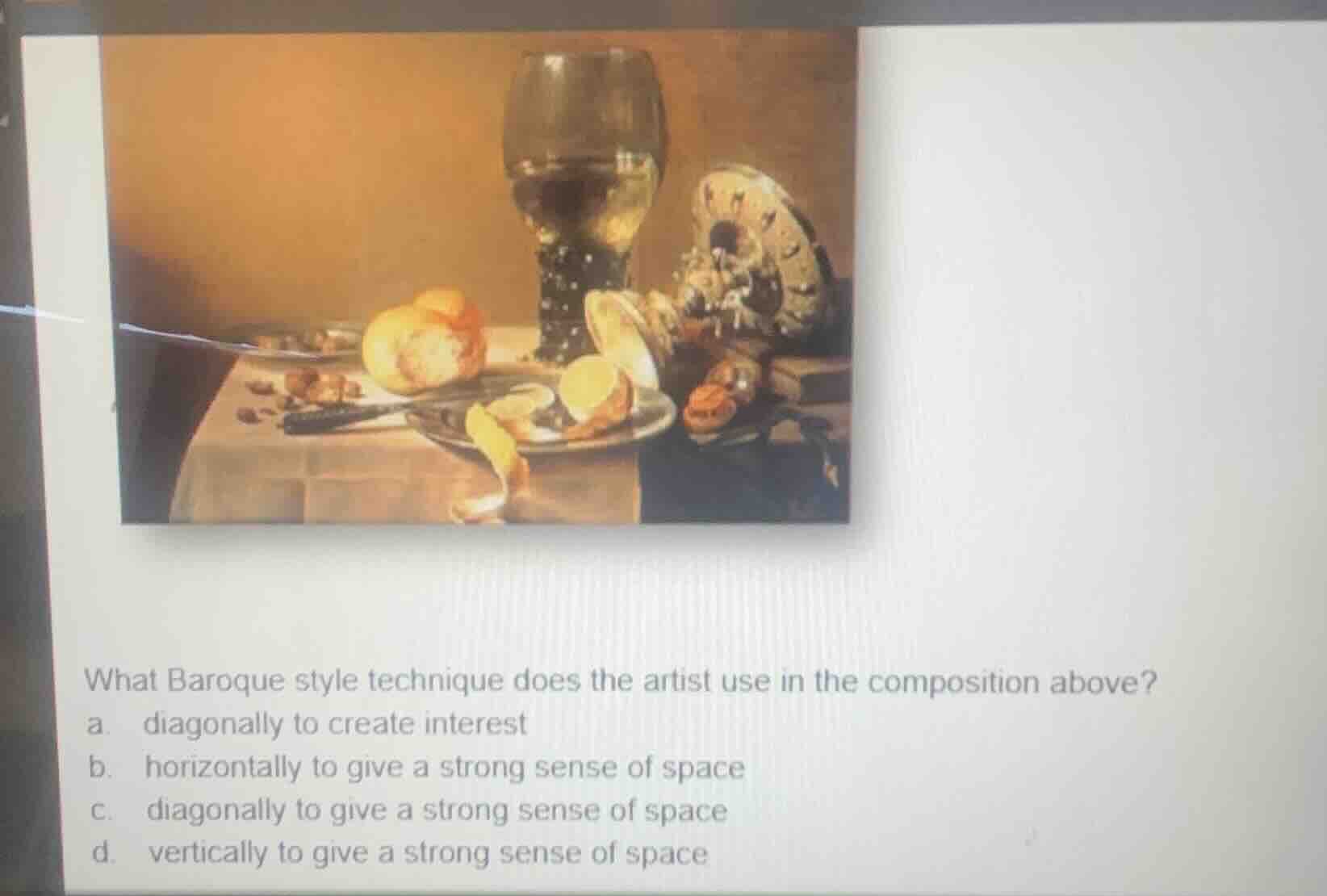
The image shows a classic Dutch Golden Age still life painting (specifically a pronkstilleven or banquet piece, featuring a roemer glass, a peeled lemon, and a tipped-over silver tazza). A hallmark of Baroque composition is the use of strong diagonal lines to guide the viewer's eye through the scene and create a dynamic, deep sense of space.
Analyze the compositional structure
The objects are arranged along a diagonal axis stretching from the lower left (the knife handle and peeled lemon rind hanging off the table edge) toward the upper right (the tipped-over tazza and the tall glass). This diagonal arrangement breaks away from the static horizontal/vertical stability of the Renaissance, creating a dynamic progression that leads the viewer's eye into the depth of the pictorial space.
Evaluate the options
- a. diagonally to create interest: While it creates interest, the primary structural purpose of the diagonal in Baroque still lifes is to establish depth and spatial recession.
- b. horizontally to give a strong sense of space: Horizontal lines tend to flatten space rather than create a dynamic sense of depth.
- c. diagonally to give a strong sense of space: This correctly identifies both the diagonal technique and its primary spatial function in Baroque compositions.
- d. vertically to give a strong sense of space: The composition is not structured vertically.

Snap & solve any problem in the app
Get step-by-step solutions on Sovi AI
Photo-based solutions with guided steps
Explore more problems and detailed explanations
- a. diagonally to create interest
- b. horizontally to give a strong sense of space
- c. diagonally to give a strong sense of space (Correct answer)
- d. vertically to give a strong sense of space