QUESTION IMAGE
Question
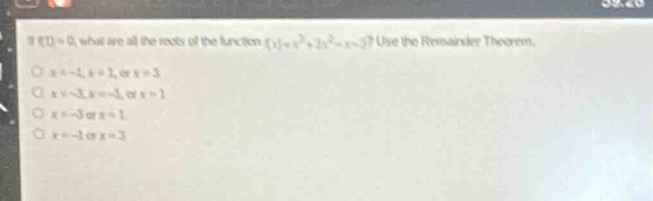
if \\(f(1) = 0\\), what are all the roots of the function \\(f(x) = x^3 + 3x^2 - x - 3\\)? use the remainder theorem.
\\(x = -1, x = 1, \text{ or } x = 3\\)
\\(x = -3, x = -1, \text{ or } x = 1\\)
\\(x = -3 \text{ or } x = 1\\)
\\(x = -1 \text{ or } x = 3\\)
🆕 New Concept Discovered: Polynomial Factor and Remainder Theorems
Using remainders to find factors and solve higher-degree equations.
Step 1: Identify the first root and factor
Since we are given that \( f(1) = 0 \), the Remainder Theorem (and Factor Theorem) tells us that \( x = 1 \) is a root of the function, and \( (x - 1) \) is a factor of:
Step 2: Divide the polynomial to find the remaining quadratic factor
We divide \( f(x) \) by \( (x - 1) \) using synthetic division:
The quotient is the quadratic expression:
Step 3: Factor the quadratic expression to find the remaining roots
Set the quadratic quotient to zero to find the other roots:
Factor the trinomial:
This gives the remaining roots:
Combining these with our first root \( x = 1 \), the complete set of roots is:

Snap & solve any problem in the app
Get step-by-step solutions on Sovi AI
Photo-based solutions with guided steps
Explore more problems and detailed explanations
\( x = -3, x = -1, \text{ or } x = 1 \)