QUESTION IMAGE
Question
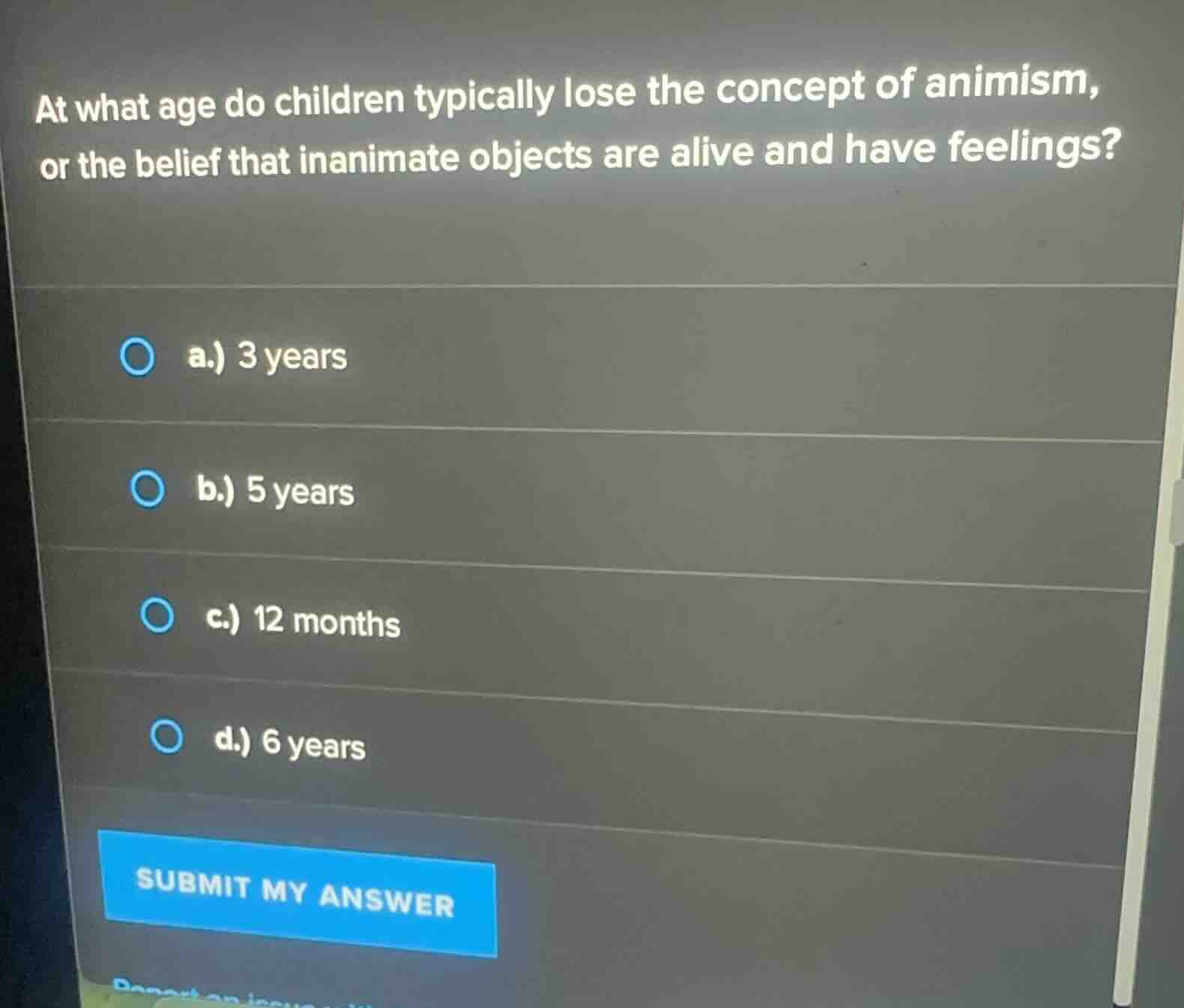
at what age do children typically lose the concept of animism, or the belief that inanimate objects are alive and have feelings?
a.) 3 years
b.) 5 years
c.) 12 months
d.) 6 years
Define animism and its developmental context
In Piagets Theory of Cognitive Development, animism is the belief that inanimate objects (such as toys, clouds, or the sun) have lifelike qualities, intentions, and feelings. This characteristic thinking is highly prominent during the preoperational stage, which typically spans from ages 2 to 7 years.
Identify when animism typically declines
As children grow, gain more experience with the physical world, and transition toward concrete operational thinking, they begin to distinguish between living and non-living things. Research in developmental psychology shows that children typically begin to lose or significantly grow out of this strict animistic thinking by around age 4 to 5, and it is largely resolved by age 5 as their biological understanding of life matures.
Evaluate the given options
- a.) 3 years: At this age, children are in the peak of the preoperational stage and strongly exhibit animism.
- b.) 5 years: By age 5, most children typically lose or transition away from general animistic beliefs as they develop a more realistic understanding of what is alive.
- c.) 12 months: Infants at 12 months are in the sensorimotor stage and do not yet possess the symbolic thought required for animism.
- d.) 6 years: While some subtle animism can persist, the typical milestone for losing this primary conceptual belief is around age 5.

Snap & solve any problem in the app
Get step-by-step solutions on Sovi AI
Photo-based solutions with guided steps
Explore more problems and detailed explanations
- a.) 3 years
- b.) 5 years (Correct answer)
- c.) 12 months
- d.) 6 years