QUESTION IMAGE
Question
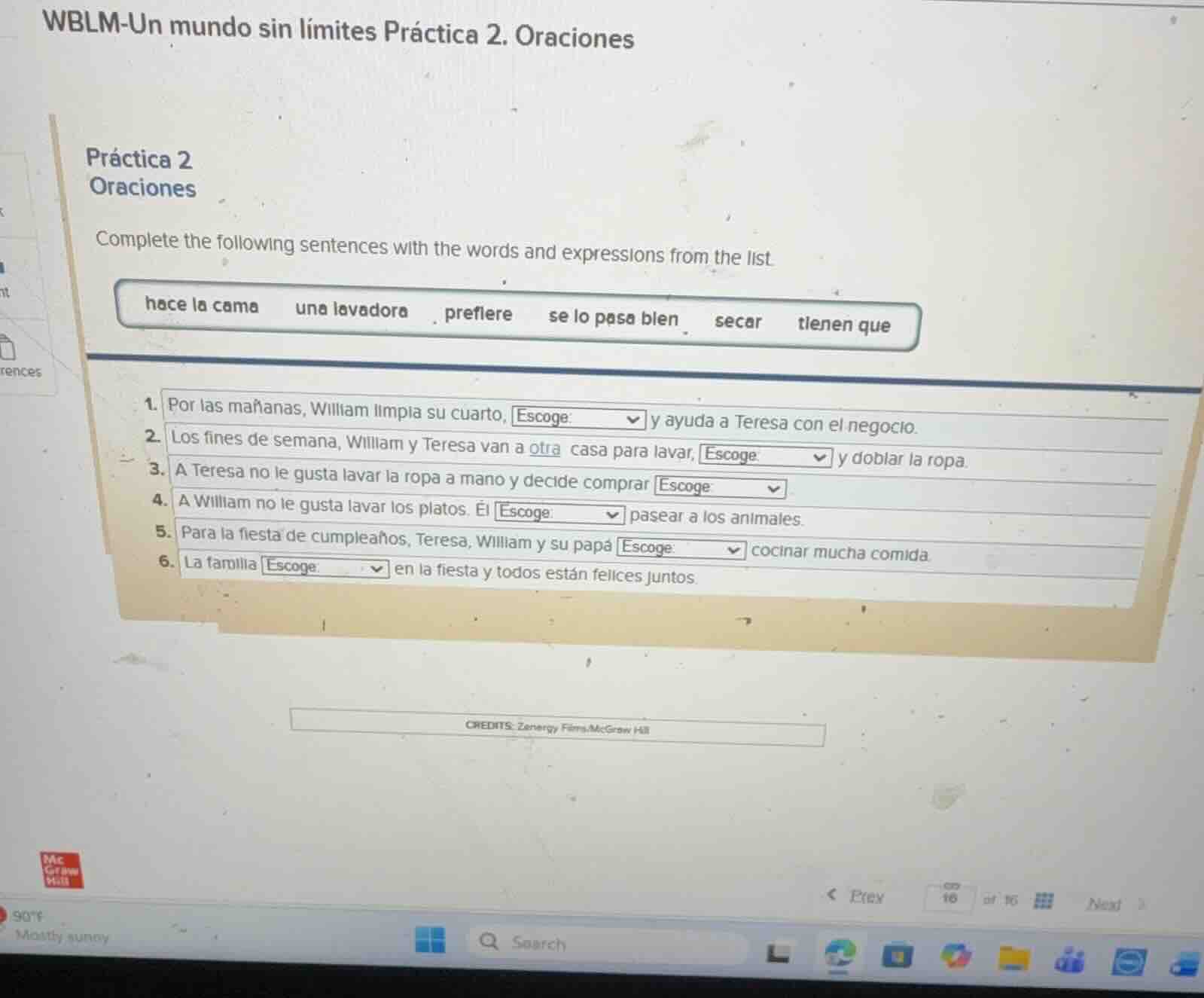
wblm-un mundo sin límites práctica 2. oraciones
práctica 2
oraciones
complete the following sentences with the words and expressions from the list.
hace la cama | una lavadora | prefiere | se lo pasa bien | secar | tienen que
- por las mañanas, william limpia su cuarto, escoge: y ayuda a teresa con el negocio.
- los fines de semana, william y teresa van a otra casa para lavar, escoge: y doblar la ropa.
- a teresa no le gusta lavar la ropa a mano y decide comprar escoge:
- a william no le gusta lavar los platos. él escoge: pasear a los animales.
- para la fiesta de cumpleaños, teresa, william y su papá escoge: cocinar mucha comida.
- la familia escoge: en la fiesta y todos están felices juntos.
Analyze sentence 1
Using the Spanish Household Chores and Spanish Household Verbs knowledge points
- Context: "Por las mañanas, William limpia su cuarto, [blank] y ayuda a Teresa con el negocio."
- Meaning: "In the mornings, William cleans his room, [blank] and helps Teresa with the business."
- Logical association: Cleaning a room is naturally paired with making the bed ("hace la cama").
Analyze sentence 2
Using the Spanish Household Chores and Spanish Logical Association knowledge points
- Context: "Los fines de semana, William y Teresa van a otra casa para lavar, [blank] y doblar la ropa."
- Meaning: "On weekends, William and Teresa go to another house to wash, [blank] and fold the clothes."
- Logical association: The sequence of doing laundry is washing ("lavar"), drying ("secar"), and folding ("doblar"). Thus, "secar" fits perfectly.
Analyze sentence 3
Using the Spanish Household Chores and Spanish Vocabulary knowledge points
- Context: "A Teresa no le gusta lavar la ropa a mano y decide comprar [blank]."
- Meaning: "Teresa does not like to wash clothes by hand and decides to buy [blank]."
- Logical association: To avoid washing clothes by hand, one buys a washing machine ("una lavadora").
Analyze sentence 4
Using the Spanish Contextual Verb Selection and Spanish Stem-Changing Verbs knowledge points
- Context: "A William no le gusta lavar los platos. Él [blank] pasear a los animales."
- Meaning: "William does not like to wash dishes. He [blank] to walk the animals."
- Logical association: Since he dislikes one chore, he prefers ("prefiere") the other.
Analyze sentence 5
Using the Spanish Contextual Verb Selection and Spanish Logical Association knowledge points
- Context: "Para la fiesta de cumpleaños, Teresa, William y su papá [blank] cocinar mucha comida."
- Meaning: "For the birthday party, Teresa, William, and their dad [blank] to cook a lot of food."
- Logical association: Preparing for a big party requires them to cook a lot of food. The plural subject matches "tienen que" (have to).
Analyze sentence 6
Using the Spanish Logical Association and Spanish Vocabulary knowledge points
- Context: "La familia [blank] en la fiesta y todos están felices juntos."
- Meaning: "The family [blank] at the party and everyone is happy together."
- Logical association: To express having a good time, the idiomatic expression "se lo pasa bien" (has a good time) is used.

Snap & solve any problem in the app
Get step-by-step solutions on Sovi AI
Photo-based solutions with guided steps
Explore more problems and detailed explanations
Question 1
Por las mañanas, William limpia su cuarto, <blank>hace la cama</blank> y ayuda a Teresa con el negocio.
Question 2
Los fines de semana, William y Teresa van a otra casa para lavar, <blank>secar</blank> y doblar la ropa.
Question 3
A Teresa no le gusta lavar la ropa a mano y decide comprar <blank>una lavadora</blank>.
Question 4
A William no le gusta lavar los platos. Él <blank>prefiere</blank> pasear a los animales.
Question 5
Para la fiesta de cumpleaños, Teresa, William y su papá <blank>tienen que</blank> cocinar mucha comida.
Question 6
La familia <blank>se lo pasa bien</blank> en la fiesta y todos están felices juntos.