QUESTION IMAGE
Question
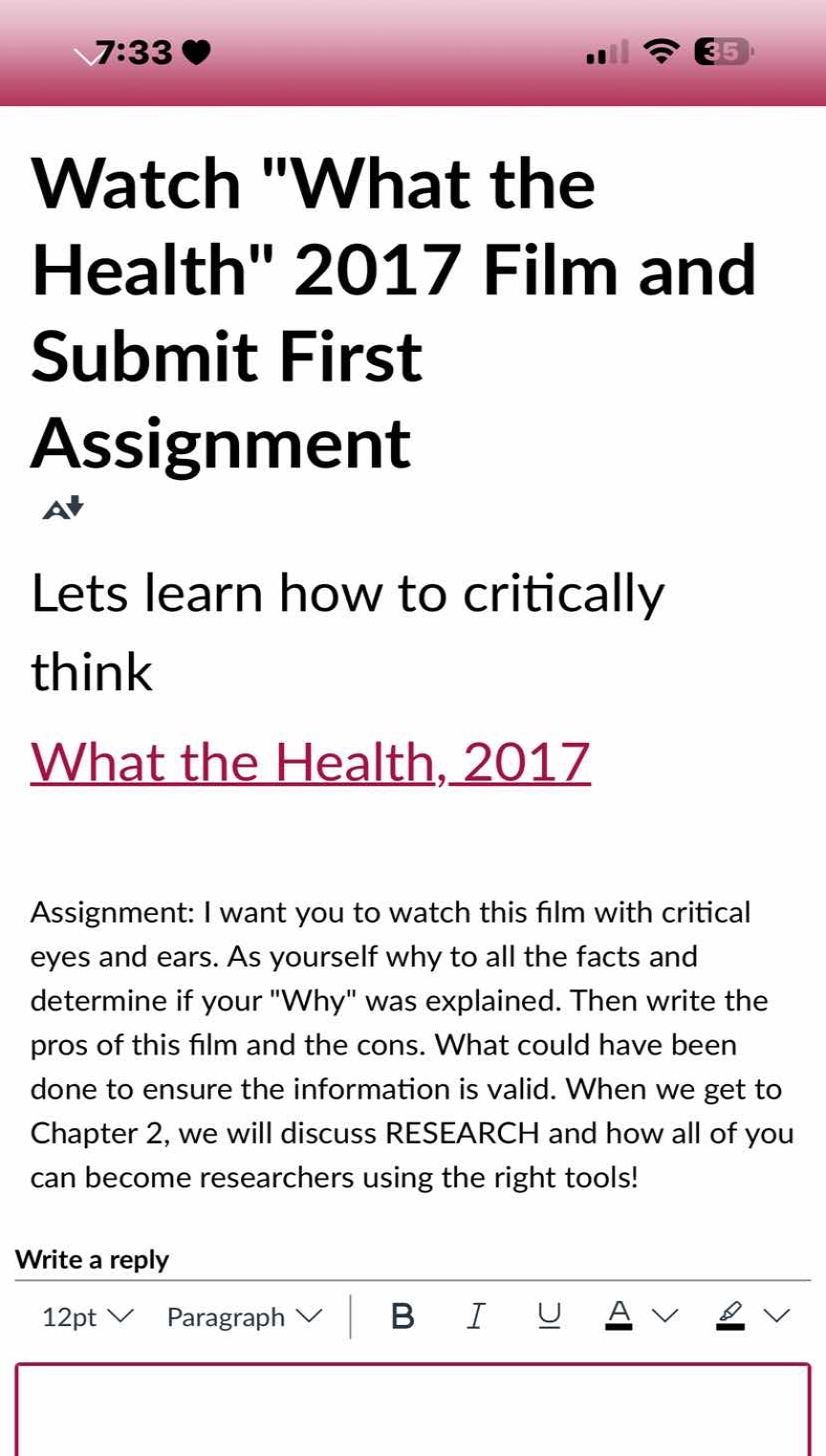
watch \what the health\ 2017 film and submit first assignment
lets learn how to critically think
what the health, 2017
assignment: i want you to watch this film with critical eyes and ears. as yourself why to all the facts and determine if your \why\ was explained. then write the pros of this film and the cons. what could have been done to ensure the information is valid. when we get to chapter 2, we will discuss research and how all of you can become researchers using the right tools!
Analyze the assignment prompt
The assignment requires watching the 2017 documentary "What the Health" and writing a critical response addressing:
- The "Why" behind the facts presented and whether they were adequately explained.
- The pros (strengths) of the film.
- The cons (weaknesses) of the film.
- What could have been done to ensure the information presented is valid.
Evaluate the film's pros and cons
- Pros: Raises public awareness about the impact of diet on health, encourages viewers to eat more whole, plant-based foods, and highlights the influence of corporate funding on public health organizations.
- Cons: Relies heavily on sensationalism, cherry-picks scientific studies, misrepresents relative risk versus absolute risk (e.g., comparing eating processed meat to smoking cigarettes), and presents correlation as causation.
Formulate methods for information validation
To ensure validity, the filmmakers should have:
- Cited peer-reviewed, high-quality meta-analyses rather than single observational studies.
- Interviewed a broader range of independent medical and nutritional experts with diverse viewpoints.
- Clearly distinguished between correlation and causation.
- Disclosed absolute risk statistics alongside relative risk statistics.

Snap & solve any problem in the app
Get step-by-step solutions on Sovi AI
Photo-based solutions with guided steps
Explore more problems and detailed explanations
Here is a structured guide to help you write your assignment response:
1. The "Why" and Fact Explanation
The film presents numerous health claims (e.g., linking meat and dairy consumption directly to chronic diseases) but often fails to explain the biological mechanisms ("Why") in a balanced way. It frequently relies on correlation rather than explaining direct causation, leaving the viewer with sensationalized conclusions rather than scientific explanations.
2. Pros of the Film
- Public Awareness: It successfully encourages viewers to think about the connection between their diet and long-term health.
- Advocacy for Plant-Based Nutrition: It promotes the consumption of whole, plant-based foods, which is generally supported by nutritionists as beneficial.
- Exposing Conflicts of Interest: It raises important questions about corporate sponsorships and financial ties between food industries and national health organizations.
3. Cons of the Film
- Sensationalism and Fear-Mongering: The film uses extreme comparisons (such as equating eating one egg a day to smoking five cigarettes) that distort scientific reality.
- Cherry-Picked Data: It selectively highlights weak observational studies that support its narrative while ignoring a vast body of conflicting scientific evidence.
- Misrepresentation of Risk: It conflates relative risk with absolute risk to make health dangers appear much larger than they actually are.
4. Ensuring Information Validity
To ensure the information was valid, the filmmakers could have:
- Used High-Quality Evidence: Relied on large-scale, peer-reviewed meta-analyses and randomized controlled trials (RCTs) rather than isolated observational studies.
- Included Diverse Expert Perspectives: Interviewed independent mainstream nutritionists, epidemiologists, and cardiologists instead of only interviewing pre-selected plant-based advocates.
- Acknowledged Study Limitations: Clearly explained that correlation does not equal causation and presented a balanced view of dietary science.