QUESTION IMAGE
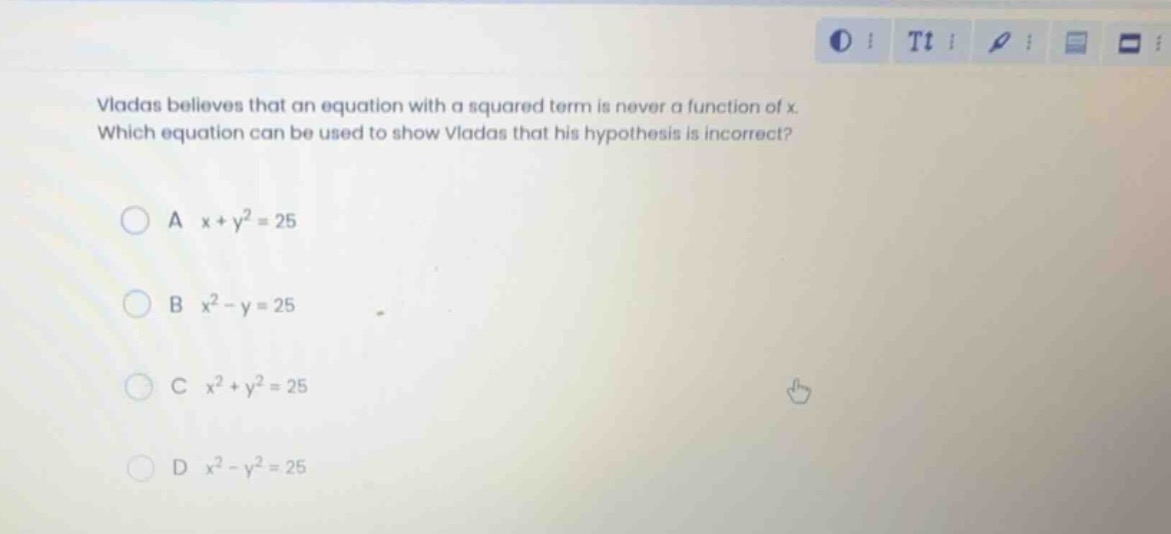
Question
vladas believes that an equation with a squared term is never a function of \\(x\\).
which equation can be used to show vladas that his hypothesis is incorrect?
a \\(x + y^2 = 25\\)
b \\(x^2 - y = 25\\)
c \\(x^2 + y^2 = 25\\)
d \\(x^2 - y^2 = 25\\)
🆕 New Concept Discovered: Identifying Functions from Equations
Each input \(x\) must pair with exactly one output \(y\).
Step 1: Understand the definition of a function
For \(y\) to be a function of \(x\), every valid input value of \(x\) must yield exactly one corresponding output value of \(y\). If an input \(x\) can produce two or more different values for \(y\), then the equation does not define \(y\) as a function of \(x\).
Step 2: Analyze equations with a squared \(y\) term
If an equation contains \(y^2\), solving for \(y\) typically involves taking a square root, which introduces a \(\pm\) sign. This means a single \(x\) value can lead to two different \(y\) values.
- For A (\(x + y^2 = 25\)):
If \(x = 0\), then \(y = 5\) or \(y = -5\). This is not a function.
- For C (\(x^2 + y^2 = 25\)):
If \(x = 0\), then \(y = 5\) or \(y = -5\). This is not a function.
- For D (\(x^2 - y^2 = 25\)):
If \(x = 10\), then \(y = \pm\sqrt{75}\). This is not a function.
Step 3: Analyze the equation with only a squared \(x\) term
For B (\(x^2 - y = 25\)), we can solve directly for \(y\):
For any real number we choose for \(x\), squaring it and subtracting \(25\) will yield exactly one unique value for \(y\). Therefore, this equation contains a squared term (\(x^2\)) but successfully defines \(y\) as a function of \(x\). This disproves Vladas's hypothesis.

Snap & solve any problem in the app
Get step-by-step solutions on Sovi AI
Photo-based solutions with guided steps
Explore more problems and detailed explanations
B \(x^2 - y = 25\)