Sovi.AI - AI Math Tutor

Scan to solve math questions

QUESTION IMAGE

the vertices of a quadrilateral in the coordinate plane are known. how …

Question

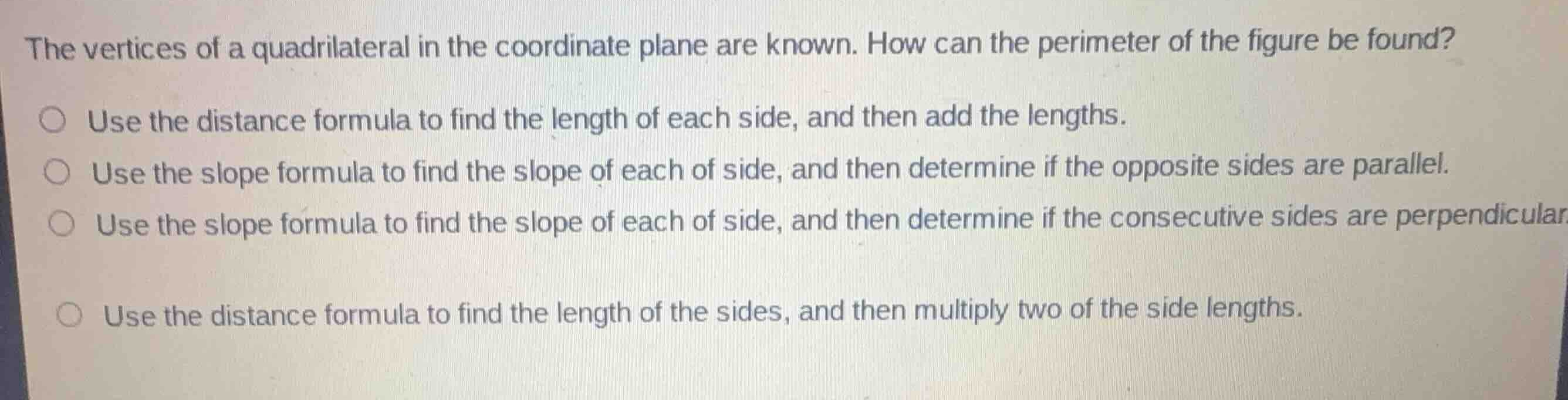
the vertices of a quadrilateral in the coordinate plane are known. how can the perimeter of the figure be found?

use the distance formula to find the length of each side, and then add the lengths.
use the slope formula to find the slope of each of side, and then determine if the opposite sides are parallel.
use the slope formula to find the slope of each of side, and then determine if the consecutive sides are perpendicular.
use the distance formula to find the length of the sides, and then multiply two of the side lengths.

Explanation:

Response

<pre_analysis>
{
"quality": "clear",
"question_count": 1,
"skills_matched": [
"direct_cot",
"multiple_choice_formatter",
"explain_then_answer",
"tutor",
"mastery_adaptive_brevity"
],
"needs_drawing": false,
"concepts_used": [
"Perimeter in Coordinate Plane"
],
"new_concepts": [],
"current_concepts": [
"Perimeter in Coordinate Plane",
"Properties of Polygons"
]
}
</pre_analysis>

<reasoning>

Define perimeter of a polygon

Using the Perimeter in Coordinate Plane knowledge point
The perimeter of any polygon is the total distance around its outer boundary, which is found by calculating the sum of the lengths of all its sides.

Analyze the given options

Using the Perimeter in Coordinate Plane knowledge point

  • Option 1: Finding the length of each side using the distance formula and adding them directly yields the perimeter.
  • Option 2: Finding slopes to check if opposite sides are parallel determines if the figure is a parallelogram, not its perimeter.
  • Option 3: Finding slopes to check if consecutive sides are perpendicular determines if the angles are right angles, not its perimeter.
  • Option 4: Multiplying side lengths is used for finding area (e.g., of a rectangle), not the perimeter.

</reasoning>

<answer>
<mcq-correct>(A) Use the distance formula to find the length of each side, and then add the lengths.</mcq-correct>
<mcq-option>(B) Use the slope formula to find the slope of each of side, and then determine if the opposite sides are parallel.</mcq-option>
<mcq-option>(C) Use the slope formula to find the slope of each of side, and then determine if the consecutive sides are perpendicular.</mcq-option>
<mcq-option>(D) Use the distance formula to find the length of the sides, and then multiply two of the side lengths.</mcq-option>
</answer>

<post_analysis>
{
"subject": "Mathematics",
"question_type": "Multiple Choice",
"knowledge_point": [
"Mathematics",
"Geometry",
"Perimeter in Coordinate Plane"
]
}
</post_analysis>

Answer:

<pre_analysis>
{
"quality": "clear",
"question_count": 1,
"skills_matched": [
"direct_cot",
"multiple_choice_formatter",
"explain_then_answer",
"tutor",
"mastery_adaptive_brevity"
],
"needs_drawing": false,
"concepts_used": [
"Perimeter in Coordinate Plane"
],
"new_concepts": [],
"current_concepts": [
"Perimeter in Coordinate Plane",
"Properties of Polygons"
]
}
</pre_analysis>

<reasoning>

Define perimeter of a polygon

Using the Perimeter in Coordinate Plane knowledge point
The perimeter of any polygon is the total distance around its outer boundary, which is found by calculating the sum of the lengths of all its sides.

Analyze the given options

Using the Perimeter in Coordinate Plane knowledge point

  • Option 1: Finding the length of each side using the distance formula and adding them directly yields the perimeter.
  • Option 2: Finding slopes to check if opposite sides are parallel determines if the figure is a parallelogram, not its perimeter.
  • Option 3: Finding slopes to check if consecutive sides are perpendicular determines if the angles are right angles, not its perimeter.
  • Option 4: Multiplying side lengths is used for finding area (e.g., of a rectangle), not the perimeter.

</reasoning>

<answer>
<mcq-correct>(A) Use the distance formula to find the length of each side, and then add the lengths.</mcq-correct>
<mcq-option>(B) Use the slope formula to find the slope of each of side, and then determine if the opposite sides are parallel.</mcq-option>
<mcq-option>(C) Use the slope formula to find the slope of each of side, and then determine if the consecutive sides are perpendicular.</mcq-option>
<mcq-option>(D) Use the distance formula to find the length of the sides, and then multiply two of the side lengths.</mcq-option>
</answer>

<post_analysis>
{
"subject": "Mathematics",
"question_type": "Multiple Choice",
"knowledge_point": [
"Mathematics",
"Geometry",
"Perimeter in Coordinate Plane"
]
}
</post_analysis>