QUESTION IMAGE
Question
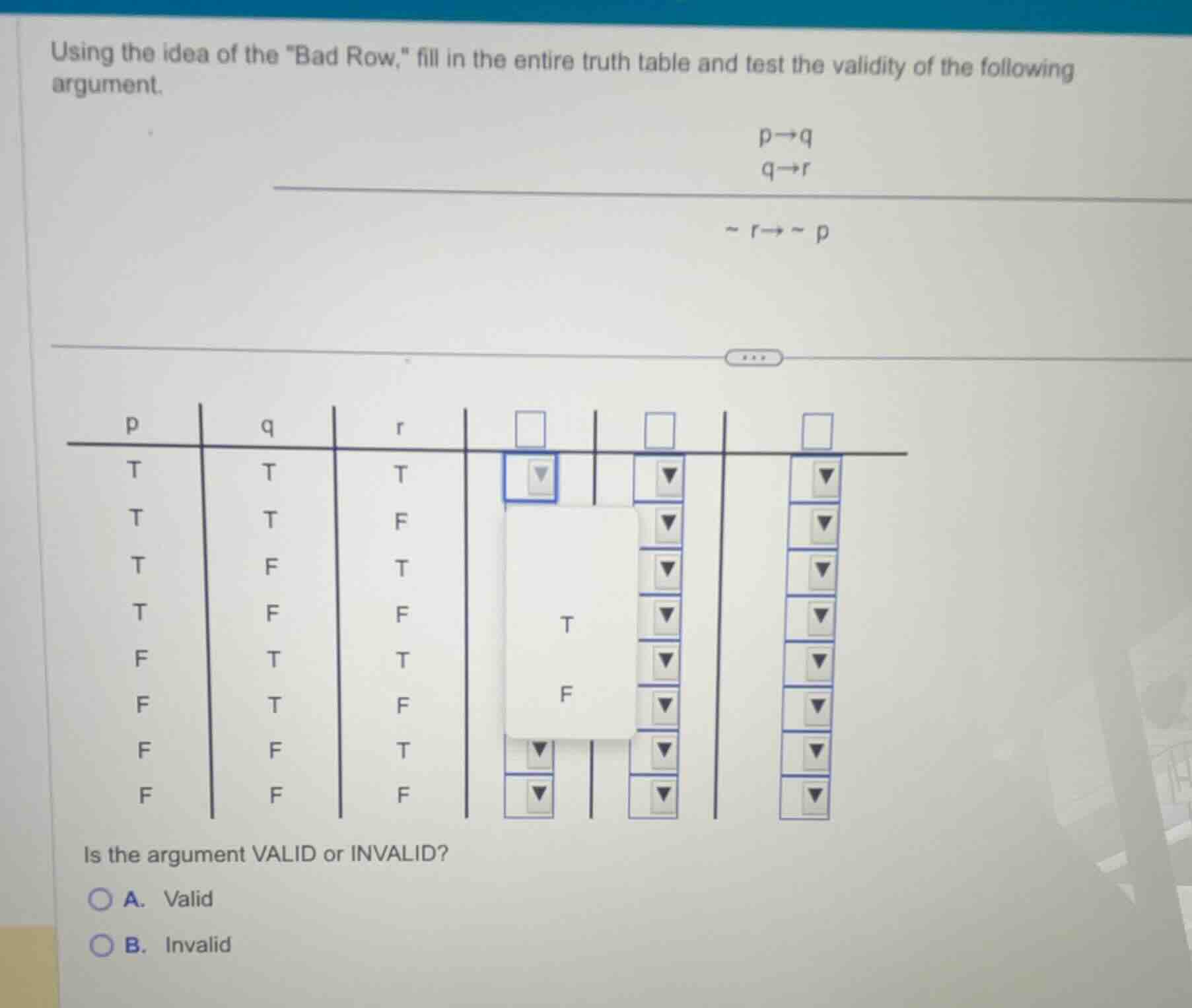
using the idea of the \bad row,\ fill in the entire truth table and test the validity of the following argument.
\\
\
\\
is the argument valid or invalid?
a. valid
b. invalid
Identify the column headers and premises
Using the Truth Tables knowledge point
The argument is:
Premise 1: \(p
ightarrow q\)
Premise 2: \(q
ightarrow r\)
Conclusion: \(\sim r
ightarrow \sim p\)
The three blank column headers in the truth table correspond to the premises and the conclusion:
Column 4: \(p
ightarrow q\)
Column 5: \(q
ightarrow r\)
Column 6: \(\sim r
ightarrow \sim p\)
Evaluate the truth values for each row
Using the Truth Tables knowledge point
Row 1: \(p=T, q=T, r=T\)
- \(p
ightarrow q = T
ightarrow T = T\)
- \(q
ightarrow r = T
ightarrow T = T\)
- \(\sim r
ightarrow \sim p = F
ightarrow F = T\)
Row 2: \(p=T, q=T, r=F\)
- \(p
ightarrow q = T
ightarrow T = T\)
- \(q
ightarrow r = T
ightarrow F = F\)
- \(\sim r
ightarrow \sim p = T
ightarrow F = F\)
Row 3: \(p=T, q=F, r=T\)
- \(p
ightarrow q = T
ightarrow F = F\)
- \(q
ightarrow r = F
ightarrow T = T\)
- \(\sim r
ightarrow \sim p = F
ightarrow F = T\)
Row 4: \(p=T, q=F, r=F\)
- \(p
ightarrow q = T
ightarrow F = F\)
- \(q
ightarrow r = F
ightarrow F = T\)
- \(\sim r
ightarrow \sim p = T
ightarrow F = F\)
Row 5: \(p=F, q=T, r=T\)
- \(p
ightarrow q = F
ightarrow T = T\)
- \(q
ightarrow r = T
ightarrow T = T\)
- \(\sim r
ightarrow \sim p = F
ightarrow T = T\)
Row 6: \(p=F, q=T, r=F\)
- \(p
ightarrow q = F
ightarrow T = T\)
- \(q
ightarrow r = T
ightarrow F = F\)
- \(\sim r
ightarrow \sim p = T
ightarrow T = T\)
Row 7: \(p=F, q=F, r=T\)
- \(p
ightarrow q = F
ightarrow F = T\)
- \(q
ightarrow r = F
ightarrow T = T\)
- \(\sim r
ightarrow \sim p = F
ightarrow T = T\)
Row 8: \(p=F, q=F, r=F\)
- \(p
ightarrow q = F
ightarrow F = T\)
- \(q
ightarrow r = F
ightarrow F = T\)
- \(\sim r
ightarrow \sim p = T
ightarrow T = T\)
Analyze argument validity using the "Bad Row" method
Using the Argument Validity knowledge point
A "Bad Row" (counterexample) is a row where all premises are true, but the conclusion is false.
The premises are \(p
ightarrow q\) and \(q
ightarrow r\).
Rows where both premises are true:
- Row 1: Conclusion is \(T\)
- Row 5: Conclusion is \(T\)
- Row 7: Conclusion is \(T\)
- Row 8: Conclusion is \(T\)
Since there is no row where all premises are true and the conclusion is false, there is no "Bad Row." Therefore, the argument is valid.

Snap & solve any problem in the app
Get step-by-step solutions on Sovi AI
Photo-based solutions with guided steps
Explore more problems and detailed explanations
Question 1
The completed truth table is:
| \(p\) | \(q\) | \(r\) | \(p |
ightarrow q\) | \(q
ightarrow r\) | \(\sim r
ightarrow \sim p\) |
| T | T | T | T | T | T |
| T | T | F | T | F | F |
| T | F | T | F | T | T |
| T | F | F | F | T | F |
| F | T | T | T | T | T |
| F | T | F | T | F | T |
| F | F | T | T | T | T |
| F | F | F | T | T | T |
Question 2
- A. Valid (Correct answer)
- B. Invalid