QUESTION IMAGE
Question
use the text below to answer the question that follows:
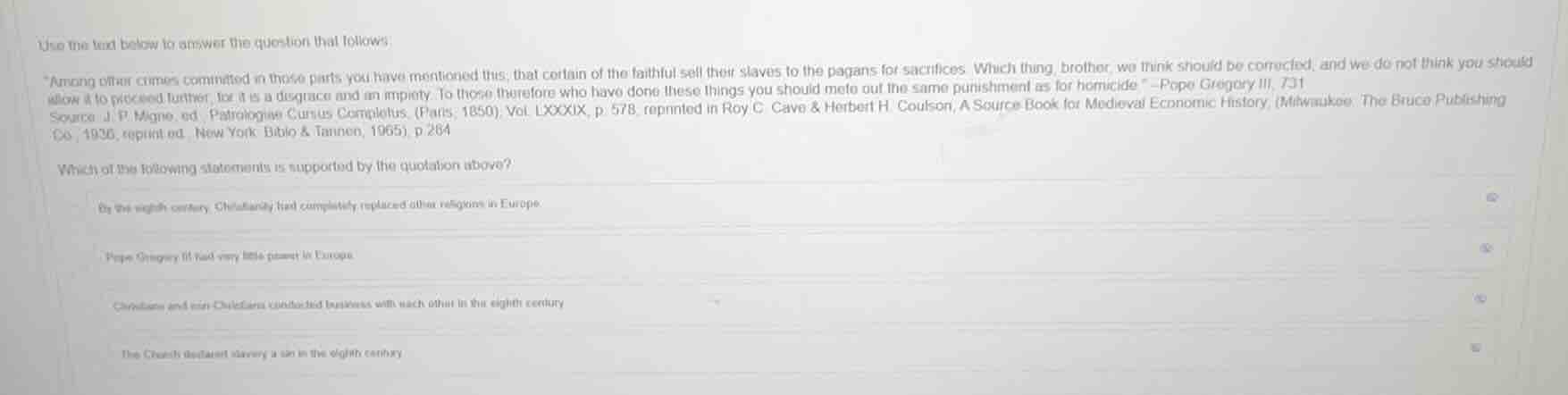
\among other crimes committed in those parts you have mentioned this, that certain of the faithful sell their slaves to the pagans for sacrifices. which thing, brother, we think should be corrected, and we do not think you should allow it to proceed further, for it is a disgrace and an impiety. to those therefore who have done these things you should mete out the same punishment as for homicide.\ - pope gregory iii, 731
source: j. p. migne, ed., patrologiae cursus completus, (paris, 1850), vol. lxxxix, p. 578, reprinted in roy c. cave & herbert h. coulson, a source book for medieval economic history, (milwaukee: the bruce publishing co., 1936; reprint ed., new york: biblo & tannen, 1965), p. 284.
which of the following statements is supported by the quotation above?
by the eighth century, christianity had completely replaced other religions in europe.
pope gregory iii had very little power in europe.
christians and non-christians conducted business with each other in the eighth century.
the church declared slavery a sin in the eighth century.
Analyze the historical source text
The text is a decree from Pope Gregory III in 731 CE. It states: "certain of the faithful sell their slaves to the pagans for sacrifices." This shows that "the faithful" (Christians) were selling slaves to "pagans" (non-Christians). This transaction represents economic exchange or business between Christians and non-Christians during the eighth century.
Evaluate the first option
The first option states: "By the eighth century, Christianity had completely replaced other religions in Europe." The text explicitly mentions "pagans" who are buying slaves for sacrifices, which proves that non-Christian religions still existed in Europe during the eighth century. Thus, this statement is incorrect.
Evaluate the second option
The second option states: "Pope Gregory III had very little power in Europe." The text shows the Pope issuing a direct command to mete out "the same punishment as for homicide" to those who sell slaves to pagans. This demonstrates significant ecclesiastical authority rather than a lack of power, making this statement unsupported.
Evaluate the third option
The third option states: "Christians and non-Christians conducted business with each other in the eighth century." The text describes "the faithful" (Christians) selling slaves to "pagans" (non-Christians). Selling goods or slaves constitutes a business transaction. Therefore, this statement is directly supported by the text.
Evaluate the fourth option
The fourth option states: "The Church declared slavery a sin in the eighth century." The Pope does not condemn slavery itself as a sin; rather, he condemns the specific act of selling slaves to pagans for sacrifices, calling that specific act "a disgrace and an impiety." Thus, this statement is incorrect.

Snap & solve any problem in the app
Get step-by-step solutions on Sovi AI
Photo-based solutions with guided steps
Explore more problems and detailed explanations
- (A) By the eighth century, Christianity had completely replaced other religions in Europe.
- (B) Pope Gregory III had very little power in Europe.
- (C) Christians and non-Christians conducted business with each other in the eighth century. (Correct answer)
- (D) The Church declared slavery a sin in the eighth century.