QUESTION IMAGE
Question
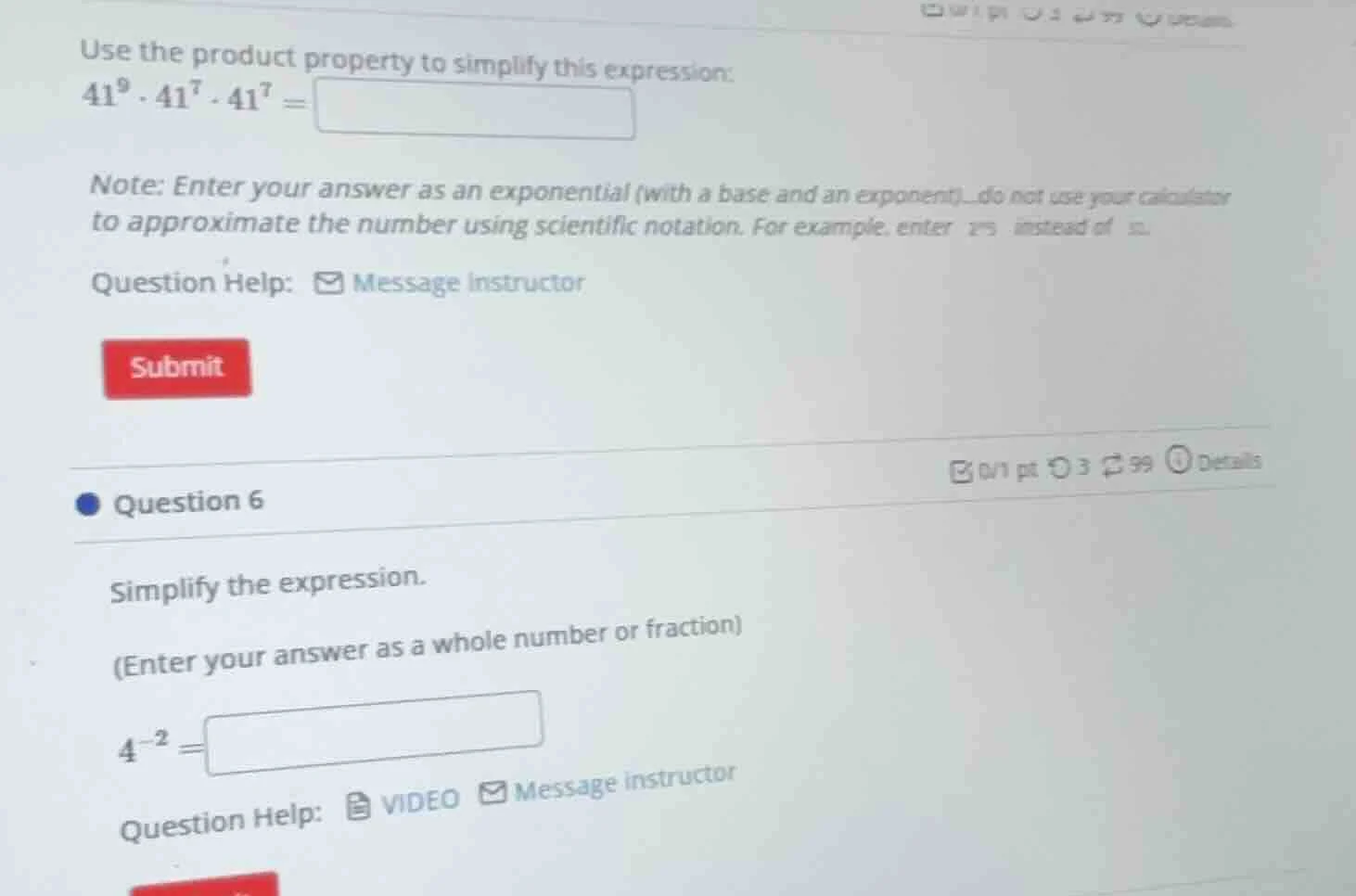
use the product property to simplify this expression:
$41^9 \cdot 41^7 \cdot 41^7 = \square$
note: enter your answer as an exponential (with a base and an exponent). do not use your calculator to approximate the number using scientific notation. for example, enter $2^5$ instead of 32.
question help: \\( \boldsymbol{\text{message instructor}} \\)
\\( \boldsymbol{\text{submit}} \\)
\\( \boldsymbol{\text{question 6}} \\)
simplify the expression.
(enter your answer as a whole number or fraction)
$4^{-2} = \square$
question help: \\( \boldsymbol{\text{video}} \\) \\( \boldsymbol{\text{message instructor}} \\)
Step1: Apply product rule for exponents
For $41^9 \cdot 41^7 \cdot 41^7$, use $a^m \cdot a^n = a^{m+n}$.
Step2: Calculate the sum of exponents
Add the exponents together.
$9+7+7=23$
Step3: Apply negative exponent rule
For $4^{-2}$, use $a^{-n}=\frac{1}{a^n}$.
$4^{-2}=\frac{1}{4^2}$
Step4: Evaluate the positive exponent
Calculate the value of $4^2$.
$4^2=16$

Snap & solve any problem in the app
Get step-by-step solutions on Sovi AI
Photo-based solutions with guided steps
Explore more problems and detailed explanations
$41^{23}$
$\frac{1}{16}$