QUESTION IMAGE
Question
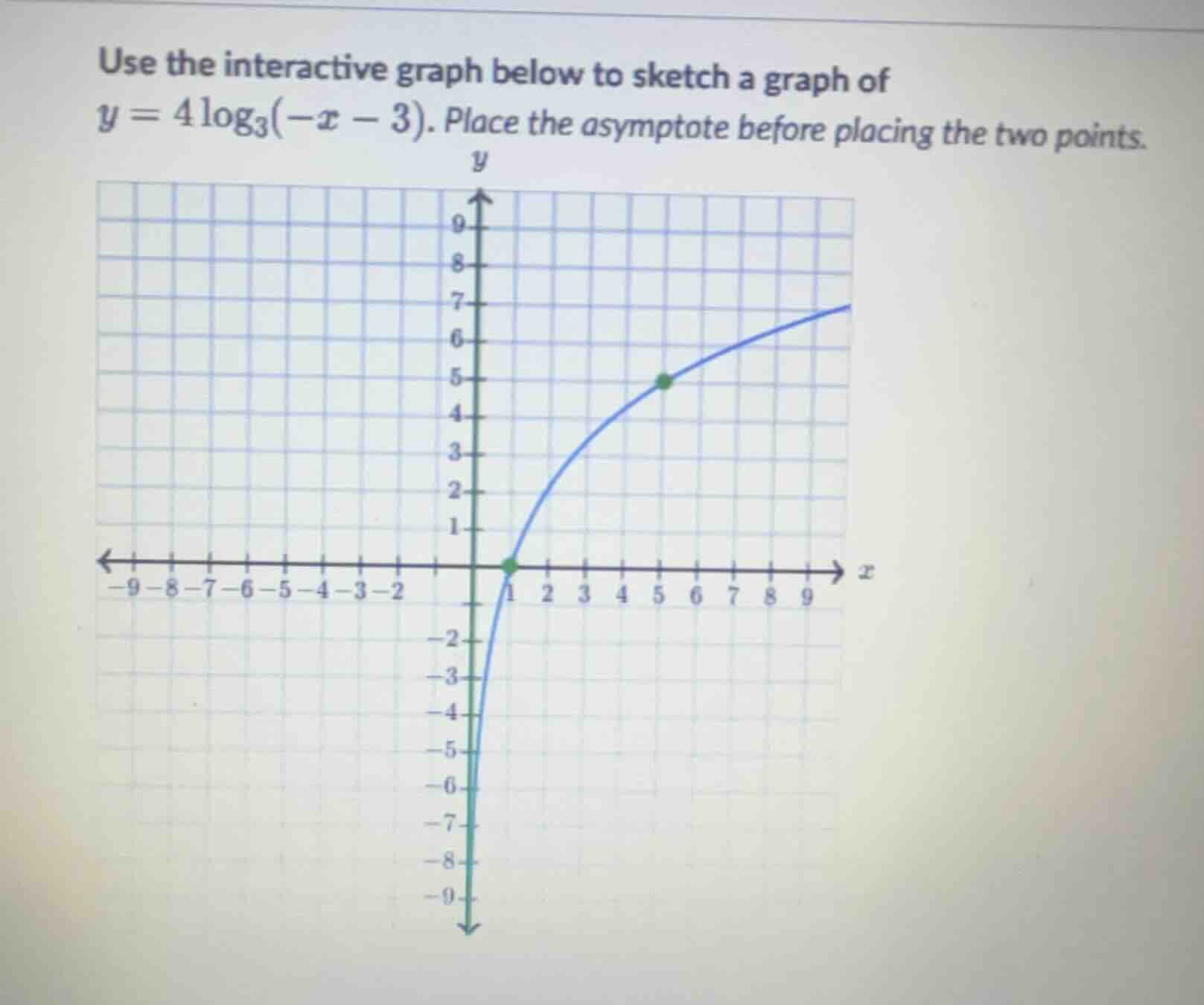
use the interactive graph below to sketch a graph of $y = 4\log_{3}(-x - 3)$. place the asymptote before placing the two points.
Step1: Find the vertical asymptote
For the logarithmic function \( y = a\log_b(u) \), the vertical asymptote occurs where \( u = 0 \). Here, \( u=-x - 3 \), so set \( -x - 3=0 \). Solving for \( x \): \( -x=3 \) → \( x = - 3 \). So the vertical asymptote is \( x=-3 \).
Step2: Find two points on the graph
We can choose values of \( x \) such that \( -x - 3 \) is a power of 3 (since the base of the logarithm is 3) to make calculation easier.
- Case 1: Let \( -x - 3 = 1 \) (since \( \log_3(1)=0 \)). Solving \( -x - 3 = 1 \): \( -x=4 \) → \( x=-4 \). Then \( y = 4\log_3(1)=4\times0 = 0 \). So one point is \( (-4,0) \).
- Case 2: Let \( -x - 3 = 3 \) (since \( \log_3(3)=1 \)). Solving \( -x - 3 = 3 \): \( -x=6 \) → \( x=-6 \). Then \( y = 4\log_3(3)=4\times1 = 4 \). Wait, but looking at the graph, maybe another choice. Let's try \( -x - 3=\frac{1}{3} \), then \( \log_3(\frac{1}{3})=-1 \). Solving \( -x - 3=\frac{1}{3} \): \( -x=\frac{1}{3}+3=\frac{10}{3} \) → \( x = -\frac{10}{3}\approx - 3.33 \), not helpful. Alternatively, let's use the point from the graph's green dots. Wait, the given graph has a point at \( (1,0) \)? No, wait the function is \( y = 4\log_3(-x - 3) \). Wait, maybe I made a mistake earlier. Let's re - evaluate.
Wait, let's take \( x=-4 \): \( -x - 3=4 - 3 = 1 \), so \( y = 4\log_3(1)=0 \), so point \( (-4,0) \).
Take \( x=-6 \): \( -x - 3=6 - 3 = 3 \), so \( y = 4\log_3(3)=4\times1 = 4 \), so point \( (-6,4) \).
Or take \( x=-2 \): \( -x - 3=2 - 3=-1 \), but logarithm of negative number is undefined. So we need \( -x - 3>0 \) → \( x < - 3 \). So the domain is \( x < - 3 \). Wait, earlier when I took \( x=-4 \) (which is less than - 3), that's good. When I took \( x=-6 \) (also less than - 3), that's good.
Wait, maybe the graph in the problem has a typo or my initial analysis is wrong? Wait no, the function is \( y = 4\log_3(-x - 3) \), so the argument \( -x - 3>0\Rightarrow x < - 3 \). So the graph should be to the left of \( x = - 3 \). But the given graph in the problem shows a graph to the right of \( x = 1 \), which is a contradiction. Wait, maybe the function is \( y = 4\log_3(x - 3) \)? No, the problem says \( y = 4\log_3(-x - 3) \).
Wait, perhaps I messed up the sign. Let's re - derive the vertical asymptote: for \( y=\log_b(f(x)) \), vertical asymptote at \( f(x)=0 \). Here \( f(x)=-x - 3 \), so \( -x - 3 = 0\Rightarrow x=-3 \). So the vertical asymptote is \( x = - 3 \).
To plot the graph: draw the vertical line \( x=-3 \) (asymptote). Then plot the point \( (-4,0) \) (when \( x=-4 \), \( y = 4\log_3(1)=0 \)) and another point, say when \( -x - 3 = 3 \), \( x=-6 \), \( y = 4\log_3(3)=4 \), so point \( (-6,4) \), or when \( -x - 3=\frac{1}{3} \), \( x=-\frac{10}{3}\approx - 3.33 \), \( y = 4\log_3(\frac{1}{3})=4\times(-1)=-4 \), so point \( (-\frac{10}{3},-4)\approx(-3.33,-4) \).

Snap & solve any problem in the app
Get step-by-step solutions on Sovi AI
Photo-based solutions with guided steps
Explore more problems and detailed explanations
The vertical asymptote is \( x = - 3 \). Two points on the graph can be \( (-4,0) \) and \( (-6,4) \) (or other valid points calculated using the function \( y = 4\log_3(-x - 3) \)) and the graph is sketched with the vertical asymptote at \( x=-3 \) and the points plotted accordingly. If we follow the steps, the vertical asymptote is \( x=-3 \), and two points are \( (-4,0) \) and \( (-6,4) \) (or equivalent points from the function's evaluation).