QUESTION IMAGE
Question
use the graph of (y = f(x)) to answer the following questions.
(a) find (f(-5)) and (f(2)).
(b) what is the domain of (f)?
(c) what is the range of (f)?
(d) identify the intercepts.
(e) for what values of (x) does (f(x) = 8)?
(a) (f(-5) = \square)
⚡ Using what you learned: domain and range · evaluating functions
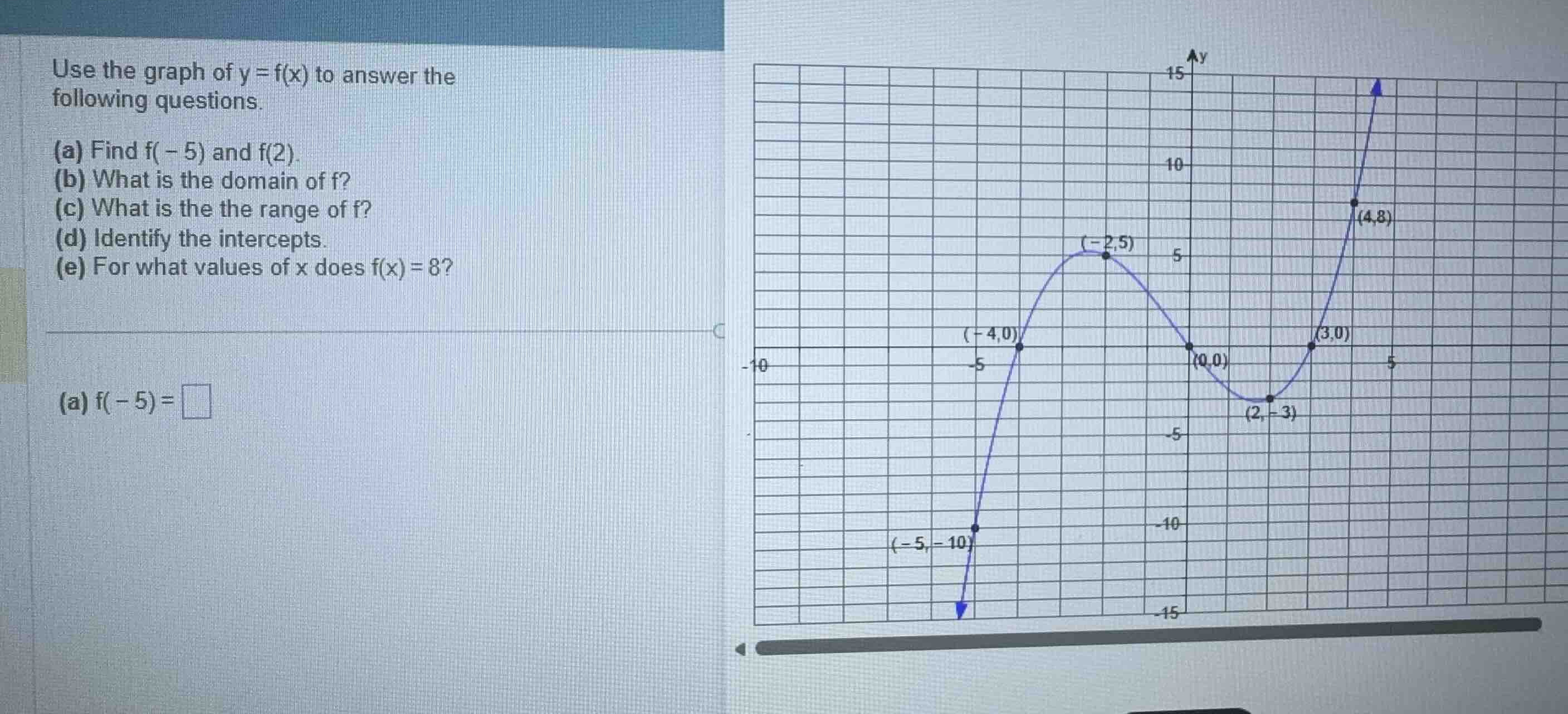
Step 1: Find \( f(-5) \) and \( f(2) \)
Locate the given \( x \)-values on the horizontal axis and find their corresponding \( y \)-values on the graph:
- The point with \( x = -5 \) is labeled \( (-5, -10) \). Thus, \( f(-5) = -10 \).
- The point with \( x = 2 \) is labeled \( (2, -3) \). Thus, \( f(2) = -3 \).
Step 2: Determine the domain of \( f \)
The domain represents all possible input values (\( x \)-values) for the function:
- Looking at the graph, the curve continues infinitely to the left (indicated by the downward arrow on the left) and infinitely to the right (indicated by the upward arrow on the right).
- Therefore, the domain is all real numbers:
Step 3: Determine the range of \( f \)
The range represents all possible output values (\( y \)-values) for the function:
- The graph extends infinitely downwards on the left and infinitely upwards on the right.
- Therefore, the range is all real numbers:
Step 4: Identify the intercepts
- \( x \)-intercepts (where the graph crosses the \( x \)-axis, i.e., \( y = 0 \)):
Looking at the labeled points on the \( x \)-axis:
So, the \( x \)-intercepts are \( x = -4 \), \( x = 0 \), and \( x = 3 \).
- \( y \)-intercept (where the graph crosses the \( y \)-axis, i.e., \( x = 0 \)):
The graph crosses the origin:
So, the \( y \)-intercept is \( y = 0 \).
Step 5: Find \( x \) when \( f(x) = 8 \)
Find the point on the graph where the \( y \)-value is \( 8 \):
- The labeled point with a \( y \)-coordinate of \( 8 \) is \( (4, 8) \).
- Therefore, \( f(x) = 8 \) when \( x = 4 \).

Snap & solve any problem in the app
Get step-by-step solutions on Sovi AI
Photo-based solutions with guided steps
Explore more problems and detailed explanations
- (a) \( f(-5) = -10 \) and \( f(2) = -3 \)
- (b) Domain: \( (-\infty, \infty) \)
- (c) Range: \( (-\infty, \infty) \)
- (d) \( x \)-intercepts: \( (-4, 0), (0, 0), (3, 0) \); \( y \)-intercept: \( (0, 0) \)
- (e) \( x = 4 \)