QUESTION IMAGE
Question
use the following information to answer question 14.
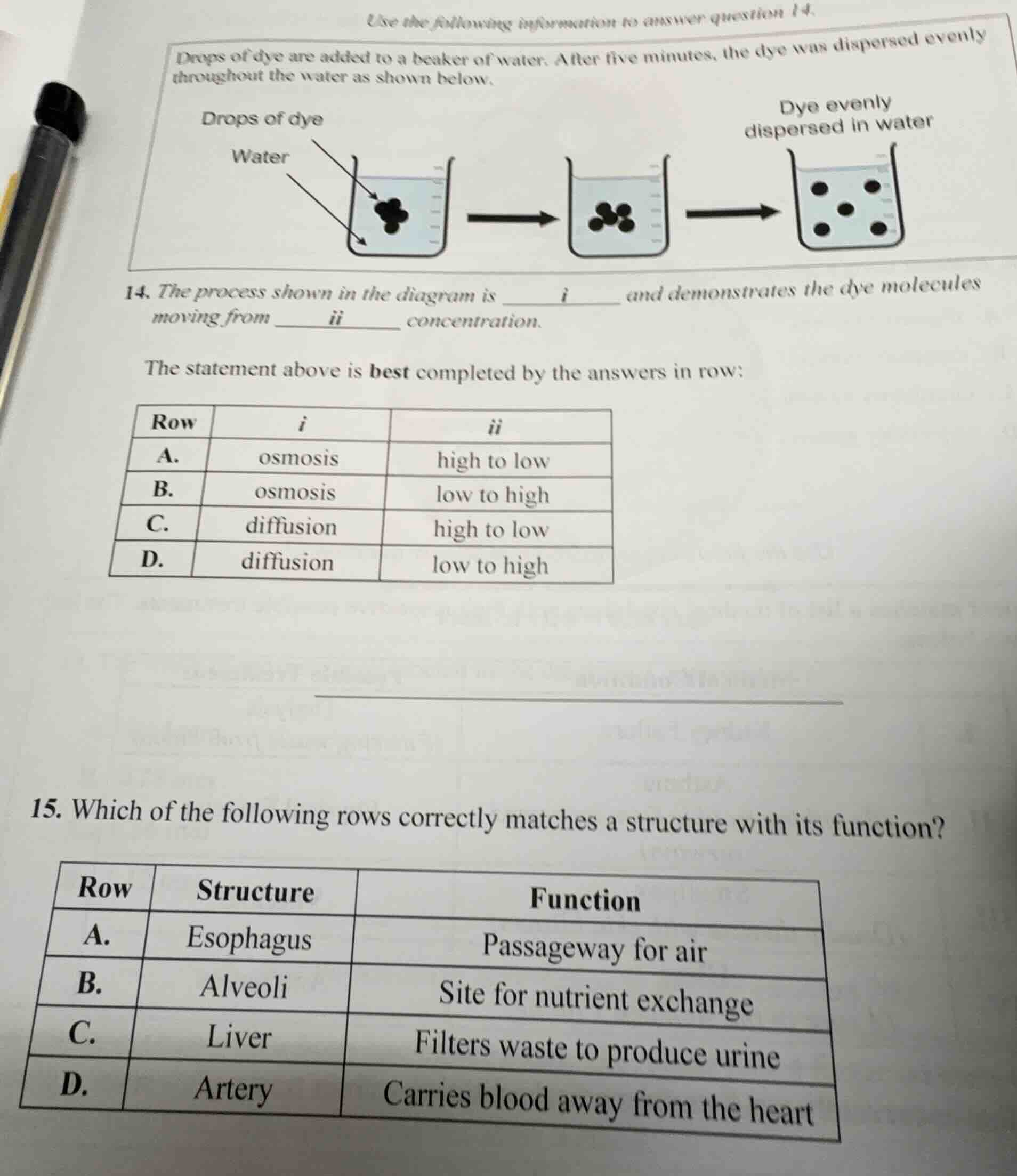
drops of dye are added to a beaker of water. after five minutes, the dye was dispersed evenly throughout the water as shown below.
- the process shown in the diagram is i and demonstrates the dye molecules moving from ii concentration.
the statement above is best completed by the answers in row:
\
- which of the following rows correctly matches a structure with its function?
\
<pre_analysis>
{
"quality": "clear",
"question_count": 2,
"skills_matched": [
"direct_cot",
"multiple_choice_formatter",
"explain_then_answer",
"tutor"
],
"needs_drawing": false,
"concepts_used": [
"Particle Theory of Matter"
],
"new_concepts": [
"Diffusion and Osmosis",
"Human Organ Systems"
],
"current_concepts": [
"Particle Theory of Matter",
"Diffusion and Osmosis",
"Human Organ Systems"
]
}
</pre_analysis>
<reasoning>
Analyze Question 14
The diagram shows drops of dye added to a beaker of water. Over time, the dye particles spread out until they are evenly dispersed throughout the water.
- Identify the process (i):
- Diffusion is the movement of solute particles (like dye) from an area of higher concentration to an area of lower concentration until they are evenly distributed.
- Osmosis is specifically the diffusion of water (solvent) molecules across a selectively permeable membrane. Since this is the spreading of dye particles in water without a membrane, the process is diffusion.
- This process is driven by the random motion of particles, which is a key concept in the Particle Theory of Matter.
- Identify the direction of movement (ii):
- The dye molecules start highly concentrated in one spot (high concentration) and naturally spread out to fill the areas where there are fewer dye molecules (low concentration).
- Therefore, the molecules move from high to low concentration.
Matching these findings to the options:
- i = diffusion
- ii = high to low
This corresponds to Row C.
Analyze Question 15
We need to evaluate each row to find the correct match between a human body structure and its primary function:
- Row A: Esophagus — Passageway for air
- Incorrect. The esophagus is a muscular tube that carries food and liquids from the mouth to the stomach. The trachea (windpipe) is the passageway for air.
- Row B: Alveoli — Site for nutrient exchange
- Incorrect. Alveoli are tiny air sacs in the lungs where gas exchange (oxygen and carbon dioxide) occurs. Nutrient exchange occurs in the capillaries of the small intestine.
- Row C: Liver — Filters waste to produce urine
- Incorrect. The kidneys filter waste from the blood to produce urine. The liver has many functions, including detoxifying chemicals and producing bile, but it does not produce urine.
- Row D: Artery — Carries blood away from the heart
- Correct. Arteries are blood vessels that carry oxygenated blood away from the heart to the rest of the body (with the exception of the pulmonary artery, which still carries blood away from the heart to the lungs).
This corresponds to Row D.
</reasoning>
<answer>
Question 14
<mcq-option>(A) i: osmosis; ii: high to low</mcq-option>
<mcq-option>(B) i: osmosis; ii: low to high</mcq-option>
<mcq-correct>(C) i: diffusion; ii: high to low</mcq-correct>
<mcq-option>(D) i: diffusion; ii: low to high</mcq-option>
Question 15
<mcq-option>(A) Esophagus — Passageway for air</mcq-option>
<mcq-option>(B) Alveoli — Site for nutrient exchange</mcq-option>
<mcq-option>(C) Liver — Filters waste to produce urine</mcq-option>
<mcq-correct>(D) Artery — Carries blood away from the heart</mcq-correct>
</answer>
<post_analysis>
{
"subject": "Natural Science",
"question_type": "Multiple Choice",
"knowledge_point": [
"Natural Science",
"Biology",
"Cell Transport and Human Anatomy"
]
}
</post_analysis>
Snap & solve any problem in the app
Get step-by-step solutions on Sovi AI
Photo-based solutions with guided steps
Explore more problems and detailed explanations
<pre_analysis>
{
"quality": "clear",
"question_count": 2,
"skills_matched": [
"direct_cot",
"multiple_choice_formatter",
"explain_then_answer",
"tutor"
],
"needs_drawing": false,
"concepts_used": [
"Particle Theory of Matter"
],
"new_concepts": [
"Diffusion and Osmosis",
"Human Organ Systems"
],
"current_concepts": [
"Particle Theory of Matter",
"Diffusion and Osmosis",
"Human Organ Systems"
]
}
</pre_analysis>
<reasoning>
Analyze Question 14
The diagram shows drops of dye added to a beaker of water. Over time, the dye particles spread out until they are evenly dispersed throughout the water.
- Identify the process (i):
- Diffusion is the movement of solute particles (like dye) from an area of higher concentration to an area of lower concentration until they are evenly distributed.
- Osmosis is specifically the diffusion of water (solvent) molecules across a selectively permeable membrane. Since this is the spreading of dye particles in water without a membrane, the process is diffusion.
- This process is driven by the random motion of particles, which is a key concept in the Particle Theory of Matter.
- Identify the direction of movement (ii):
- The dye molecules start highly concentrated in one spot (high concentration) and naturally spread out to fill the areas where there are fewer dye molecules (low concentration).
- Therefore, the molecules move from high to low concentration.
Matching these findings to the options:
- i = diffusion
- ii = high to low
This corresponds to Row C.
Analyze Question 15
We need to evaluate each row to find the correct match between a human body structure and its primary function:
- Row A: Esophagus — Passageway for air
- Incorrect. The esophagus is a muscular tube that carries food and liquids from the mouth to the stomach. The trachea (windpipe) is the passageway for air.
- Row B: Alveoli — Site for nutrient exchange
- Incorrect. Alveoli are tiny air sacs in the lungs where gas exchange (oxygen and carbon dioxide) occurs. Nutrient exchange occurs in the capillaries of the small intestine.
- Row C: Liver — Filters waste to produce urine
- Incorrect. The kidneys filter waste from the blood to produce urine. The liver has many functions, including detoxifying chemicals and producing bile, but it does not produce urine.
- Row D: Artery — Carries blood away from the heart
- Correct. Arteries are blood vessels that carry oxygenated blood away from the heart to the rest of the body (with the exception of the pulmonary artery, which still carries blood away from the heart to the lungs).
This corresponds to Row D.
</reasoning>
<answer>
Question 14
<mcq-option>(A) i: osmosis; ii: high to low</mcq-option>
<mcq-option>(B) i: osmosis; ii: low to high</mcq-option>
<mcq-correct>(C) i: diffusion; ii: high to low</mcq-correct>
<mcq-option>(D) i: diffusion; ii: low to high</mcq-option>
Question 15
<mcq-option>(A) Esophagus — Passageway for air</mcq-option>
<mcq-option>(B) Alveoli — Site for nutrient exchange</mcq-option>
<mcq-option>(C) Liver — Filters waste to produce urine</mcq-option>
<mcq-correct>(D) Artery — Carries blood away from the heart</mcq-correct>
</answer>
<post_analysis>
{
"subject": "Natural Science",
"question_type": "Multiple Choice",
"knowledge_point": [
"Natural Science",
"Biology",
"Cell Transport and Human Anatomy"
]
}
</post_analysis>