QUESTION IMAGE
Question
use the five numbers 16, 15, 12, 13, and 12 to complete parts a) through e) below.
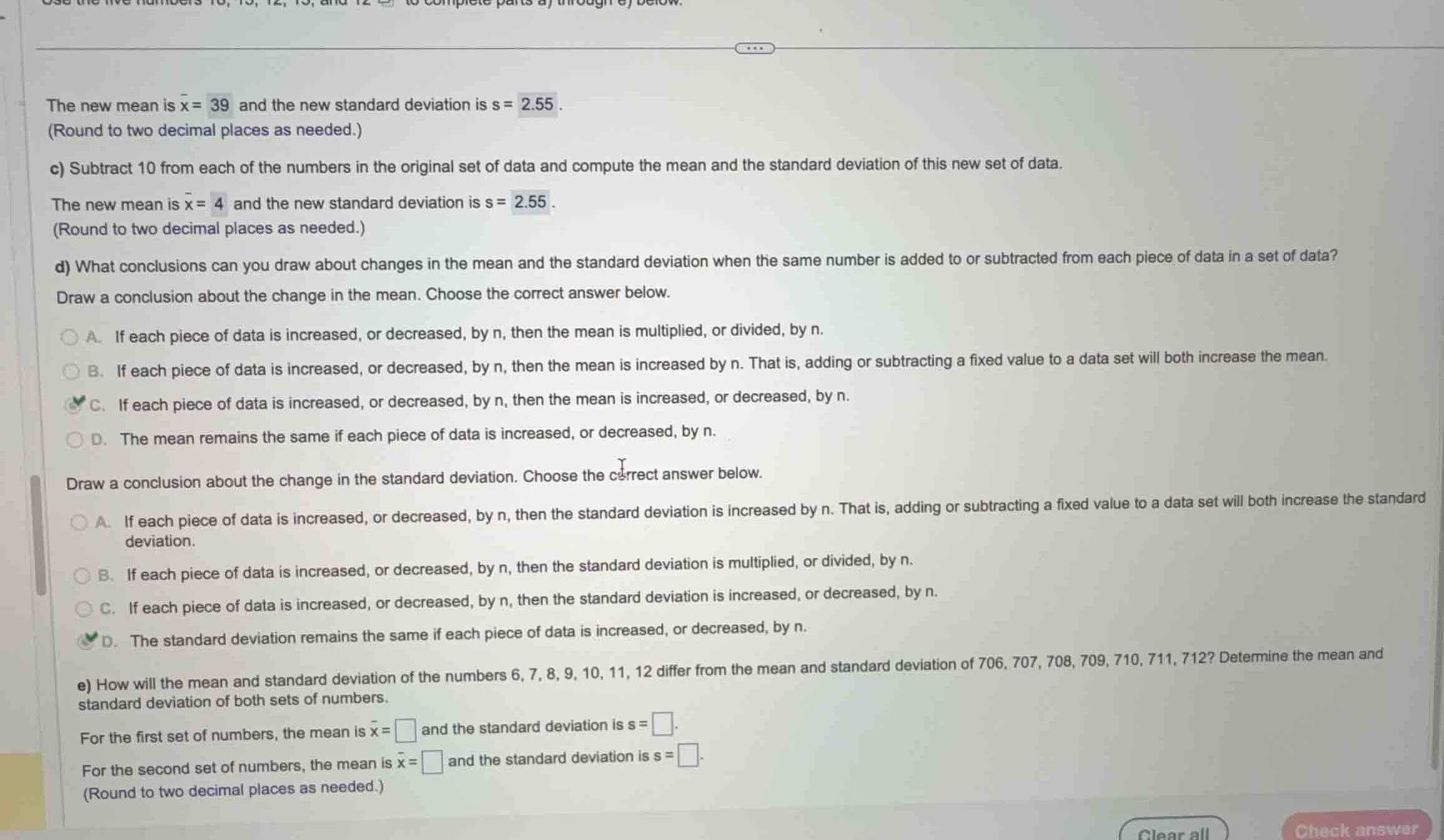
the new mean is \\(\bar{x} = 39\\) and the new standard deviation is \\(s = 2.55\\).
(round to two decimal places as needed.)
c) subtract 10 from each of the numbers in the original set of data and compute the mean and the standard deviation of this new set of data.
the new mean is \\(\bar{x} = 4\\) and the new standard deviation is \\(s = 2.55\\).
(round to two decimal places as needed.)
d) what conclusions can you draw about changes in the mean and the standard deviation when the same number is added to or subtracted from each piece of data in a set of data?
draw a conclusion about the change in the mean. choose the correct answer below.
a. if each piece of data is increased, or decreased, by n, then the mean is multiplied, or divided, by n.
b. if each piece of data is increased, or decreased, by n, then the mean is increased by n. that is, adding or subtracting a fixed value to a data set will both increase the mean.
c. if each piece of data is increased, or decreased, by n, then the mean is increased, or decreased, by n.
d. the mean remains the same if each piece of data is increased, or decreased, by n.
draw a conclusion about the change in the standard deviation. choose the correct answer below.
a. if each piece of data is increased, or decreased, by n, then the standard deviation is increased by n. that is, adding or subtracting a fixed value to a data set will both increase the standard deviation.
b. if each piece of data is increased, or decreased, by n, then the standard deviation is multiplied, or divided, by n.
c. if each piece of data is increased, or decreased, by n, then the standard deviation is increased, or decreased, by n.
d. the standard deviation remains the same if each piece of data is increased, or decreased, by n.
e) how will the mean and standard deviation of the numbers 6, 7, 8, 9, 10, 11, 12 differ from the mean and standard deviation of 706, 707, 708, 709, 710, 711, 712? determine the mean and standard deviation of both sets of numbers.
for the first set of numbers, the mean is \\(\bar{x} = \\) and the standard deviation is \\(s = \\).
for the second set of numbers, the mean is \\(\bar{x} = \\) and the standard deviation is \\(s = \\).
(round to two decimal places as needed.)
Calculate statistics for the first set
Using the Mean Calculation and Sample Standard Deviation knowledge points
The first set of numbers is \(6, 7, 8, 9, 10, 11, 12\).
The number of data points is \(n = 7\).
The sum of the values is:
The mean is:
The squared deviations from the mean are:
The sum of squared deviations is:
The sample standard deviation is:
Calculate statistics for the second set
Using the Linear Transformations of Data knowledge point
The second set of numbers is \(706, 707, 708, 709, 710, 711, 712\).
Each value in this set is obtained by adding \(700\) to the corresponding value in the first set.
The new mean is:
Since adding a constant to each data point does not change the spread of the data, the standard deviation remains unchanged:

Snap & solve any problem in the app
Get step-by-step solutions on Sovi AI
Photo-based solutions with guided steps
Explore more problems and detailed explanations
For the first set of numbers, the mean is \(\bar{x} =\) <blank>9</blank> and the standard deviation is \(s =\) <blank>2.16</blank>.
For the second set of numbers, the mean is \(\bar{x} =\) <blank>709</blank> and the standard deviation is \(s =\) <blank>2.16</blank>.