QUESTION IMAGE
Question
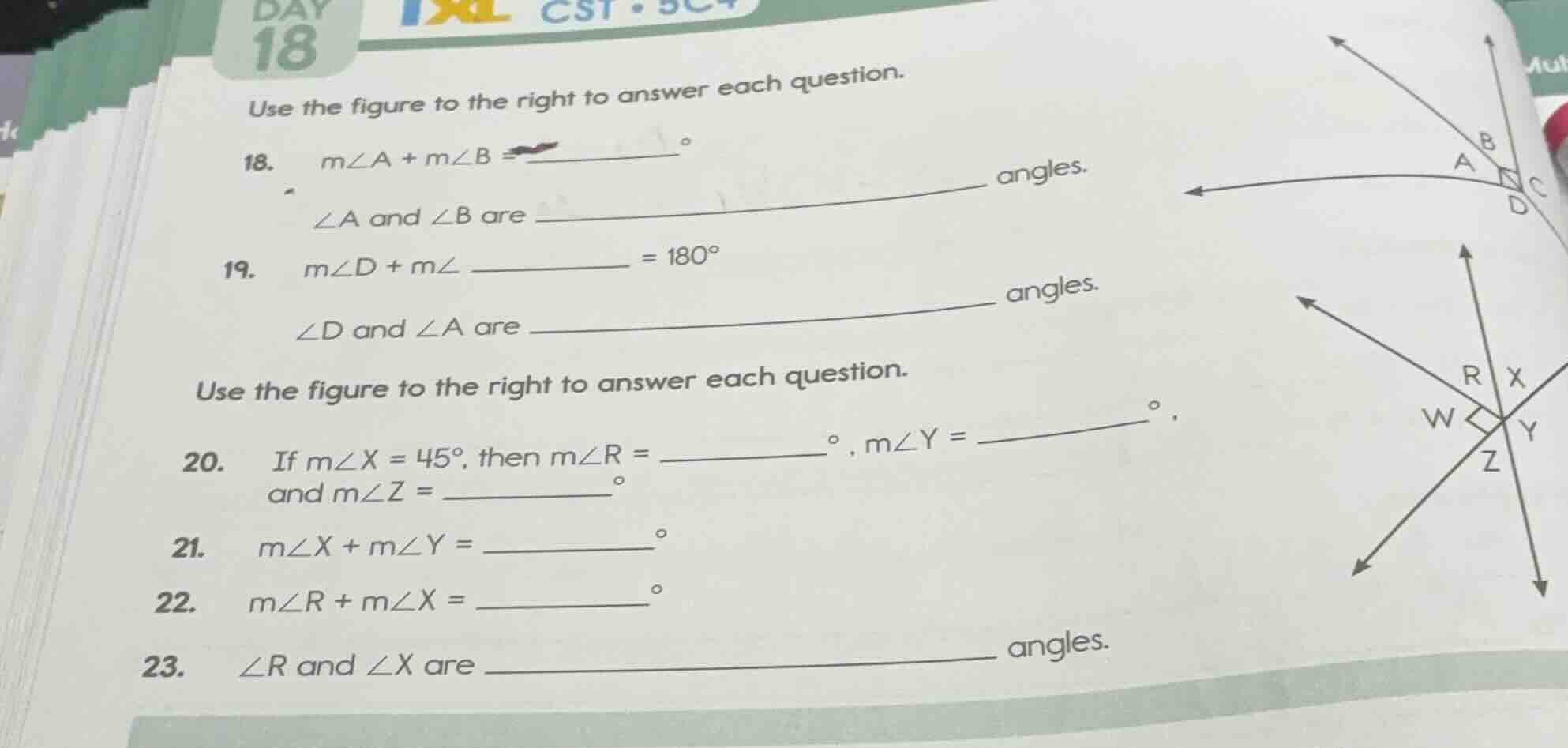
use the figure to the right to answer each question.
- \\(m\angle a + m\angle b = \underline{\qquad\qquad}^{\circ}\\)
\\(\angle a\\) and \\(\angle b\\) are \underline{\qquad\qquad} angles.
- \\(m\angle d + m\angle \underline{\qquad\qquad} = 180^{\circ}\\)
\\(\angle d\\) and \\(\angle a\\) are \underline{\qquad\qquad} angles.
use the figure to the right to answer each question.
- if \\(m\angle x = 45^{\circ}\\), then \\(m\angle r = \underline{\qquad\qquad}^{\circ}\\), \\(m\angle y = \underline{\qquad\qquad}^{\circ}\\), and \\(m\angle z = \underline{\qquad\qquad}^{\circ}\\).
- \\(m\angle x + m\angle y = \underline{\qquad\qquad}^{\circ}\\)
- \\(m\angle r + m\angle x = \underline{\qquad\qquad}^{\circ}\\)
- \\(\angle r\\) and \\(\angle x\\) are \underline{\qquad\qquad} angles.
Analyze the first figure (Questions 18 and 19)
The first figure shows two intersecting lines forming a right angle. The square symbol at the intersection of the lines forming \(\angle A\) and \(\angle B\) indicates a right angle (\(90^\circ\)).
- \(\angle A\) and \(\angle B\) form a right angle, so their measures add up to \(90^\circ\). Angles that add up to \(90^\circ\) are complementary.
- \(\angle D\) and \(\angle A\) lie on a straight line, so their measures add up to \(180^\circ\). Therefore, \(m\angle D + m\angle A = 180^\circ\). Angles that add up to \(180^\circ\) are supplementary.
Analyze the second figure (Questions 20 to 23)
The second figure shows two intersecting lines forming four angles: \(\angle R\), \(\angle X\), \(\angle Y\), and \(\angle Z\).
- \(\angle X\) and \(\angle Z\) are vertical angles, so they are equal: \(m\angle Z = m\angle X = 45^\circ\).
- \(\angle X\) and \(\angle R\) form a linear pair on a straight line, so they are supplementary: \(m\angle R = 180^\circ - 45^\circ = 135^\circ\).
- \(\angle X\) and \(\angle Y\) form a linear pair on a straight line, so they are supplementary: \(m\angle Y = 180^\circ - 45^\circ = 135^\circ\).
- Therefore, \(m\angle X + m\angle Y = 45^\circ + 135^\circ = 180^\circ\).
- Also, \(m\angle R + m\angle X = 135^\circ + 45^\circ = 180^\circ\).
- Since \(\angle R\) and \(\angle X\) add up to \(180^\circ\), they are supplementary angles.

Snap & solve any problem in the app
Get step-by-step solutions on Sovi AI
Photo-based solutions with guided steps
Explore more problems and detailed explanations
Question 18
\(m\angle A + m\angle B =\) <blank>\(90\)</blank>\(^\circ\)
\(\angle A\) and \(\angle B\) are <blank>complementary</blank> angles.
Question 19
\(m\angle D + m\angle\) <blank>\(A\)</blank> \(= 180^\circ\)
\(\angle D\) and \(\angle A\) are <blank>supplementary</blank> angles.
Question 20
If \(m\angle X = 45^\circ\), then \(m\angle R =\) <blank>\(135\)</blank>\(^\circ\), \(m\angle Y =\) <blank>\(135\)</blank>\(^\circ, and\ m\angle Z =\) <blank>\(45\)</blank>\(^\circ\).
Question 21
\(m\angle X + m\angle Y =\) <blank>\(180\)</blank>\(^\circ\)
Question 22
\(m\angle R + m\angle X =\) <blank>\(180\)</blank>\(^\circ\)
Question 23
\(\angle R\) and \(\angle X\) are <blank>supplementary</blank> angles.