QUESTION IMAGE
Question
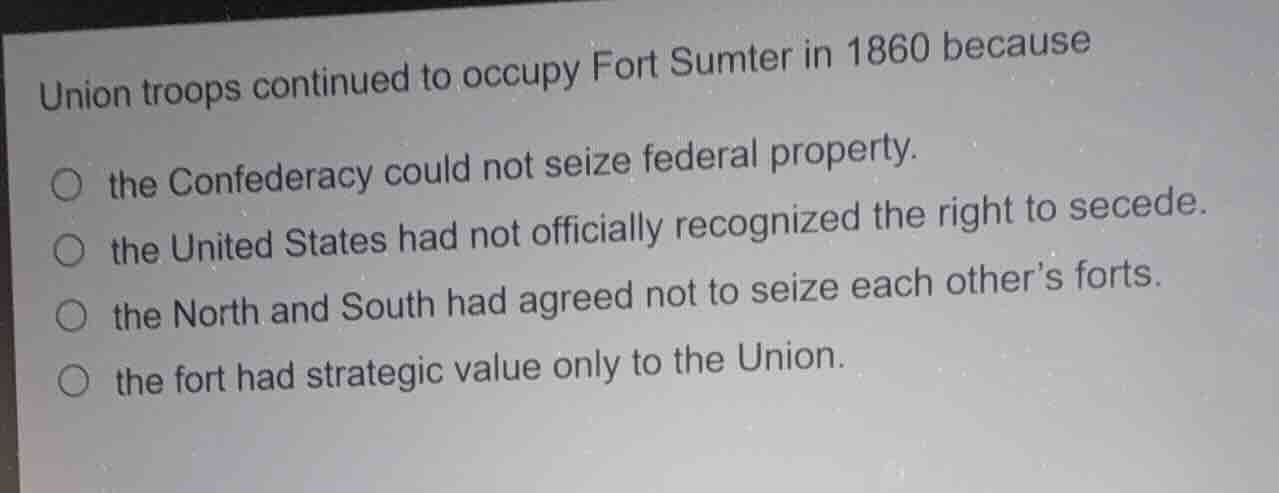
union troops continued to occupy fort sumter in 1860 because
the confederacy could not seize federal property.
the united states had not officially recognized the right to secede.
the north and south had agreed not to seize each others forts.
the fort had strategic value only to the union.
Analyze the federal stance on secession
Using the Secession Justification knowledge point, the United States government, under both President James Buchanan and President-elect Abraham Lincoln, maintained that secession was unconstitutional and legally void. Because the United States did not officially recognize the right of Southern states to secede, it continued to view federal installations located within seceded states—such as Fort Sumter in South Carolina—as sovereign U.S. territory that must remain occupied by federal troops.
Evaluate the strategic value of the fort
Using the Strategic Value of Fort Sumter knowledge point, the fort guarded Charleston Harbor, making it highly valuable to both sides. The Union maintained its garrison to assert its sovereign authority over federal property, while the Confederacy demanded its evacuation to assert its own independence. This directly refutes the claim that the fort had strategic value only to the Union.
Assess the remaining options
- The Confederacy did eventually seize federal property, including arsenals and other forts, so they were physically capable of doing so.
- There was no agreement between the North and South to refrain from seizing forts; in fact, South Carolina authorities actively demanded the surrender of Fort Sumter.
- Therefore, the primary legal and political reason Union troops remained is that the United States did not recognize the legitimacy of secession.

Snap & solve any problem in the app
Get step-by-step solutions on Sovi AI
Photo-based solutions with guided steps
Explore more problems and detailed explanations
- the Confederacy could not seize federal property.
- the United States had not officially recognized the right to secede. (Correct answer)
- the North and South had agreed not to seize each other's forts.
- the fort had strategic value only to the Union.