QUESTION IMAGE
Question
type the correct answer in each box. use numerals instead of words.
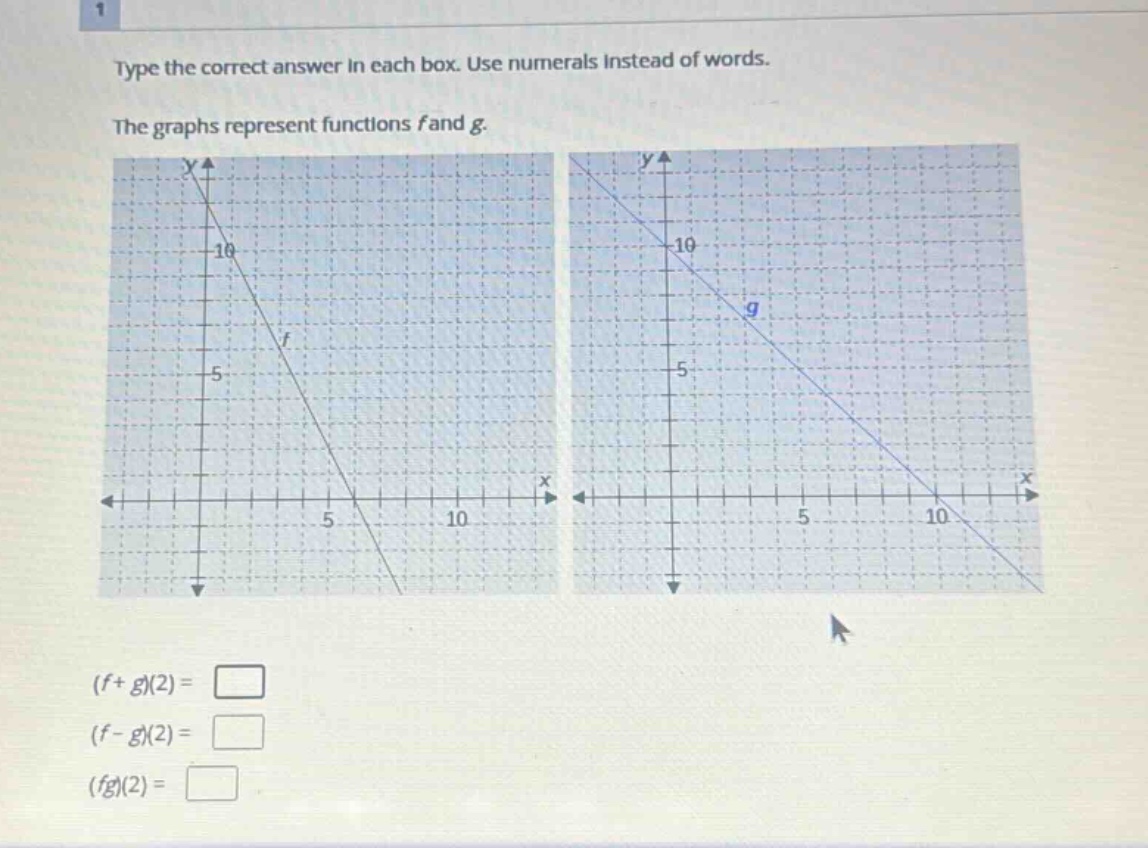
the graphs represent functions \\(f\\) and \\(g\\).
\\((f + g)(2) = \\)
\\((f - g)(2) = \\)
\\((fg)(2) = \\)
🆕 New Concept Discovered: Operations on Functions
Combining functions using addition, subtraction, and multiplication.
Step 1: Find \( f(2) \) and \( g(2) \) from the graphs
To evaluate the combined functions at \( x = 2 \), we first find the individual outputs from each graph:
- For \( f(2) \): Look at the graph of \( f \) on the left. At \( x = 2 \), the vertical line intersects the graph of \( f \) at \( y = 8 \). Thus, \( f(2) = 8 \).
- For \( g(2) \): Look at the graph of \( g \) on the right. At \( x = 2 \), the vertical line intersects the graph of \( g \) at \( y = 8 \). Thus, \( g(2) = 8 \).
Step 2: Evaluate \( (f + g)(2) \)
Using the definition of function addition:
$$ (f + g)(2) = f(2) + g(2) $$
$$ (f + g)(2) = 8 + 8 = 16 $$
Step 3: Evaluate \( (f - g)(2) \)
Using the definition of function subtraction:
$$ (f - g)(2) = f(2) - g(2) $$
$$ (f - g)(2) = 8 - 8 = 0 $$
Step 4: Evaluate \( (fg)(2) \)
Using the definition of function multiplication:
$$ (fg)(2) = f(2) \cdot g(2) $$
$$ (fg)(2) = 8 \cdot 8 = 64 $$

Snap & solve any problem in the app
Get step-by-step solutions on Sovi AI
Photo-based solutions with guided steps
Explore more problems and detailed explanations
- \( (f + g)(2) = \) 16
- \( (f - g)(2) = \) 0
- \( (fg)(2) = \) 64