QUESTION IMAGE
Question
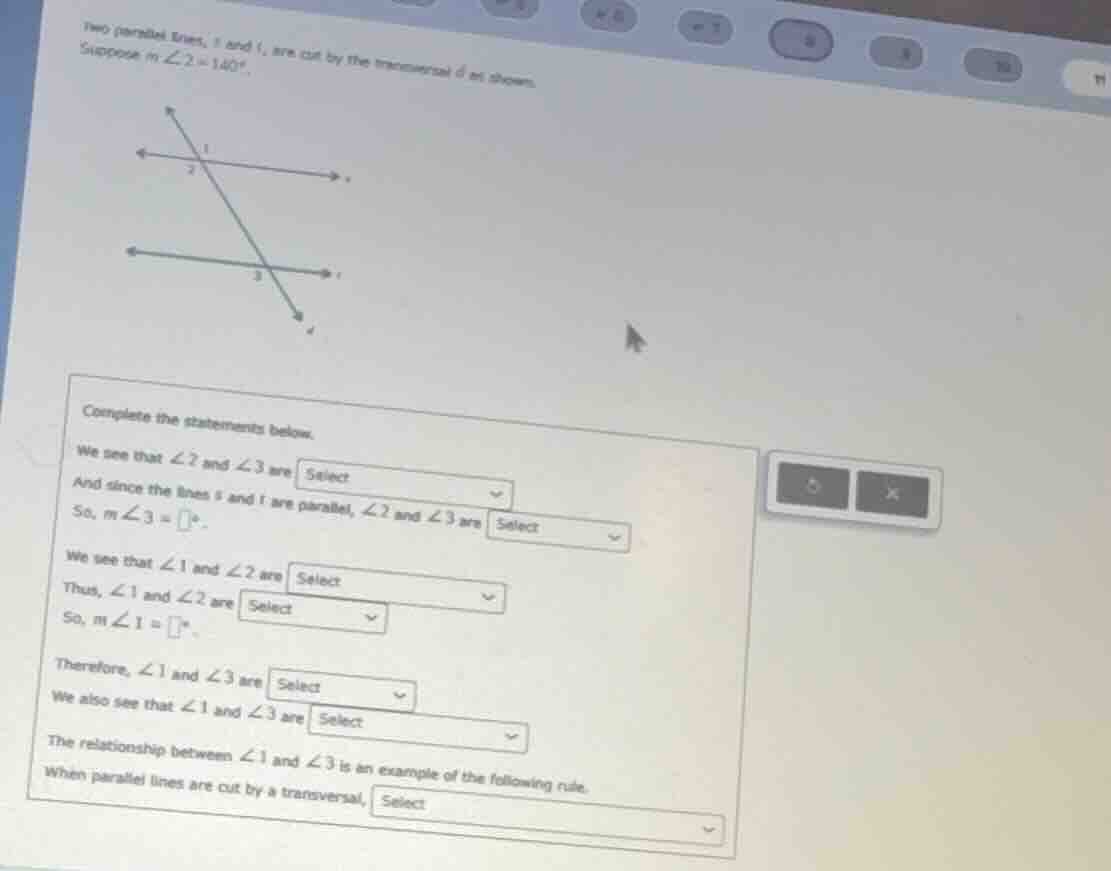
two parallel lines, \\(s\\) and \\(t\\), are cut by the transversal \\(d\\) as shown. suppose \\(m\angle 2 = 140^\circ\\).
complete the statements below.
we see that \\(\angle 2\\) and \\(\angle 3\\) are select
and since the lines \\(s\\) and \\(t\\) are parallel, \\(\angle 2\\) and \\(\angle 3\\) are select
so, \\(m\angle 3 = \quad^\circ\\).
we see that \\(\angle 1\\) and \\(\angle 2\\) are select
thus, \\(\angle 1\\) and \\(\angle 2\\) are select
so, \\(m\angle 1 = \quad^\circ\\).
therefore, \\(\angle 1\\) and \\(\angle 3\\) are select
we also see that \\(\angle 1\\) and \\(\angle 3\\) are select
the relationship between \\(\angle 1\\) and \\(\angle 3\\) is an example of the following rule.
when parallel lines are cut by a transversal, select
⚡ Using what you learned: lines and angles (parallel, transversal, vertical)
Step 1: Analyze the relationship between \(\angle 2\) and \(\angle 3\)
- Relationship type: \(\angle 2\) and \(\angle 3\) are on opposite sides of the transversal line \(d\) and lie between the two parallel lines \(s\) and \(t\). This makes them alternate interior angles.
- Property: Since lines \(s\) and \(t\) are parallel, alternate interior angles are equal (congruent).
- Calculation:
Step 2: Analyze the relationship between \(\angle 1\) and \(\angle 2\)
- Relationship type: \(\angle 1\) and \(\angle 2\) lie on a straight line (the transversal line \(d\)). This makes them adjacent angles that form a linear pair.
- Property: Angles that form a linear pair are supplementary, meaning their measures add up to \(180^\circ\) (supplementary).
- Calculation:
Step 3: Analyze the relationship between \(\angle 1\) and \(\angle 3\)
- Relationship type: \(\angle 1\) and \(\angle 3\) lie on the same side of the transversal line \(d\), with one on the interior and one on the exterior in corresponding positions relative to the parallel lines. This makes them corresponding angles.
- Property: Since lines \(s\) and \(t\) are parallel, corresponding angles are equal (congruent).
- General Rule: When parallel lines are cut by a transversal, corresponding angles are congruent.
---

Snap & solve any problem in the app
Get step-by-step solutions on Sovi AI
Photo-based solutions with guided steps
Explore more problems and detailed explanations
- We see that \(\angle 2\) and \(\angle 3\) are alternate interior angles.
- And since the lines \(s\) and \(t\) are parallel, \(\angle 2\) and \(\angle 3\) are congruent.
- So, \(m\angle 3 = 140^\circ\).
- We see that \(\angle 1\) and \(\angle 2\) are adjacent angles.
- Thus, \(\angle 1\) and \(\angle 2\) are supplementary.
- So, \(m\angle 1 = 40^\circ\).
- Therefore, \(\angle 1\) and \(\angle 3\) are corresponding angles.
- We also see that \(\angle 1\) and \(\angle 3\) are congruent.
- The relationship between \(\angle 1\) and \(\angle 3\) is an example of the following rule: When parallel lines are cut by a transversal, corresponding angles are congruent.