QUESTION IMAGE
Question
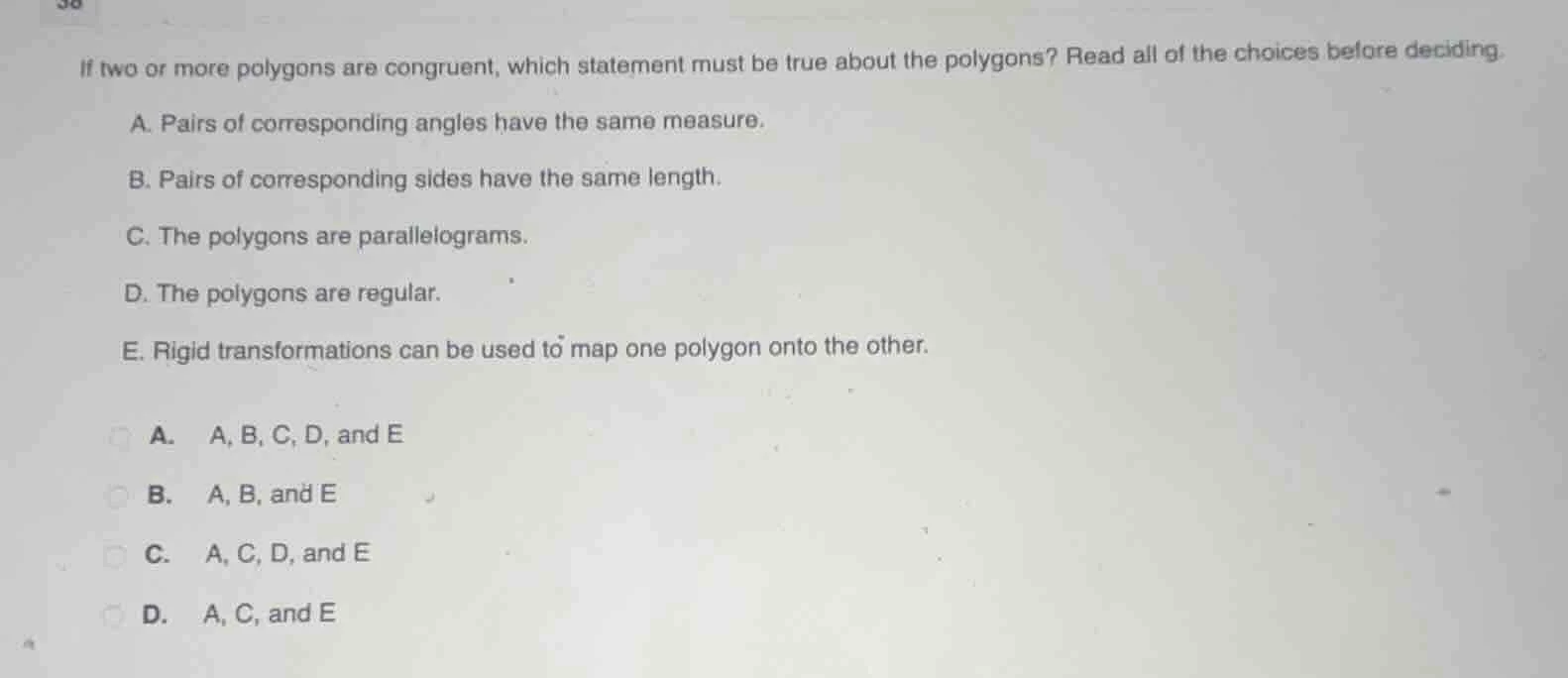
if two or more polygons are congruent, which statement must be true about the polygons? read all of the choices before deciding. a. pairs of corresponding angles have the same measure. b. pairs of corresponding sides have the same length. c. the polygons are parallelograms. d. the polygons are regular. e. rigid transformations can be used to map one polygon onto the other. a. a, b, c, d, and e b. a, b, and e c. a, c, d, and e d. a, c, and e
Brief Explanations
- Congruent polygons have identical corresponding angles (A is true) and identical corresponding side lengths (B is true).
- Congruent polygons can be mapped onto each other via rigid transformations (translations, rotations, reflections, which preserve size/shape, so E is true).
- Congruent polygons do not have to be parallelograms (e.g., congruent triangles are polygons but not parallelograms, so C is false).
- Congruent polygons do not have to be regular (e.g., congruent rectangles that are not squares are not regular, so D is false).
Only statements A, B, and E must be true.

Snap & solve any problem in the app
Get step-by-step solutions on Sovi AI
Photo-based solutions with guided steps
Explore more problems and detailed explanations
B. A, B, and E