QUESTION IMAGE
Question
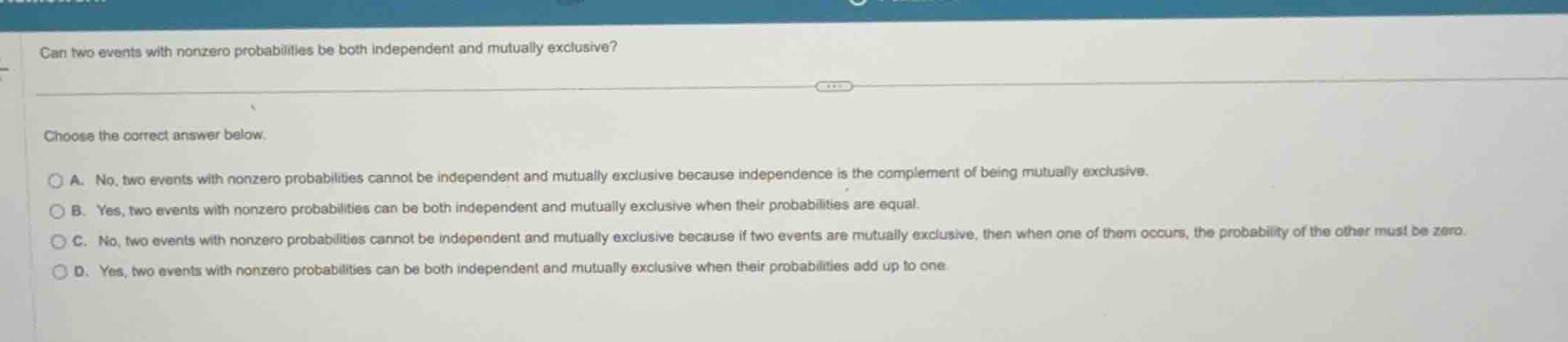
can two events with nonzero probabilities be both independent and mutually exclusive?
choose the correct answer below.
a. no, two events with nonzero probabilities cannot be independent and mutually exclusive because independence is the complement of being mutually exclusive.
b. yes, two events with nonzero probabilities can be both independent and mutually exclusive when their probabilities are equal.
c. no, two events with nonzero probabilities cannot be independent and mutually exclusive because if two events are mutually exclusive, then when one of them occurs, the probability of the other must be zero.
d. yes, two events with nonzero probabilities can be both independent and mutually exclusive when their probabilities add up to one.
Define mutually exclusive events
Using the Mutually Exclusive Events knowledge point
Define independent events
Using the Independent Events Probability knowledge point
Analyze the contradiction for nonzero probabilities
Using the Independent Events Probability and Mutually Exclusive Events knowledge points
Connect to the conceptual explanation
If two events are mutually exclusive, the occurrence of one event means the other cannot occur. Therefore, if event \(A\) occurs, the probability of event \(B\) occurring becomes zero, which changes its probability from its original nonzero value \(P(B)\). This dependency means they cannot be independent.

Snap & solve any problem in the app
Get step-by-step solutions on Sovi AI
Photo-based solutions with guided steps
Explore more problems and detailed explanations
- A. No, two events with nonzero probabilities cannot be independent and mutually exclusive because independence is the complement of being mutually exclusive.
- B. Yes, two events with nonzero probabilities can be both independent and mutually exclusive when their probabilities are equal.
- C. No, two events with nonzero probabilities cannot be independent and mutually exclusive because if two events are mutually exclusive, then when one of them occurs, the probability of the other must be zero. (Correct answer)
- D. Yes, two events with nonzero probabilities can be both independent and mutually exclusive when their probabilities add up to one.